
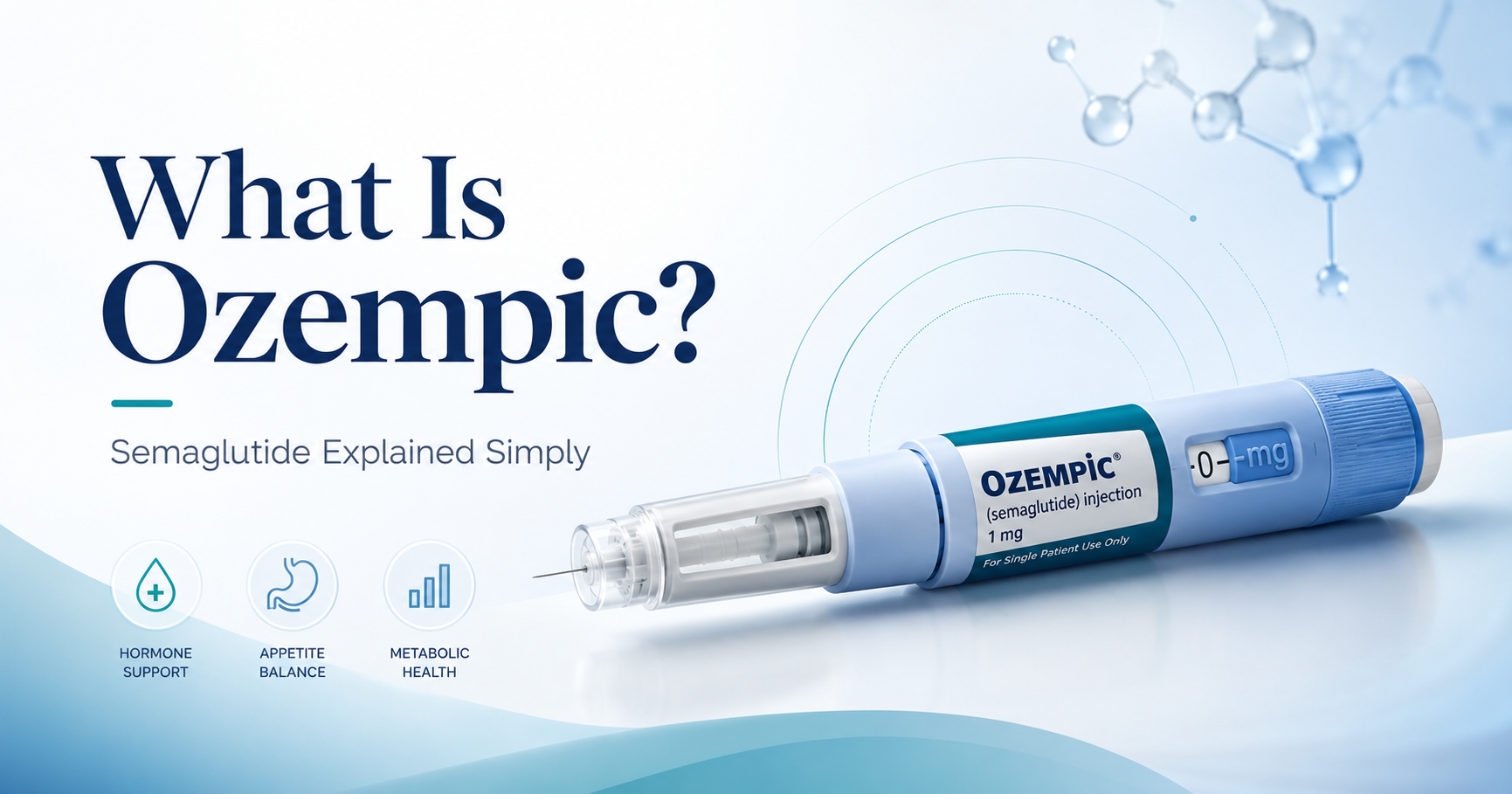
What Is Ozempic? A Plain-English Guide to the Medication Everyone Talks About
Before you can understand the hype, fear, reviews, weight-loss stories, or online claims around Ozempic, you need to understand what Ozempic actually is. Ozempic is a specific prescription medication, not a general name for every semaglutide product or every GLP-1 injection. This plain-English guide explains the basics: the brand name, the active ingredient, the drug class, and the medical context behind one of the most talked-about medications in the world.
What Is Ozempic?
The first mistake people make with Ozempic is thinking the name explains the whole story.
It does not.
“Ozempic” is not the name of a diet trend. It is not a general word for weight-loss injections. It is not automatically the same thing as every product called semaglutide online.
Ozempic is a specific prescription medication. Its active ingredient is semaglutide. Its drug class is GLP-1 receptor agonist. Its main medical context is type 2 diabetes care.
That sounds simple once you see it clearly. But online, those pieces often get mixed together until Ozempic starts meaning five different things at once.
This guide gives you the clean version: what Ozempic is, what the key terms mean, and why understanding the difference matters.
Sources used note: This article is based on official Ozempic prescribing information, official Ozempic safety information, and publicly available medical and regulatory references.
Quick Answer: What Is Ozempic?
Ozempic is a brand-name prescription medication that contains semaglutide.
Semaglutide is the active ingredient. GLP-1 receptor agonist is the drug class. Type 2 diabetes is the central medical context in official prescribing information.
Ozempic became widely known because semaglutide can affect appetite and fullness, which pulled the medication into the weight-loss conversation. But “famous for weight loss” and “officially understood only as a weight-loss shot” are not the same thing.
That difference is the heart of the confusion.
The Clean Identity: Brand, Ingredient, Class, Context
The easiest way to understand Ozempic is to separate four layers.
Ozempic is the brand name.
Semaglutide is the active ingredient.
GLP-1 receptor agonist is the medication class.
Type 2 diabetes care is the main official medical context.
Most confusion starts when those layers collapse into one word.
Someone says “Ozempic” but means semaglutide in general. Someone says “semaglutide” but is talking about a compounded product. Someone says “GLP-1” but means an entire drug category. Someone says “weight-loss shot” but may not know which medication, dose, product, or supervision was involved.
Once you separate the layers, Ozempic becomes much easier to understand.
What Does “Semaglutide” Mean?
Semaglutide is the active ingredient in Ozempic.
That matters because a brand name and an active ingredient are not the same thing. A brand name points to a specific medication product. An active ingredient points to the substance that produces the medication’s effect.
This is why Ozempic and semaglutide are closely connected, but not interchangeable in every conversation.
A person talking about Ozempic may mean the actual brand-name medication. A person talking about semaglutide may be talking more broadly, including other branded medications or compounded products.
The safer habit is simple: when you hear “semaglutide,” ask what product is actually being discussed.
What Does “GLP-1 Receptor Agonist” Mean?
GLP-1 receptor agonist sounds complicated, but the basic idea is not.
GLP-1 is one of the body’s natural signals involved in how the body responds after eating. It is connected with blood sugar regulation, appetite signaling, fullness, and stomach emptying.
A GLP-1 receptor agonist is a medication that activates that pathway.
That is enough for this article. The full mechanism deserves its own guide, but you do not need a biochemistry lecture to understand the identity of Ozempic.
The important point is this: Ozempic belongs to a medication class that connects diabetes, appetite, digestion, and weight-related conversations. That is why one medication name appears in so many different searches.
What Is Ozempic Used For?
Official prescribing information describes Ozempic as a prescription medication used in adults with type 2 diabetes.
Its labeled uses include improving blood sugar control along with diet and exercise. Official labeling also describes certain cardiovascular and kidney-related risk-reduction uses in specific adults with type 2 diabetes.
That does not mean Ozempic is appropriate for everyone with diabetes. It also does not mean it is a casual product for anyone who wants to lose weight.
It means Ozempic has a defined medical role, and that role should be understood before the internet turns the medication into a slogan.
Why Ozempic Is Not Just “A Weight-Loss Shot”
Ozempic became famous partly because people heard about appetite changes and weight loss.
That public attention is real. But it can make the medication sound simpler than it is.
Calling Ozempic “a weight-loss shot” skips the identity of the drug. It ignores the brand, the active ingredient, the medication class, the official medical context, and the difference between Ozempic and other semaglutide-related products.
A shortcut phrase may be easy to remember, but it is not always safe or accurate.
A better phrase would be: Ozempic is a semaglutide medication in the GLP-1 receptor agonist class, used in specific medical contexts, and widely discussed because semaglutide can affect appetite and fullness.
Less catchy. Much more accurate.
Why Ozempic Gets Confused With Wegovy and Other Products
Ozempic is not the only medication people discuss when they talk about semaglutide or GLP-1 drugs.
Wegovy is also part of the semaglutide conversation. Compounded semaglutide is another conversation. GLP-1 medications as a category are an even broader conversation.
This is where the internet gets messy.
A review may be about Ozempic. A headline may be about Wegovy. A seller may promote compounded semaglutide. A social media post may just say “GLP-1.” A reader may see all of that and assume it is one identical thing.
It is not.
The product matters. The label matters. The dose matters. The source matters. The medical purpose matters.
That is why this identity question is not just academic. It changes how you read everything else.
What “Generic Ozempic” Usually Gets Wrong
The phrase “generic Ozempic” can be misleading.
Ozempic is a specific brand-name medication. Products advertised online as semaglutide, compounded semaglutide, or “cheap Ozempic” are not automatically the same thing as FDA-approved Ozempic.
Sometimes the phrase is used casually by people who mean “semaglutide.” Sometimes it is used in marketing. Sometimes it hides important differences in product source, formulation, concentration, instructions, and medical supervision.
The phrase sounds simple. The reality is not.
If a product is being described as “generic Ozempic,” the next question should be: what exactly is it?
What the Internet Often Gets Wrong
The internet usually tries to turn Ozempic into one clean story.
- 1A miracle.
- 2A danger.
- 3A shortcut.
- 4A celebrity secret.
- 5A weight-loss hack.
- 6A scary side-effect headline.
But Ozempic is not best understood through any single story.
It is a prescription medication with a brand name, an active ingredient, a drug class, an official label, and a specific medical context. After that, there are other conversations: weight loss, reviews, side effects, dosing, compounded products, online sellers, and safety concerns.
Those topics matter. They just should not replace the basic identity of the medication.
Start with identity first. Then the rest of the conversation becomes easier to judge.
The Simple Version to Remember
- 1Ozempic is the brand.
- 2Semaglutide is the active ingredient.
- 3GLP-1 receptor agonist is the medication class.
- 4Type 2 diabetes care is the core official medical context.
- 5Weight loss is a major reason the public became interested.
- 6Other semaglutide products, compounded products, Wegovy, and GLP-1 drugs are related conversations, not automatically the same thing.
That is the clean version.
Bottom Line
Ozempic is not just a viral medication name.
It is a specific prescription medication containing semaglutide. It belongs to the GLP-1 receptor agonist class and is officially used in defined medical contexts for adults with type 2 diabetes.
The reason Ozempic feels confusing is that the same word now appears in many conversations at once: diabetes, appetite, weight loss, celebrity stories, online sellers, compounded semaglutide, reviews, and safety questions.
The best first step is not to decide whether Ozempic is “good” or “bad.”
The best first step is to understand what it is.
FAQ
Frequently Asked Questions
Ozempic is a brand-name prescription medication that contains semaglutide. It belongs to a class of medicines called GLP-1 receptor agonists.
The active ingredient in Ozempic is semaglutide.
Not exactly. Ozempic is the brand-name medication. Semaglutide is the active ingredient inside it. Semaglutide may also be discussed in other branded medications or compounded products.
Ozempic is a GLP-1 receptor agonist. That means it works with GLP-1 receptor pathways involved in blood sugar, appetite, fullness, and digestion.
No. Ozempic is not simply a weight-loss shot. Official prescribing information describes it as a prescription medication used in adults with type 2 diabetes in specific medical contexts.
People often say that because semaglutide can affect appetite and fullness, and many online conversations focus on weight loss. But that phrase does not explain the full medical context of Ozempic.
Not automatically. “Generic Ozempic” can be a misleading phrase. A product promoted as semaglutide or compounded semaglutide is not automatically the same as FDA-approved Ozempic.
No. Ozempic.review provides general educational information only. Personal medication decisions should be made with a licensed healthcare professional.
Sources
- 1Ozempic Prescribing Information — official information on semaglutide, GLP-1 receptor agonist classification, labeled uses, and safety information.
- 2Official Ozempic Safety Information — official medication and safety information.
- 3FDA / regulatory references — public drug labeling and safety-related information.
Dr. Sheri Tomas
Comments (0)
Be the first to comment on this article.
