
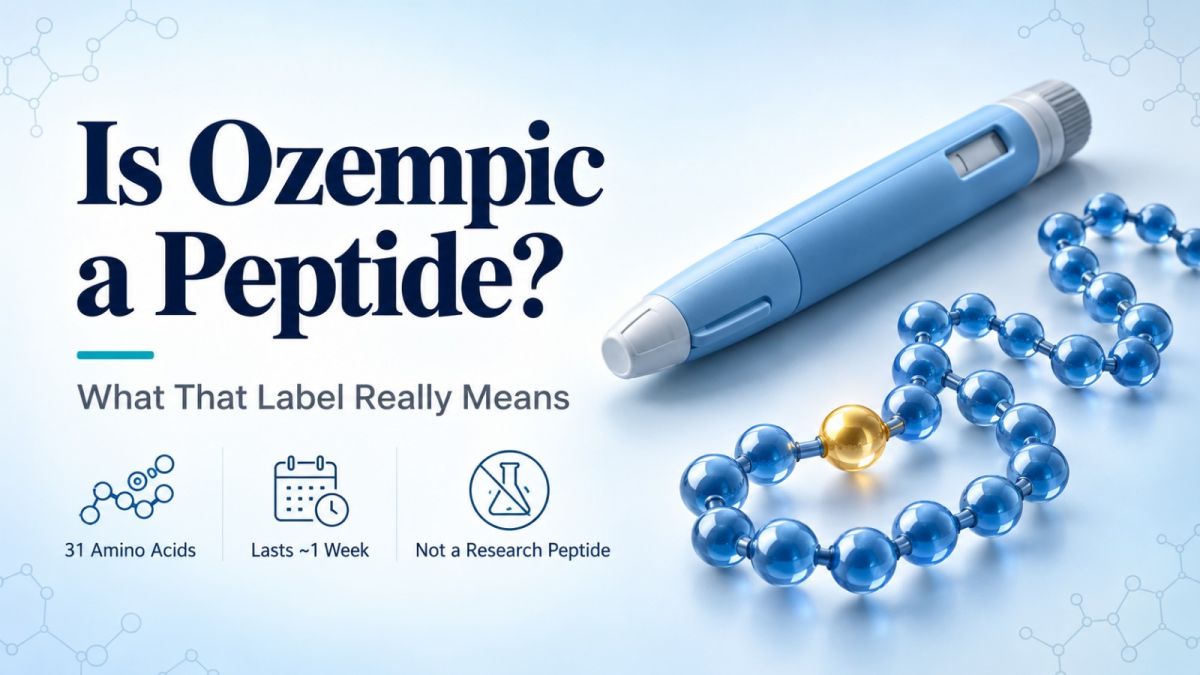
Is Ozempic a Peptide? What It Means and Why It Matters
Yes, Ozempic's semaglutide is a 31-amino-acid peptide. Why that matters for injections, storage and generics, and how it differs from peptides sold online.
Written by Dr. Sheri Tomas. Updated October 22, 2026.
Yes. The active ingredient in Ozempic, semaglutide, is a peptide: a chain of 31 amino acids built as a modified copy of GLP-1, a hormone your gut makes after meals. That single fact explains a lot about the drug, from why it's an injection to why it has to be kept cold and why it lasts a whole week.
But "peptide" has also become a marketing word. Wellness clinics and websites now sell "peptides" as a category, sometimes with semaglutide in the same list as unapproved compounds. Being a peptide doesn't make those products anything like Ozempic. Here's what the label means and where the line is.
What a Peptide Is
Peptides and proteins are both made of amino acids linked in a chain. The difference is length. Peptides are short chains; proteins are long ones that fold into complex shapes. Many hormones in your body are peptides, including insulin, glucagon and GLP-1.
U.S. law draws the line at 40 amino acids. Since March 2020, FDA has treated anything longer as a protein, regulated as a biologic, and anything 40 or shorter as a peptide, regulated as a regular drug. That's why insulin moved to the biologics pathway in 2020, while semaglutide, at 31 amino acids, is approved as a standard drug. It sounds technical, but it matters for generics, as you'll see below.
What Kind of Peptide Semaglutide Is
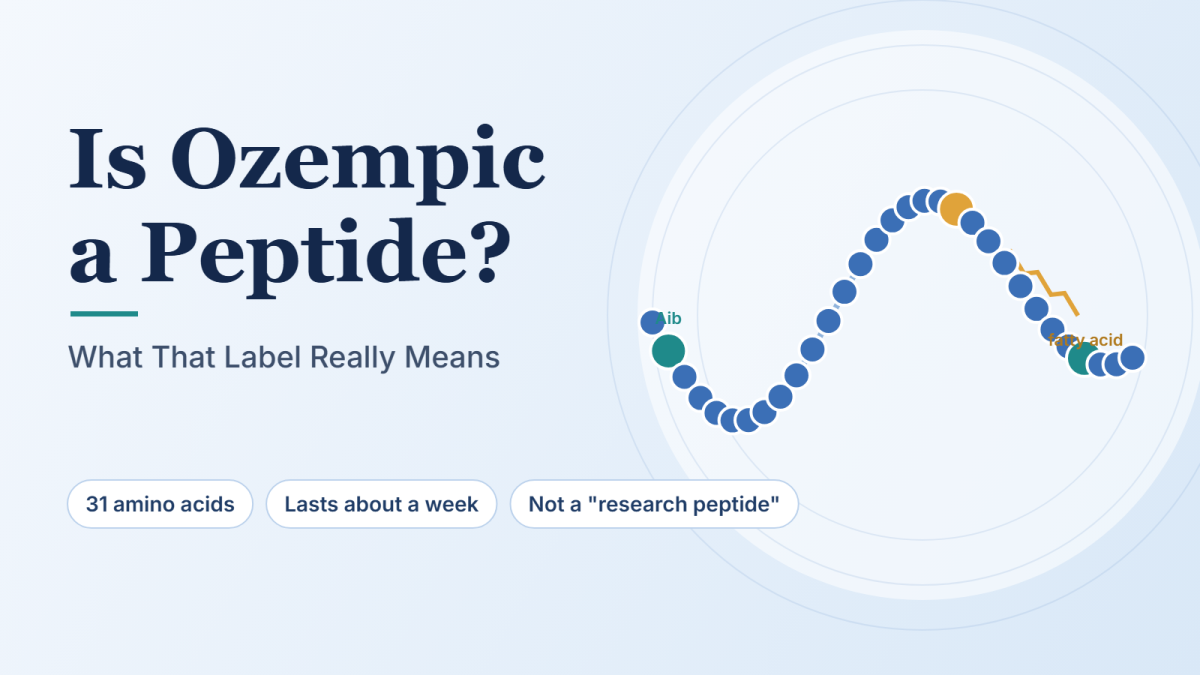
Natural GLP-1 lasts about two minutes in the blood before an enzyme called DPP-4 breaks it down. Semaglutide keeps about 94% of the same structure but has three deliberate changes that stretch its half-life to about a week.
How semaglutide differs from natural GLP-1
Position 8: alanine swapped for Aib, an unnatural amino acid
Blocks the DPP-4 enzyme from cutting the chain
The peptide isn't broken down within minutes
Position 26: a fatty acid chain attached through a linker
Lets semaglutide bind loosely to albumin, the main protein in blood
It circulates for days and is released slowly
Position 34: lysine swapped for arginine
Makes sure the fatty chain attaches only at position 26
A consistent molecule in every batch
The result is a half-life of about 165 hours, which is why Ozempic is a once-weekly shot. For what the molecule does once it reaches its receptor, see how Ozempic works and our explainer on GLP-1.
How Ozempic's Peptide Is Made
Novo Nordisk doesn't extract semaglutide from anything. According to the European product information, the peptide backbone is produced by yeast cells using recombinant DNA technology, and the fatty acid side chain is then attached chemically. It's a precise, heavily controlled process, and it's one reason the supply couldn't simply be scaled up overnight during the shortage.
Why It Matters That Ozempic Is a Peptide
- 1It has to be injected, or taken in a special way. Stomach acid and digestive enzymes break peptides down, the same way they digest protein in food. The pill versions, Ozempic tablets and the Wegovy pill, contain an absorption enhancer called SNAC and must be swallowed on an empty stomach with a small sip of water, 30 minutes before food or other medicines.
- 2Heat damages it. Like other peptide drugs, semaglutide can lose potency if it gets too hot or freezes. Unused pens go in the fridge; see our storage guide.
- 3It isn't a steroid and it isn't insulin. Semaglutide is a hormone look-alike that activates the GLP-1 receptor. It helps your own pancreas release insulin when blood sugar is high, but it doesn't replace insulin.
- 4Generics follow the drug route, not the biosimilar route. Because semaglutide is under 40 amino acids, a U.S. generic would be approved like other generic drugs. Patents block that until at least 2031; Canada approved generics in 2026. See Ozempic vs semaglutide.
Ozempic and the "Peptide" Market
Search for peptides online and you'll find clinics and shops selling BPC-157, TB-500, ipamorelin and similar compounds, often next to semaglutide or tirzepatide. That shelf placement is misleading. Ozempic went through large clinical trials involving tens of thousands of people; most of the popular wellness peptides have little or no human trial data and aren't FDA-approved for any use.
The rules are also in flux. In February 2026, HHS announced plans to move about 14 peptides, including BPC-157 and TB-500, off FDA's restricted compounding list, and in July an FDA advisory committee voted to recommend several of them. Those steps would allow compounding with a prescription, not approval, and the committee vote isn't binding. Separately, FDA moved in February 2026 to restrict mass-marketed compounded semaglutide and tirzepatide.
Ozempic vs other semaglutide sold as a "peptide"
FDA-approved
Yes
No
No
Who makes it
Novo Nordisk, FDA-inspected
A compounding pharmacy
Unknown, often overseas
Prescription needed
Yes
Yes
Sold without one
Dose
Fixed pen settings in mg
Varies; often measured in syringe units
Unverified; testing has found underdosing
Main risk
Known side effects
Dosing errors, quality varies
Contamination, wrong dose, no oversight
"Research use only" means the seller is saying the product isn't meant for people. Independent testing of gray-market peptide vials has found bacterial contamination, solvent residue and doses below the label. If you're considering compounded semaglutide instead of Ozempic, read our compounded semaglutide guide first.
Bottom Line
Ozempic is a peptide drug: semaglutide is a 31-amino-acid, lab-made version of the GLP-1 hormone, engineered to last a week. That's why it's injected, why it needs careful storage, and why generics will follow the standard drug route. But sharing the word "peptide" doesn't put Ozempic in the same category as unapproved wellness peptides or unregulated vials sold online. For a broader overview, start with What Is Ozempic?.
FAQ
A peptide. Semaglutide has 31 amino acids. U.S. regulators classify chains over 40 amino acids as proteins, so Ozempic is regulated as a drug, not a biologic.
It's a modified copy of a peptide hormone, GLP-1. It activates the same receptor as your natural GLP-1 but lasts about a week instead of a couple of minutes.
Your stomach digests peptides like food protein. The Ozempic pen is injected under the skin. The tablet versions use an absorption enhancer and strict empty-stomach instructions to get enough through.
No. Ozempic is an FDA-approved drug made by Novo Nordisk. Most wellness peptides aren't approved for any use, and "research use only" semaglutide isn't regulated at all.
No. Steroids are a different class of molecules. Semaglutide is a peptide that mimics a gut hormone.
Chemically, yes, but insulin has 51 amino acids, so U.S. regulators have treated it as a biologic since 2020. That's one reason insulin and semaglutide follow different paths to lower-cost versions.
Sources
- 1Semaglutide structure and mechanism, RCSB Protein Data Bank (PDB-101)
- 2Ozempic product information, European Medicines Agency
- 3Ozempic (semaglutide) prescribing information, Novo Nordisk
- 4FDA smooths transition of biologic approvals, PharmTech
- 55 things to know about the FDA's peptide reversal, AJMC, August 2026
- 6FDA's concerns with unapproved GLP-1 drugs used for weight loss, U.S. Food and Drug Administration

Dr. Sheri Tomas
Author
Comments (0)
Be the first to comment on this article.
More articles