
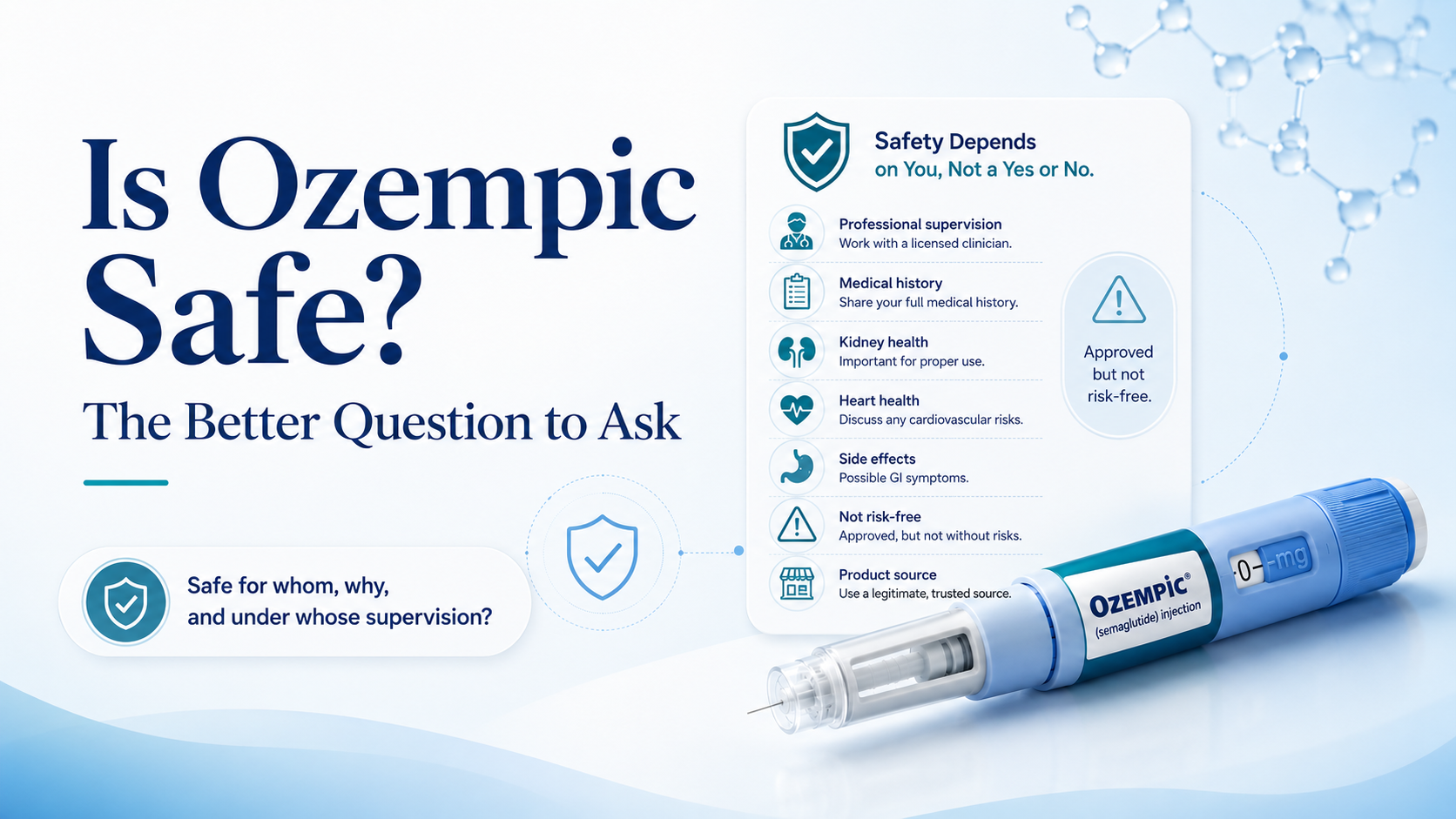
Is Ozempic Safe? The Better Question to Ask
The better question is not simply “Is Ozempic safe?” It is “safe for whom, for what reason, and under whose supervision?” Ozempic is an FDA-approved prescription medication, but approved does not mean risk-free. This plain-English guide explains the main safety issues people should understand before trusting a simple yes-or-no answer.
Is Ozempic Safe? The Better Question to Ask
The better question is not “Is Ozempic safe?” It is “safe for whom, for what reason, and under whose supervision?”
That difference matters because people do not search this question for the same reason. One person may have type 2 diabetes. Another may be asking about weight loss. Someone else may be worried about long-term use, kidney disease, heart disease, pregnancy, breastfeeding, compounded products, online pharmacies, or stories they saw on Reddit.
Ozempic is an FDA-approved prescription medication. But FDA-approved does not mean risk-free. It means the drug has been reviewed for specific uses, with specific warnings, contraindications, dosing information, and safety labeling.
This article is for education only. It is not medical advice, diagnosis, or treatment guidance. Ozempic is a prescription medication, and personal safety questions should be discussed with a licensed healthcare professional.
Quick Answer: Is Ozempic Safe?
Ozempic can be appropriate for some adults when prescribed and monitored by a licensed healthcare professional, but it is not safe for everyone and it is not risk-free. Ozempic is FDA-approved for adults with type 2 diabetes. It is approved to improve blood sugar control along with diet and exercise. Ozempic injection is also approved to reduce the risk of major cardiovascular events in certain adults with type 2 diabetes and established heart disease, and to reduce certain kidney-related risks in adults with type 2 diabetes and chronic kidney disease. That does not mean Ozempic is harmless. Its official prescribing information includes serious warnings and precautions, including thyroid C-cell tumor risk, pancreatitis, diabetic retinopathy complications, low blood sugar risk when used with insulin or insulin-releasing medicines, kidney injury related to dehydration, severe gastrointestinal reactions, allergic reactions, gallbladder disease, and pulmonary aspiration risk during anesthesia or deep sedation. So the honest answer is:
- 1Ozempic is not automatically dangerous.
- 2Ozempic is not automatically safe for everyone.
- 3Ozempic safety depends on the person, the reason for use, the medical history, the product source, and medical supervision.
Why “Safe” Is the Wrong One-Word Question
“Safe” sounds simple, but with prescription medications it rarely is. A medication can be approved and still have serious risks. A medication can help one patient and be inappropriate for another. A side effect can be mild for one person and medically important for someone else. With Ozempic, the better questions are:
- 1Is it being used for an FDA-approved reason or off-label?
- 2Does the person have type 2 diabetes?
- 3Does the person have a history of pancreatitis, gallbladder disease, kidney problems, diabetic retinopathy, or severe gastrointestinal disease?
- 4Is the medication coming from a licensed pharmacy?
- 5Is it real Ozempic or a compounded, counterfeit, or online product?
- 6Is the person pregnant, trying to become pregnant, or breastfeeding?
- 7Is a licensed healthcare professional monitoring side effects and other medications?
That is the real safety conversation. Not a headline. Not a TikTok comment. Not “my friend was fine.”
Is Ozempic Safe for Type 2 Diabetes?
Ozempic was developed and approved for adults with type 2 diabetes, so this is the clearest medical context for the drug. For adults with type 2 diabetes, Ozempic may be prescribed to help improve blood sugar control. Its label also includes cardiovascular and kidney-related uses for certain adults with type 2 diabetes who meet specific criteria. But even in diabetes, “approved” does not mean “right for every diabetic.” Other medications, eye disease, kidney risk, digestive symptoms, and blood sugar patterns can all matter. For a broader plain-English overview, see: What Is Ozempic?
Is Ozempic Safe for Weight Loss?
Ozempic is widely discussed for weight loss, but Ozempic itself is not FDA-approved as a weight-loss medication. Its active ingredient, semaglutide, is also used in Wegovy, which is FDA-approved for chronic weight management in certain people. But Ozempic and Wegovy are not the same product in labeling, approved use, dose structure, or medical context. That does not mean doctors never prescribe Ozempic off-label. Off-label prescribing can happen in medicine. But off-label does not mean casual, risk-free, or “basically a wellness shot.” The safety question for weight loss is whether this specific person is an appropriate candidate, whether the product is legitimate, whether side effects are being monitored, and whether the benefits outweigh the risks. For the deeper weight-loss discussion, see: Ozempic for Weight Loss.
Is Ozempic Safe Long Term?
Long-term safety is not a “yes forever” question. Ozempic and other GLP-1 medications are often discussed as long-term therapies, especially because weight and blood sugar changes may reverse after stopping in some people. But “long term” does not mean “set it and forget it.” Long-term use raises practical questions: Are side effects manageable? Is nutrition staying adequate? Are gastrointestinal symptoms mild or severe? Are kidney risks being monitored when dehydration is possible? Is the person still benefiting enough to justify continued treatment? A useful way to think about it: long-term Ozempic safety is not only about what happens in year one. It is about whether the medication remains appropriate as the person’s health, labs, side effects, and goals change.
Is Ozempic Safe for the Kidneys?
Ozempic’s relationship with kidneys is more nuanced than people expect. On one hand, Ozempic injection has an FDA-approved kidney-related indication for certain adults with type 2 diabetes and chronic kidney disease. On the other hand, the prescribing information warns about acute kidney injury related to volume depletion. In plain English, severe nausea, vomiting, diarrhea, or poor fluid intake can lead to dehydration, and dehydration can stress the kidneys. So the answer is not “Ozempic is good for kidneys” or “Ozempic is bad for kidneys.” Kidney safety depends on the person’s condition and what happens during treatment.
Is Ozempic Safe for Heart Patients?
Ozempic injection is approved to reduce the risk of major cardiovascular events in certain adults with type 2 diabetes and established cardiovascular disease. That is a major reason GLP-1 medications are no longer discussed only as blood sugar drugs. They are part of a broader metabolic health conversation. But this does not mean every person with heart disease should automatically use Ozempic, or that Ozempic is “heart-safe” in every possible situation. Heart history, diabetes status, other medications, kidney function, gastrointestinal tolerance, and overall risk profile all matter.
Who Should Be Extra Careful With Ozempic?
Some people need a more careful conversation before using Ozempic or continuing it. This includes people who are pregnant, trying to become pregnant, or breastfeeding; people with a personal or family history of medullary thyroid carcinoma or Multiple Endocrine Neoplasia syndrome type 2; people with a history of pancreatitis; people with severe gastrointestinal disease; people with gallbladder problems; people with kidney issues or dehydration risk; people with diabetic retinopathy; and people taking insulin or medicines that increase insulin release. That list does not mean everyone in those categories can never use a GLP-1 medication. It means the safety question is more personal and should be handled by a licensed healthcare professional.
Common Side Effects vs Serious Warnings
A lot of people hear about nausea and think that is the whole Ozempic safety story. It is not. Common side effects listed for Ozempic include nausea, vomiting, diarrhea, abdominal pain, and constipation. For some people, these are mild and improve over time. For others, they can be disruptive or medically important, especially if they affect hydration and nutrition. More serious warnings and risks include pancreatitis, gallbladder disease, kidney injury related to dehydration, severe gastrointestinal reactions, serious allergic reactions, diabetic retinopathy complications, and the boxed warning about thyroid C-cell tumors based on animal studies. For a deeper look at symptoms people commonly discuss, see: Ozempic Side Effects.
Are Ozempic Injections Safe?
Ozempic is an injectable prescription medication, and the FDA-approved product comes in a prefilled pen. The injection format itself is not the main concern when the product is legitimate and used as prescribed. The bigger safety issues are whether the medication is real, whether it is appropriate for the person, whether the pen is used correctly, and whether the person understands not to share pens. The official safety information warns not to share an Ozempic pen with other people, even if the needle has been changed, because of infection risk.
Is Compounded or “Generic Ozempic” Safe?
There is no FDA-approved generic Ozempic in the United States. Products marketed as “generic Ozempic,” “compound Ozempic,” “off-brand Ozempic,” or “knockoff Ozempic” should be treated carefully. Compounded semaglutide is not the same as Ozempic. FDA has warned that compounded drugs are not FDA-approved and that the agency does not review compounded drugs for safety, effectiveness, or quality before they are marketed. FDA has also warned about dosing errors, salt forms such as semaglutide sodium and semaglutide acetate, fraudulent compounded GLP-1 products, illegal online sales, and products falsely marketed for research use while being sold for human use. This topic deserves its own guide because it is one of the biggest safety traps in the GLP-1 space. Read next: Compounded Semaglutide vs Ozempic.
Is Buying Ozempic Online Safe?
Buying Ozempic online can be risky if the source is not a legitimate, licensed pharmacy. FDA has warned about counterfeit Ozempic and illegally marketed GLP-1 products. Counterfeit drugs may contain the wrong ingredient, too much or too little active ingredient, no active ingredient, or harmful ingredients. The phrase “online Ozempic” can mean very different things. It might mean a legitimate prescription filled by a licensed pharmacy. Or it might mean a fake product, a research-use product, a foreign product, a compounded product, or a product sold without proper medical oversight. This should be handled as its own safety topic, not as a casual shopping question.
Is Ozempic Safer Than Mounjaro, Zepbound, Wegovy, or Tirzepatide?
This is a common search, but it is not a clean ranking. Ozempic and Wegovy both involve semaglutide, but they have different approved uses and dosing contexts. Mounjaro and Zepbound involve tirzepatide, a dual GIP/GLP-1 receptor agonist, not a GLP-1-only medication. So the better question is not “which one is safer?” The better question is “which medication is appropriate for this person’s diagnosis, risk factors, goals, and medical history?” For related context, see: Ozempic vs Wegovy and GLP-1 Medications.
What About Alcohol, Fasting, Microdosing, or Stopping Ozempic?
These are real safety questions, but they should not be answered with internet confidence. Alcohol can matter because Ozempic affects blood sugar, appetite, digestion, nausea, and hydration for some people. Fasting can become more complicated if someone is eating very little, feeling nauseated, or using diabetes medications. Microdosing is not the standard FDA-approved Ozempic dosing approach. Stopping Ozempic may affect appetite, weight, blood sugar, and treatment goals. Each of these deserves a careful answer. None should be handled as a one-line social media tip.
The Real Safety Checklist
A better Ozempic safety question sounds like this:
- 1Is this the FDA-approved product?
- 2Is it prescribed for a clear medical reason?
- 3Is the person an appropriate candidate?
- 4Are pregnancy, breastfeeding, kidney, gallbladder, pancreas, eye, and thyroid-related risks being considered?
- 5Are other medications being reviewed?
- 6Are side effects being monitored?
- 7Is the medication coming from a legitimate pharmacy?
- 8Does the person understand the difference between Ozempic, Wegovy, compounded semaglutide, and counterfeit products?
That is a much better conversation than “Is Ozempic safe?”
The Bottom Line
Ozempic is not a miracle shot, and it is not a poison. It is a powerful prescription medication with real benefits for some people and real risks for others. The internet wants a simple answer because simple answers are easy to share. But Ozempic safety is not one-size-fits-all. It depends on the person, the reason for use, the medical history, the product source, and the quality of medical supervision. The best plain-English answer is this: Ozempic may be safe and appropriate for some adults when prescribed and monitored correctly, but it is not safe for everyone, not approved for every use, and not interchangeable with compounded, counterfeit, or “generic” products. If the question is serious enough to search, it is serious enough to ask a licensed healthcare professional.
FAQ
Is Ozempic safe?
Ozempic can be appropriate for some adults when prescribed and monitored by a licensed healthcare professional, but it is not risk-free and it is not safe for everyone.
How safe is Ozempic?
Ozempic has been reviewed by FDA for specific approved uses, but its label includes important warnings and precautions. Safety depends on the person’s diagnosis, medical history, other medications, side effects, and product source.
Is Ozempic safe for weight loss?
Ozempic is not FDA-approved as a weight-loss medication, although it may be prescribed off-label in some cases. Weight-loss use should be discussed with a licensed healthcare professional because risks, benefits, and alternatives vary by person.
Is Ozempic safe for diabetics?
Ozempic is FDA-approved for adults with type 2 diabetes, but it is not automatically right for every person with diabetes. Other medications, eye disease, kidney risks, gastrointestinal symptoms, and blood sugar patterns can all matter.
Is Ozempic safe long term?
Ozempic may be used long term in some people, but long-term safety depends on ongoing benefit, side effects, medical monitoring, and changes in health over time.
Is Ozempic safe for kidneys?
Ozempic has a kidney-related FDA-approved use for certain adults with type 2 diabetes and chronic kidney disease. However, the label also warns about kidney injury related to dehydration from gastrointestinal side effects.
Is Ozempic safe for heart patients?
Ozempic injection is approved to reduce the risk of major cardiovascular events in certain adults with type 2 diabetes and established cardiovascular disease. That does not mean it is automatically appropriate for every person with heart disease.
Is Ozempic safe during pregnancy?
Pregnancy is a special medical situation, not a casual safety question. Anyone pregnant, trying to become pregnant, or concerned about pregnancy and Ozempic should speak directly with a licensed healthcare professional.
Is Ozempic safe while breastfeeding?
Breastfeeding questions should be handled with a licensed healthcare professional. The answer depends on the person, the infant, the medication plan, and available safety information.
Is compounded Ozempic safe?
“Compounded Ozempic” is not the same as Ozempic. Compounded semaglutide products are not FDA-approved, and FDA has warned about dosing errors, salt forms, fraudulent products, and other concerns.
Is generic Ozempic safe?
There is no FDA-approved generic Ozempic in the United States. Products marketed as “generic Ozempic” should be viewed carefully.
Is buying Ozempic online safe?
It depends on the source. A legitimate prescription filled by a licensed pharmacy is different from counterfeit, illegal, research-use, or unapproved products sold online.
Is Ozempic safer than Mounjaro or Zepbound?
There is no universal answer. Ozempic contains semaglutide. Mounjaro and Zepbound contain tirzepatide. They have different labels, approved uses, mechanisms, and patient considerations.
Is it safe to stop taking Ozempic?
Stopping Ozempic can affect blood sugar, appetite, weight, and treatment goals. This should be discussed with a licensed healthcare professional rather than handled based on internet advice.
Sources
- 1FDA — Ozempic Prescribing Information:
- 2https://www.accessdata.fda.gov/drugsatfda_docs/label/2025/209637s025lbl.pdf
- 4Ozempic — Important Safety Information and FAQs:
- 5https://www.ozempic.com/faqs/ozempic-pen.html
- 7FDA — FDA’s Concerns with Unapproved GLP-1 Drugs Used for Weight Loss:
- 8https://www.fda.gov/drugs/postmarket-drug-safety-information-patients-and-providers/medications-containing-semaglutide-marketed-type-2-diabetes-or-weight-loss
- 10FDA — Understanding the Risks of Compounded Drugs:
- 11https://www.fda.gov/drugs/human-drug-compounding/understanding-risks-compounded-drugs
- 13FDA — Dosing Errors Associated with Compounded Injectable Semaglutide Products:
- 14https://www.fda.gov/drugs/human-drug-compounding/fda-alerts-health-care-providers-compounders-and-patients-dosing-errors-associated-compounded
- 16FDA — Counterfeit Ozempic Information:
- 17https://www.fda.gov/drugs/drug-safety-and-availability/fda-warns-consumers-not-use-counterfeit-ozempic-semaglutide-found-us-drug-supply-chain
Editorial Team
Comments (0)
Be the first to comment on this article.
