
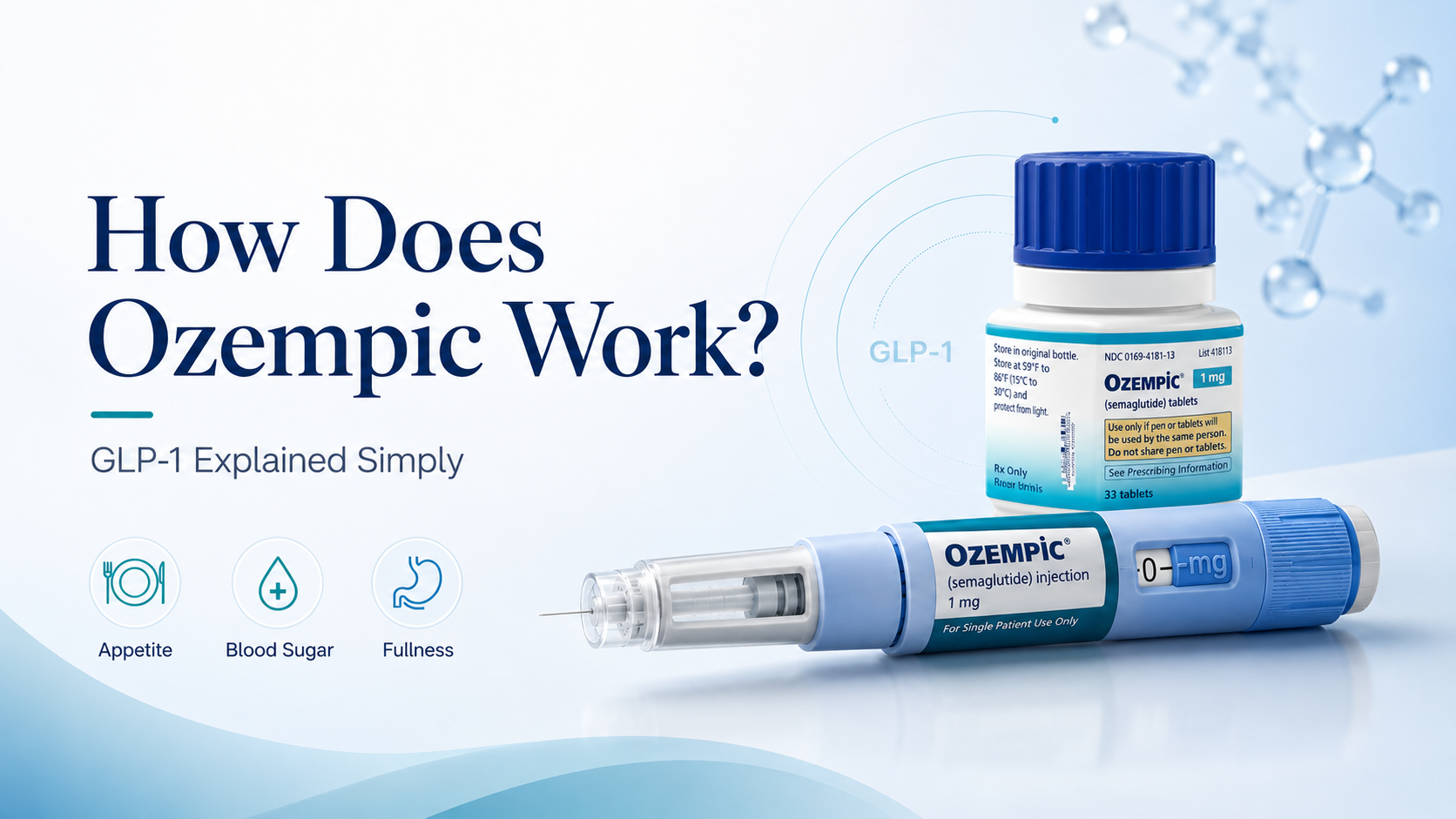
How Does Ozempic Work? GLP-1 Explained Simpl
Ozempic works by copying a signal your body already uses after eating. It does not act like a stimulant, a fat burner, or a magic switch. Instead, semaglutide works through GLP-1 receptor pathways involved in blood sugar, insulin, glucagon, stomach emptying, fullness, and appetite. This guide explains that process in plain English — so the mechanism finally feels like something you can understand, not a biochemistry lecture.
How Does Ozempic Work? GLP-1 Explained Simply
Ozempic works by copying a signal your body already uses after eating.
That is the simple version.
The more interesting version is this: Ozempic does not work like a stimulant, a fat burner, or a magic switch. It works more like a messenger that shows up at a very specific moment — when the body is trying to decide what to do with food.
Blood sugar rises.
The pancreas needs to respond.
The liver needs to slow down sugar release.
The stomach does not need to empty everything at once.
The brain receives signals about fullness.
Ozempic sits inside that conversation.
That is why one medication can be discussed in diabetes, appetite, digestion, weight-loss stories, side effects, and GLP-1 news all at the same time. It is not because Ozempic does one tiny thing. It is because GLP-1 signaling touches several connected systems.
This guide explains how Ozempic works in plain English — without turning it into a biochemistry lecture.
Sources used note: This article is based on official Ozempic prescribing information, official Ozempic educational materials, and publicly available medical and regulatory references.
Quick Answer: How Does Ozempic Work?
In plain English, that means semaglutide activates GLP-1 receptor pathways — the same type of pathway your body uses after eating to help manage blood sugar, insulin, glucagon, fullness, and stomach emptying.
Ozempic works mainly by helping the body respond to high blood sugar more appropriately, reducing the liver’s release of sugar, and slowing how quickly food leaves the stomach.
That is the core mechanism.
The rest of the story is about why that mechanism affects how people feel, eat, digest, and talk about the medication online.
GLP-1 is short for glucagon-like peptide-1.
The name sounds like it was designed to scare normal people away. But the idea is simple.
GLP-1 is one of the body’s “food has arrived” signals.
After you eat, your body has to organize the response. It needs to manage blood sugar, tell the pancreas what is happening, communicate with the liver, slow digestion at the right time, and send fullness signals.
GLP-1 is part of that system.
Ozempic works by activating the GLP-1 receptor. That does not mean Ozempic is the same as natural GLP-1 in every way. It means semaglutide is designed to act on the same receptor pathway in a longer-lasting medication form.
The best way to think about it is not “Ozempic forces the body to do something random.”
It is more like: Ozempic amplifies a signal the body already understands.
The Four-Part Story: Pancreas, Liver, Stomach, Brain
Ozempic is easiest to understand if you split the mechanism into four places:
- 1the pancreas;
- 2the liver;
- 3the stomach;
- 4the brain and appetite system.
That does not mean the medication works only in those places. It means those are the easiest doors into the story.
The pancreas helps manage insulin.
The liver can release sugar into the blood.
The stomach controls how quickly food moves forward.
The brain helps interpret hunger and fullness.
GLP-1 signaling touches all of that.
That is why Ozempic does not feel like a simple “diabetes drug” in public discussion. It sits at the intersection of blood sugar, appetite, and digestion.
Ozempic Helps the Pancreas Respond When Blood Sugar Is High
The pancreas is the organ most people forget about until blood sugar becomes a problem.
One of its jobs is to release insulin. Insulin helps move sugar from the blood into cells where the body can use or store it.
Ozempic helps stimulate insulin secretion when blood sugar is elevated.
That last part matters: when blood sugar is elevated.
This is one reason GLP-1 receptor agonists are different from the simplistic way people sometimes talk about them online. Ozempic is not just “more insulin all the time.” Its insulin-related effect is tied to blood sugar conditions.
In plain English: when blood sugar is high after food, Ozempic helps the body answer that moment more strongly.
That is central to why Ozempic is used in type 2 diabetes care.
Ozempic Helps Reduce the Liver’s Sugar Release
Most people think blood sugar only comes from food.
That is not the whole story.
Your liver can also release sugar into the bloodstream. That can be useful in the right situation. But in type 2 diabetes, blood sugar regulation can already be difficult, so extra sugar release can add to the problem.
Ozempic helps lower glucagon secretion.
Glucagon is a hormone that tells the liver to release sugar. When glucagon is lower, the liver may release less sugar into the blood.
This is the second major piece of the Ozempic mechanism.
The pancreas side is about insulin.
The liver side is about glucagon.
Together, they help explain why Ozempic is discussed in blood sugar and A1C conversations.
Ozempic Slows Food Leaving the Stomach
This is the part many people feel before they understand it.
Ozempic can slow how quickly food leaves the stomach, especially after eating.
That matters because digestion speed affects how quickly glucose enters the bloodstream and how full someone may feel after a meal.
Think of the stomach like a gate, not just a bag.
If the gate opens very quickly, food moves forward quickly. If the gate opens more slowly, the body receives that food more gradually.
This does not mean the stomach stops working. It means the timing changes.
This part of the mechanism helps explain why Ozempic is so often discussed alongside fullness, nausea, appetite changes, and digestive side effects. Those topics deserve their own guide, but the connection starts here.
When a medication changes digestion timing, people may notice it.
Ozempic Can Affect Fullness and Appetite Signals
This is where Ozempic became famous outside diabetes.
People do not talk about Ozempic only because of lab numbers. They talk about it because many people notice changes in hunger, fullness, food interest, or how much they feel like eating.
That does not make Ozempic a casual weight-loss shortcut.
It means GLP-1 signaling is connected to appetite and satiety pathways.
Satiety is the feeling of “I have had enough.” Appetite is the desire to eat. Food interest is the part people often describe in everyday language as cravings, food noise, or thinking about food less.
Those phrases are not all medical terms. But they point to something real: Ozempic is discussed in weight-related conversations because semaglutide can influence how the body and brain respond to food.
The important point is context.
Appetite change is part of why Ozempic became famous. It is not the same as saying Ozempic should be used casually or without medical supervision.
Why Ozempic Is Taken Weekly
Ozempic is known as a once-weekly medication.
That does not happen by accident.
Semaglutide is designed to last longer in the body than natural GLP-1. Natural GLP-1 is broken down quickly. Semaglutide is modified so it stays active longer.
One reason is albumin binding, which helps prolong its action. Another is that semaglutide is stabilized against breakdown by the DPP-4 enzyme.
You do not need to memorize those names.
The useful point is simpler: Ozempic is engineered to keep GLP-1 receptor activity going over time, which is why the medication is not taken like a short-acting signal after every meal.
This is also why dosing questions should not be guessed from social media. A long-acting medication is not something to casually repeat, skip, or adjust based on a comment thread.
What Ozempic Does Not Do
Understanding what Ozempic does not do is just as important as understanding what it does.
- 1Ozempic does not melt fat directly.
- 2It does not work like caffeine.
- 3It does not force weight loss by itself.
- 4It does not replace food choices, medical care, or monitoring.
- 5It does not mean every person will have the same result.
- 6It does not make every semaglutide product online the same as Ozempic.
The mechanism is not magic. It is biology.
Ozempic works through GLP-1 receptor pathways. Those pathways can influence blood sugar, digestion, appetite, and fullness. What happens for an individual person depends on their medical situation, dose, other medications, diagnosis, follow-up care, and how their body responds.
Why This Mechanism Can Create Side Effects
The same mechanism that explains why Ozempic works also helps explain why side effects are common.
If a medication affects stomach emptying, fullness, appetite, and digestion, it makes sense that some people may notice nausea, constipation, stomach discomfort, reduced appetite, or other digestive symptoms.
This article is not a side-effects guide. The point here is narrower: Ozempic’s side effects are not random. Many of them connect back to the same GLP-1 pathways that make the medication work.
That is why mechanism matters.
When you understand the mechanism, the medication becomes less mysterious.
Why This Mechanism Became a Cultural Story
Ozempic did not become famous only because it lowers blood sugar.
It became famous because the mechanism touched something personal: eating.
Food is not just biology. It is habit, emotion, stress, social life, identity, and health. A medication that can change appetite and fullness is going to create a louder conversation than a medication people understand only through lab numbers.
But headlines simplify. Mechanism explains.
The real story is not “a shot that makes people thin.” The real story is a GLP-1 receptor agonist that changes several food-response signals at once.
The Simple Version to Remember
If you remember only one thing, remember this:
Ozempic works by activating GLP-1 receptor pathways that help the body respond to food.
That response includes:
- 1more insulin when blood sugar is high;
- 2less glucagon signaling that can raise blood sugar;
- 3slower movement of food out of the stomach;
- 4stronger fullness and appetite-related signals.
That is why Ozempic belongs in diabetes conversations.
That is why it appears in weight-loss conversations.
And that is why it can also appear in digestion and side-effect conversations.
Same mechanism. Different angles.
Bottom Line
Ozempic makes more sense when you stop thinking of it as one simple internet category.
It is a GLP-1 receptor agonist, and GLP-1 sits at the crossroads of blood sugar, food, fullness, and digestion.
Once you understand that crossroads, the rest of the Ozempic conversation becomes much easier to read.
FAQ
Frequently Asked Questions
Ozempic works by activating GLP-1 receptor pathways. These pathways help the body respond to food by influencing insulin, glucagon, stomach emptying, fullness, and appetite signals.
GLP-1 stands for glucagon-like peptide-1. It is a natural body signal involved in blood sugar regulation, digestion, appetite, and fullness after eating.
Ozempic helps stimulate insulin secretion when blood sugar is high and helps lower glucagon secretion. Glucagon is a hormone that can tell the liver to release sugar into the bloodstream.
Yes. Ozempic can slow how quickly food leaves the stomach. This can affect how full someone feels and how quickly glucose enters the bloodstream after eating.
Ozempic can influence fullness and appetite-related signals through GLP-1 receptor pathways. That is one reason it is widely discussed in weight-related conversations.
No. Ozempic is not a direct fat burner. It works through GLP-1 receptor pathways connected to blood sugar, digestion, fullness, and appetite.
Semaglutide is designed to last longer in the body than natural GLP-1. Official prescribing information describes mechanisms such as albumin binding and stabilization against DPP-4 breakdown, which help explain its longer action.
No. Ozempic.review provides general educational information only. Personal medication decisions should be made with a licensed healthcare professional.
Sources
- 1Ozempic Prescribing Information — official information on semaglutide, GLP-1 receptor agonist mechanism, insulin secretion, glucagon secretion, gastric emptying, and long half-life.
- 2Official Ozempic Educational Materials — plain-language explanation of how Ozempic works through the pancreas, liver, and stomach.
- 3FDA / regulatory references — public drug labeling and safety-related information.
Dr. Sheri Tomas
Comments (0)
Be the first to comment on this article.
