
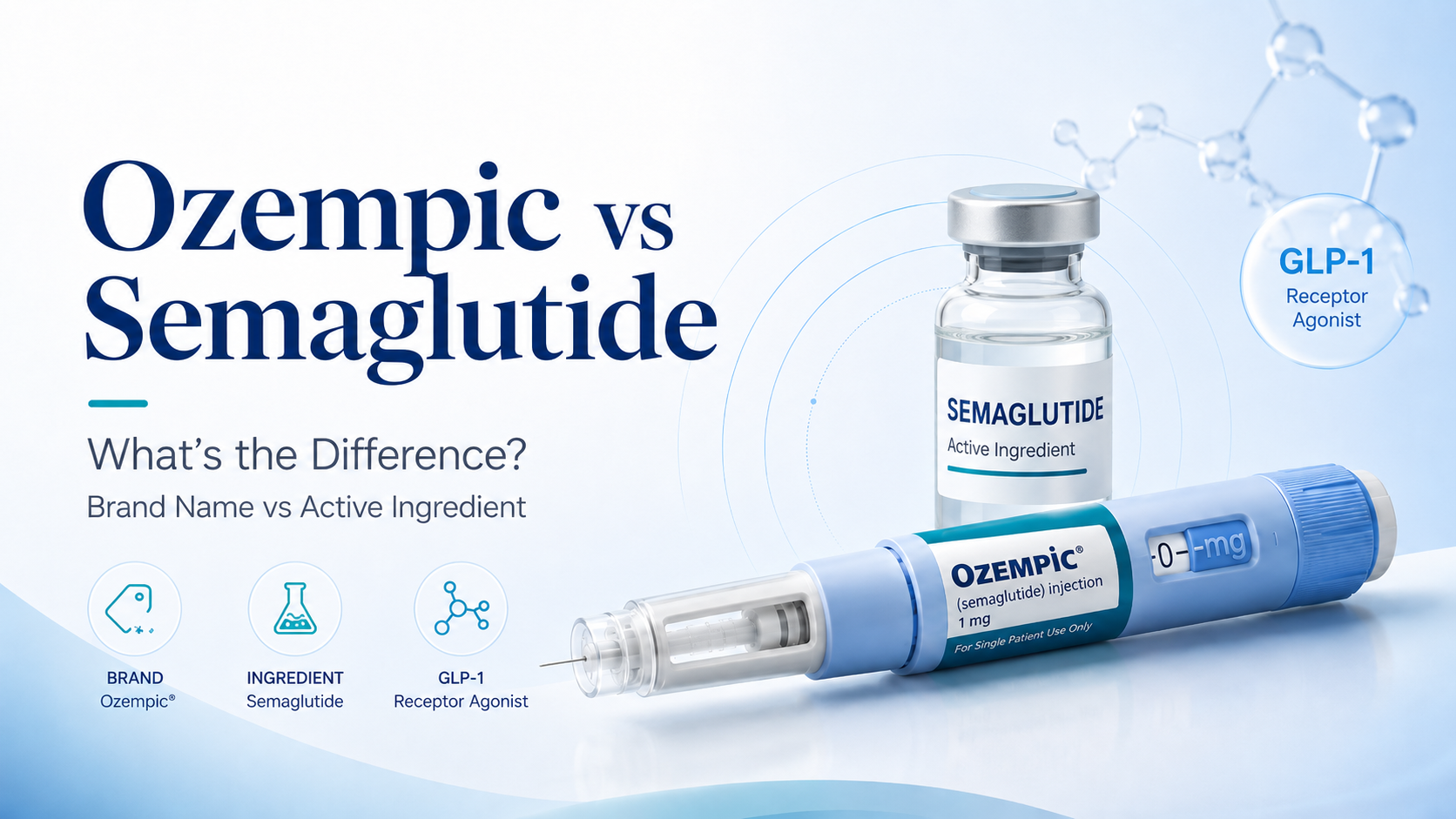
Ozempic vs Semaglutide: What’s the Difference?
Ozempic and semaglutide are often used like they mean the same thing, but they do not do the same job. Ozempic is a brand-name prescription medication. Semaglutide is the active ingredient inside it. That difference matters because semaglutide can appear in different products, labels, doses, and online claims — and confusing the brand with the ingredient can make reviews, “generic Ozempic” ads, Wegovy comparisons, and compounded semaglutide discussions much harder to understand.
Ozempic vs Semaglutide: What’s the Difference?
Ozempic and semaglutide are closely connected.
But they are not the same word doing the same job.
That is where the confusion starts.
Someone says “Ozempic” when they mean a specific brand-name medication. Someone else says “semaglutide” when they mean the active ingredient. A social post says “GLP-1.” A seller says “generic Ozempic.” A review says “I tried semaglutide,” but never tells you whether it was Ozempic, Wegovy, a compounded product, or something else.
Suddenly, one medication conversation turns into five different conversations wearing the same jacket.
This guide explains the difference in plain English: what Ozempic is, what semaglutide is, why the distinction matters, and why online claims can become misleading fast.
Sources used note: This article is based on official Ozempic prescribing information, official Wegovy prescribing information, FDA safety communication about compounded semaglutide dosing errors, and publicly available medical and regulatory references.
Quick Answer: Ozempic vs Semaglutide
Ozempic is a brand-name prescription medication.
Semaglutide is the active ingredient in Ozempic.
That is the simplest difference.
A brand name points to a specific medication product. An active ingredient points to the substance inside the medication that produces its effect.
So yes, Ozempic contains semaglutide.
But no, not every semaglutide conversation is automatically an Ozempic conversation.
That difference matters because semaglutide can appear in different products, labels, doses, medical contexts, and online claims.
The Coffee Example: Brand vs Ingredient
Think of it like coffee.
“Starbucks” is a brand.
“Coffee” is what is inside the cup.
If someone says they drank Starbucks, you know something about the product, source, packaging, and experience. If someone says they drank coffee, that could mean a Starbucks latte, homemade espresso, gas station coffee, instant coffee, or something else entirely.
Ozempic and semaglutide work the same way.
Ozempic is the specific branded medication.
Semaglutide is the active ingredient.
The ingredient matters. But the product still matters too.
That is the whole article in one idea.
Ozempic is a brand-name prescription medication that contains semaglutide.
Official prescribing information describes Ozempic as a GLP-1 receptor agonist used in adults with type 2 diabetes in specific medical contexts.
That means Ozempic is not just a random name for “weight-loss shot.” It is a specific medication product with official labeling, defined uses, dosage forms, safety information, and prescribing instructions.
When someone says “Ozempic,” they should be talking about the actual Ozempic medication — not every semaglutide product on the internet.
What Is Semaglutide?
Semaglutide is the active ingredient.
It belongs to a class of medicines called GLP-1 receptor agonists. In simple terms, semaglutide works with GLP-1 receptor pathways involved in blood sugar, appetite, fullness, and digestion.
But this article is not about the full mechanism. The important point here is identity.
Semaglutide tells you the ingredient.
It does not automatically tell you the product.
Why the Difference Matters
At first, the difference between Ozempic and semaglutide may sound like a small language issue.
It is not.
The active ingredient matters, but it is not the whole story. A medication product also has a label, dose system, approved use, formulation, source, instructions, and medical supervision.
That is why “semaglutide” is not enough information by itself.
Two people can both say they used semaglutide and still be talking about very different situations.
One may mean Ozempic prescribed for type 2 diabetes.
Another may mean Wegovy in a weight-management context.
Another may mean compounded semaglutide from a vial.
Another may mean an online product being marketed in a way that deserves caution.
Same active ingredient conversation. Not always the same product reality.
Ozempic vs Wegovy: Same Ingredient, Different Product
Ozempic and Wegovy are often confused because both are associated with semaglutide.
But they are not simply two labels slapped on the same public story.
They are different branded medications with different product identities, labels, dosing contexts, and approved uses.
The overlap is semaglutide.
The difference is the product context.
This section is only the short version. The full Ozempic vs Wegovy comparison deserves its own guide because dose, labeling, approved use, and patient context all matter.
Compounded Semaglutide and “Generic Ozempic”
This is where the conversation gets risky.
People may look for compounded semaglutide because of cost, access, shortages, or weight-loss demand. Online, it may be described with phrases that sound close to Ozempic: “semaglutide,” “generic Ozempic,” “compounded Ozempic,” or “cheap Ozempic.”
Those phrases can blur important differences.
Compounded semaglutide is not the same thing as FDA-approved Ozempic.
FDA has warned about dosing errors with compounded injectable semaglutide products, including situations involving multi-dose vials, measurement confusion, different concentrations, syringe units, and patients or providers miscalculating doses.
That is not just a technical detail.
If a product is measured differently, labeled differently, supplied differently, or explained poorly, the user’s risk can change.
This is why the phrase “generic Ozempic” can be misleading. It sounds like a normal brand-versus-generic comparison, but online semaglutide claims may involve very different product, source, formulation, concentration, and supervision questions.
A better question is not “Is this generic Ozempic?”
A better question is: what exactly is this product?
Why Reviews Can Be Misleading
Reviews often make the Ozempic vs semaglutide confusion worse.
A person might write, “I tried semaglutide and felt terrible.”
Another might say, “Ozempic changed my life.”
Someone else might talk about a compounded vial, but the reader assumes it was Ozempic.
That is a problem.
Reviews can be honest and still incomplete.
A review may not tell you the product, dose, diagnosis, other medications, source, duration, side effects, medical supervision, or whether the person was using Ozempic, Wegovy, compounded semaglutide, or another GLP-1-related product.
So reviews can help you understand what people are talking about.
They cannot replace the product details.
If the product is unclear, the review is incomplete.
Bottom Line
Ozempic and semaglutide are connected, but they are not the same kind of word.
Ozempic is a brand-name prescription medication.
Semaglutide is the active ingredient.
That difference matters because real medication decisions depend on the exact product, dose, label, source, medical use, and supervision — not just a familiar name in a headline, review, or online ad.
If you remember one rule, remember this:
Do not ask only, “Is it semaglutide?”
Ask, “Which semaglutide product is it?”
FAQ
Frequently Asked Questions
Not exactly. Ozempic is a brand-name medication. Semaglutide is the active ingredient inside Ozempic.
Yes. Ozempic contains semaglutide.
Semaglutide is the active ingredient name. But products marketed online as “generic Ozempic” are not automatically the same as FDA-approved Ozempic.
Wegovy and Ozempic both contain semaglutide, but they are different branded medications with different labels, dosing contexts, and approved uses.
No. Compounded semaglutide is not the same as FDA-approved Ozempic. It may involve different vial formats, concentrations, instructions, and safety concerns.
People often use the words interchangeably because Ozempic contains semaglutide and Ozempic is the more famous brand name. But the distinction matters when comparing products, labels, doses, reviews, and online claims.
Ask which product they mean: Ozempic, Wegovy, compounded semaglutide, another GLP-1 medication, or an online product. The ingredient alone does not tell the whole story.
No. Ozempic.review provides general educational information only. Personal medication decisions should be made with a licensed healthcare professional.
Sources
- 1Ozempic Prescribing Information — official information on Ozempic, semaglutide, GLP-1 receptor agonist classification, labeling, and safety information.
- 2Wegovy Prescribing Information — official information on Wegovy as a semaglutide-containing medication with its own labeling.
- 3FDA Safety Communication — dosing errors and safety concerns associated with compounded injectable semaglutide products.
- 4FDA / regulatory references — public drug labeling and safety-related information.
Editorial Team
Comments (0)
Be the first to comment on this article.
