
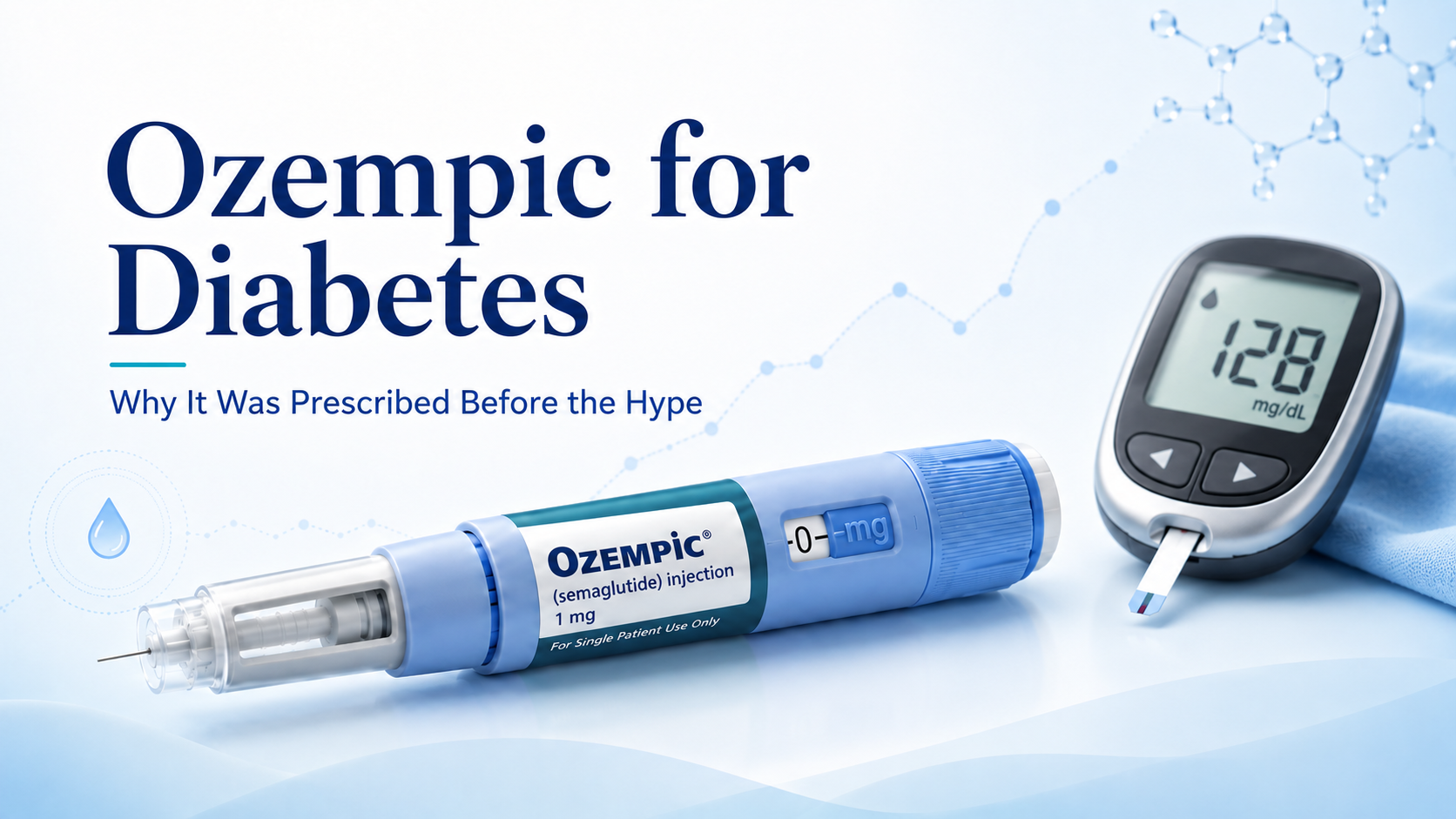
Ozempic for Diabetes: Why It Was Prescribed Before the Hype
Ozempic became famous online as part of the weight-loss conversation, but that was not where its medical story began. Ozempic was first prescribed in the type 2 diabetes context, where blood sugar control, A1C, insulin response, glucagon, cardiovascular risk, and kidney-related risk matter more than viral before-and-after photos. This guide explains why Ozempic was used for diabetes before the hype — and what people often misunderstand when they ask whether Ozempic is for diabetes or weight loss.
Ozempic for Diabetes: Why It Was Prescribed Before the Hype
Last updated: June 28, 2026
The internet met Ozempic as a weight-loss story.
Doctors met it first as a diabetes medication.
That difference matters.
Before celebrity headlines, before TikTok jokes, before “Ozempic face,” before before-and-after photos, Ozempic was prescribed in a much less viral context: adults with type 2 diabetes who needed help improving blood sugar control.
That story is not as flashy.
It is also the story that explains why Ozempic exists.
Ozempic is a prescription semaglutide medication. It belongs to a drug class called GLP-1 receptor agonists. In type 2 diabetes care, it is used with diet and exercise to help improve blood sugar. In specific adults with type 2 diabetes, it is also used to reduce certain cardiovascular and kidney-related risks.
That is the part the internet often skips.
Ozempic did not begin as a cultural shortcut for weight loss.
It began as a medication in the type 2 diabetes conversation.
This guide explains what Ozempic does for diabetes, how it works in plain English, why it is not insulin, why A1C matters, why weight loss became part of the story, and what people often misunderstand when they ask whether Ozempic is “for diabetes or weight loss.”
Sources used note: This article is based on official Ozempic prescribing information, official Ozempic patient materials, FDA approval history, Medicare information, and publicly available medical references. It is educational only and is not medical advice.
Quick Answer: Is Ozempic for Diabetes?
Yes. Ozempic is a prescription medication used in adults with type 2 diabetes.
Its main diabetes role is to help improve blood sugar control when used along with diet and exercise.
Ozempic may also be used in specific adults with type 2 diabetes to reduce the risk of major cardiovascular events, such as heart attack, stroke, or cardiovascular death, when certain risk factors are present. Current prescribing information also includes a kidney-related risk-reduction indication in adults with type 2 diabetes and chronic kidney disease.
That does not mean Ozempic is right for every person with diabetes.
- 1It does not mean it is insulin.
- 2It does not mean it is for type 1 diabetes.
- 3It does not mean people should start, stop, or change diabetes medication without a licensed healthcare professional.
The clean version is this:
- 1Ozempic is a type 2 diabetes medication first.
- 2The weight-loss conversation came later.
The Part the Internet Forgot
The internet often talks about Ozempic as if it was invented for weight loss.
That is not the original story.
Ozempic was approved in the United States in 2017 as a semaglutide injection for adults with type 2 diabetes. Its original role was not celebrity weight loss. It was blood sugar control.
That history matters because it changes how you read everything else.
When someone says “Ozempic for diabetes,” they are not talking about a side use or a trend. They are talking about the core medical context that came before the public hype.
Weight loss became part of the Ozempic story because appetite and blood sugar biology overlap. Ozempic can affect fullness, appetite, stomach emptying, and food intake, so some people may lose weight while taking it.
But overlap is not the same as original purpose.
In type 2 diabetes care, weight change may be relevant because weight, insulin resistance, blood sugar, cardiovascular risk, and metabolic health can be connected.
Still, Ozempic should not be reduced to “the weight-loss shot.”
That phrase hides the diabetes context.
It also makes people forget that Ozempic is a prescription medication with warnings, side effects, monitoring needs, and specific labeled uses.
The weight-loss story is real.
It is just not the whole Ozempic story.
What Type 2 Diabetes Actually Means
Type 2 diabetes is not just “too much sugar.”
That phrase makes the condition sound simpler than it is.
Type 2 diabetes involves how the body handles glucose after food arrives, how insulin works, how the liver releases sugar, and how blood sugar changes over time.
Insulin is the hormone that helps move glucose from the blood into cells. In type 2 diabetes, the body may not respond to insulin as well as it should. Over time, the pancreas may also struggle to keep up with the demand.
That can leave too much glucose in the blood.
One high reading can matter.
But diabetes care is usually about the pattern, not just one number.
That is why people hear about fasting glucose, after-meal glucose, and A1C. A1C gives a longer-term view of blood sugar control over roughly the past few months.
This is the world Ozempic entered before the weight-loss headlines.
- 1Not a beauty trend.
- 2Not a shortcut.
- 3A chronic blood sugar problem with long-term risk.
What Ozempic Does for People With Type 2 Diabetes
Ozempic does not “erase diabetes.”
It helps the body respond to food signals in a more useful way.
In people with type 2 diabetes, Ozempic is used to help improve blood sugar control. It belongs to a class of medications called GLP-1 receptor agonists.
GLP-1 is connected to the body’s response after eating. When food arrives, the body has to decide what to do with glucose. The pancreas, liver, stomach, and brain are all part of that conversation.
Ozempic works inside that system.
- 1It can help the pancreas release more insulin when blood sugar is high.
- 2It can help reduce glucagon, a hormone that tells the liver to release sugar.
- 3It can slow how quickly food leaves the stomach.
Together, those effects can help lower blood sugar and improve A1C in adults with type 2 diabetes.
That is the diabetes story.
The appetite and weight-loss story grew out of some of the same biology, but it is not the whole explanation.
How Ozempic Works for Diabetes: The Simple Version
The name “GLP-1 receptor agonist” sounds like it was designed to scare normal people away.
The idea is simpler than the name.
Ozempic copies the action of a signal your body already uses after eating.
Think of it like a message that says:
- 1Food has arrived.
- 2Blood sugar is rising.
- 3The pancreas should respond.
- 4The liver should not release too much extra sugar.
- 5The stomach can slow down.
In type 2 diabetes, that conversation often does not work smoothly.
Ozempic helps strengthen parts of the signal.
That is why official Ozempic materials often explain it through three simple actions:
- 1It helps the pancreas produce more insulin when blood sugar is high.
- 2It helps prevent the liver from making and releasing too much sugar.
- 3It slows food leaving the stomach.
That does not make Ozempic a cure.
It makes it one tool used in a broader diabetes treatment plan.
This is the short diabetes-focused version.
The full mechanism deserves its own guide because Ozempic also sits inside the larger GLP-1 conversation around appetite, fullness, stomach emptying, insulin, glucagon, and weight change.
Ozempic Is Not Insulin
One of the easiest mistakes is thinking Ozempic is insulin.
It is not.
Insulin is a hormone that directly helps move glucose from the blood into cells.
Ozempic is a GLP-1 receptor agonist. It works through GLP-1 pathways that influence insulin release, glucagon, stomach emptying, appetite, and blood sugar response.
That difference matters.
A person using insulin may still need insulin.
A person using Ozempic should not assume it replaces insulin.
Official Ozempic materials state that Ozempic is not a substitute for insulin and is not for use in people with type 1 diabetes or diabetic ketoacidosis.
So when people ask “Is Ozempic insulin for type 2 diabetes?” the answer is simple:
No.
Ozempic may affect insulin response.
But it is not insulin.
Why A1C Matters More Than a Viral Before-and-After Photo
A1C is boring compared with a dramatic before-and-after photo.
For diabetes care, it may be the more important number.
A before-and-after photo can show weight change. It cannot show blood sugar control. It cannot show whether A1C improved. It cannot show whether a person’s diabetes plan is safer or more sustainable.
A1C is used because it gives a longer-term picture of average blood sugar.
That matters in type 2 diabetes because the goal is not only to feel different next week. The goal is to reduce the damage that long-term high blood sugar can cause over time.
Ozempic became famous because people noticed weight change.
But before the public became fascinated with the scale, clinicians were looking at diabetes markers like blood sugar and A1C.
That is the quieter story.
It is also the more medically important one.
Ozempic for Type 1 Diabetes, Prediabetes, and Non-Diabetic Use
Not every blood sugar question belongs in the same category.
That is where people get confused.
Ozempic’s main label context is adults with type 2 diabetes. Official materials state that Ozempic is not for use in people with type 1 diabetes or people with diabetic ketoacidosis.
That does not mean every real-world question is simple.
People search for:
- 1Ozempic for type 1 diabetes;
- 2Ozempic for prediabetes;
- 3Ozempic for non-diabetics;
- 4Ozempic for weight loss without diabetes;
- 5Ozempic for kidney disease without diabetes.
Those are not questions a blog should answer with a yes or no.
The risk context changes depending on diagnosis, other medications, blood sugar patterns, kidney health, weight-related conditions, and medical history.
This is especially important for people using insulin or other glucose-lowering medications. Medication changes can affect blood sugar in serious ways.
The safest answer is this:
Ozempic’s core labeled diabetes context is type 2 diabetes, and questions outside that context require a licensed healthcare professional.
Why This Article Does Not Give an Ozempic Diabetes Dose Chart
A dose chart can make diabetes treatment look like a simple ladder.
It is not.
People search for Ozempic doses for diabetes, maximum dose of Ozempic for diabetes, Ozempic dosing for diabetes, and Ozempic dose for diabetes vs weight loss.
Those are real questions.
But this article is not the place to give dosing instructions.
Ozempic dosing belongs to official prescribing information and clinician guidance. A healthcare professional considers the person’s diagnosis, current medications, blood sugar patterns, side effects, kidney concerns, stomach symptoms, tolerance, and treatment goals.
That is different from copying a number from a search result.
A dose is not just a number.
It is part of a treatment plan.
That is why this article explains the context but does not provide a diabetes dose chart or tell readers how to adjust medication.
The safer question is not “Is Ozempic safe?”
The safer question is “Safe for which person, with which medical history, and under what supervision?”
Ozempic is an approved prescription medication for adults with type 2 diabetes, but approved does not mean risk-free.
It has warnings, possible side effects, contraindications, and situations where extra caution may be needed. A healthcare professional should review personal and family medical history, other medications, digestive symptoms, kidney health, blood sugar risk, and treatment goals.
This matters because diabetes care often involves more than one medication.
- 1Some people may be using insulin.
- 2Some may be using sulfonylureas or other glucose-lowering drugs.
- 3Some may have kidney disease, heart disease, digestive problems, or a history of pancreatitis.
That context changes the safety conversation.
For one person, Ozempic may be an appropriate part of a type 2 diabetes plan.
For another person, a clinician may choose something else.
That is why safety should be personalized, not guessed from a review.
Ozempic Side Effects in the Diabetes Context
Side effects are not separate from diabetes care.
They can affect the whole plan.
Commonly discussed Ozempic side effects include nausea, vomiting, diarrhea, constipation, stomach discomfort, reduced appetite, and changes in how food feels. Official prescribing information also includes serious warnings and risks that should be reviewed with a healthcare professional.
For someone with type 2 diabetes, side effects matter for more than comfort.
Vomiting, dehydration, reduced food intake, or trouble eating can affect blood sugar management. If someone is also using other diabetes medications, changes in food intake may make the situation more complicated.
This is why “I can barely eat” should not be treated as success.
It may be a problem.
If side effects are severe, persistent, worsening, or interfere with eating or drinking, that is a reason to contact a healthcare professional.
Ozempic vs Metformin, Insulin, and Mounjaro
Not every diabetes medication comparison is comparing the same kind of thing.
That is the first mistake.
People search for Ozempic vs metformin, Ozempic vs insulin, Ozempic vs Mounjaro, and Mounjaro vs Ozempic for type 2 diabetes.
Those are useful searches, but they need context.
- 1Metformin is a different type of diabetes medication and has long been used in type 2 diabetes care.
- 2Insulin is a hormone therapy and can be essential for some people.
- 3Ozempic is a GLP-1 receptor agonist.
- 4Mounjaro is associated with tirzepatide, a different active ingredient.
These names are often discussed together because they all appear in diabetes and weight-related conversations. But they are not interchangeable.
The better question is not:
Which one is best?
The better question is:
Which medication fits this person’s diagnosis, blood sugar pattern, other medications, medical risks, insurance coverage, and treatment goals?
That answer belongs with a licensed healthcare professional.
Does Medicare or Insurance Cover Ozempic for Diabetes?
The coverage question is not just “Does Medicare cover Ozempic?”
It is “What does this specific plan cover for this specific diagnosis?”
Many people search for whether Medicare, Medicaid, Aetna, Blue Cross Blue Shield, Cigna, Kaiser, Humana, Tricare, Anthem, or United Healthcare covers Ozempic for diabetes.
There is no universal answer.
Coverage can depend on:
- 1the plan;
- 2the formulary;
- 3the diagnosis;
- 4prior authorization rules;
- 5step therapy requirements;
- 6pharmacy benefit design;
- 7Medicare Part D or Medicare Advantage structure;
- 8state Medicaid rules;
- 9documentation from the prescriber.
A person with type 2 diabetes may be evaluated differently from someone seeking Ozempic only for weight loss.
Medicare drug coverage is usually handled through Part D or Medicare Advantage plans with drug coverage, and plan details can vary. Private insurance plans also vary.
So the practical answer is:
Check the plan formulary, ask the insurer, and work with the prescribing clinician or pharmacy on documentation.
Do not assume coverage from someone else’s story.
How Long Can You Take Ozempic for Type 2 Diabetes?
Type 2 diabetes is usually a long-term condition.
That does not mean every medication plan stays the same forever.
People search for how long they can take Ozempic for type 2 diabetes because they want to know whether it is temporary, lifelong, or something in between.
The answer depends on the person.
A healthcare professional may consider blood sugar control, A1C, side effects, weight change, kidney function, cardiovascular risk, other medications, cost, coverage, and whether treatment goals are being met.
- 1Some people may stay on a medication long term.
- 2Some may change therapy.
- 3Some may stop because of side effects, cost, pregnancy planning, other medical issues, or a better-fitting treatment plan.
The key point is simple:
Stopping can affect blood sugar, appetite, weight, and the rest of the treatment plan.
What People With Diabetes Should Not Miss
The hype makes Ozempic look like a weight-loss shortcut.
The diabetes context shows something more serious.
People with type 2 diabetes should not miss these points:
- 1Ozempic is not insulin.
- 2Ozempic is not for type 1 diabetes or diabetic ketoacidosis.
- 3A1C and blood sugar control matter more than viral weight-loss stories.
- 4Weight change may happen, but it is not the only goal.
- 5Side effects can affect eating, hydration, and blood sugar management.
- 6Coverage depends on plan rules and diagnosis.
- 7Dose changes belong with a healthcare professional.
- 8Reviews do not show the full medical context.
Ozempic can be part of a diabetes treatment plan, but it is not the whole plan.
Diet, exercise, monitoring, follow-up visits, medication review, and risk management still matter.
Bottom Line
Ozempic became famous because of weight loss.
But it was prescribed before the hype because of type 2 diabetes.
That is the part many people miss.
Ozempic is a prescription semaglutide medication used with diet and exercise to help improve blood sugar in adults with type 2 diabetes. In certain adults with type 2 diabetes, its label also includes cardiovascular and kidney-related risk-reduction uses.
- 1It is not insulin.
- 2It is not for type 1 diabetes or diabetic ketoacidosis.
- 3It is not just a weight-loss headline.
The clean way to understand Ozempic is this:
- 1Blood sugar first.
- 2Hype second.
FAQ
Frequently Asked Questions
Yes. Ozempic is used in adults with type 2 diabetes to help improve blood sugar control when used with diet and exercise.
Yes. Ozempic’s main diabetes context is adults with type 2 diabetes.
Official Ozempic materials state that Ozempic is not for use in people with type 1 diabetes or people with diabetic ketoacidosis.
No. Ozempic is not insulin. It is a GLP-1 receptor agonist that affects pathways involved in insulin response, glucagon, stomach emptying, and blood sugar control.
No one should assume Ozempic replaces insulin. Official materials state that Ozempic is not a substitute for insulin. Any insulin change should be handled by a healthcare professional.
Ozempic works through GLP-1 pathways. In plain English, it helps the pancreas respond when blood sugar is high, helps reduce excess sugar release from the liver, and slows food leaving the stomach.
For adults with type 2 diabetes, Ozempic can help improve blood sugar control. In certain adults with type 2 diabetes, it may also be used for cardiovascular and kidney-related risk-reduction contexts described in prescribing information.
Ozempic may be appropriate for some adults with type 2 diabetes, but whether it is good for a specific person depends on medical history, other medications, blood sugar goals, side effects, cost, and clinician judgment.
Safety depends on the person. Ozempic is an approved prescription medication for adults with type 2 diabetes, but it has warnings and possible side effects. A healthcare professional should review individual risk.
Commonly discussed side effects include nausea, vomiting, diarrhea, constipation, stomach discomfort, reduced appetite, and digestive changes. Official prescribing information includes additional warnings and risks.
Ozempic is used to improve blood sugar control in adults with type 2 diabetes, and A1C is one of the key measures used in diabetes care.
Ozempic’s main label context is type 2 diabetes. It may be associated with weight loss, but it is not FDA-approved as a weight-loss medication.
Yes. Ozempic was approved in the United States in 2017 as a semaglutide injection for adults with type 2 diabetes.
This is a medical question, not a blog question. Ozempic’s main label context is adults with type 2 diabetes. Non-diabetic use requires clinician evaluation.
Medicare drug coverage depends on the person’s plan, formulary, diagnosis, documentation, and prior authorization rules. Check the specific plan and pharmacy benefits.
Coverage varies by insurer and plan. Diagnosis, formulary rules, prior authorization, and prescriber documentation may all matter.
This article does not provide dose instructions. Dose questions should be handled through official prescribing information and a licensed healthcare professional.
That depends on the person’s treatment plan, blood sugar control, side effects, risks, cost, coverage, and clinician judgment. Do not stop or change diabetes medication without medical guidance.
They are different medications. Which one fits better depends on the person’s medical situation, treatment goals, risks, other medications, and clinician judgment.
Ozempic and Mounjaro are different medications with different active ingredients. A healthcare professional should compare options based on the individual patient.
No. Ozempic.review provides educational information only. It does not prescribe, diagnose, or recommend prescription medications.
Sources
- 1Ozempic Prescribing Information — official information on Ozempic indications, type 2 diabetes use, cardiovascular-risk use, kidney-risk use, limitations, dosage forms, and safety information.
- 2Official Ozempic Website — official patient-facing information on Ozempic as a GLP-1 receptor agonist for adults with type 2 diabetes.
- 3FDA Ozempic Approval Information — official approval history showing Ozempic’s diabetes context before the public weight-loss hype.
- 4Official Ozempic Patient Materials — official information stating that Ozempic is not a substitute for insulin and is not for use in people with type 1 diabetes or diabetic ketoacidosis.
- 5Medicare.gov Part D Information — official Medicare information explaining that prescription drug coverage is offered through Medicare-approved private plans and that plan details can vary.
Editorial Team
Comments (0)
Be the first to comment on this article.
