
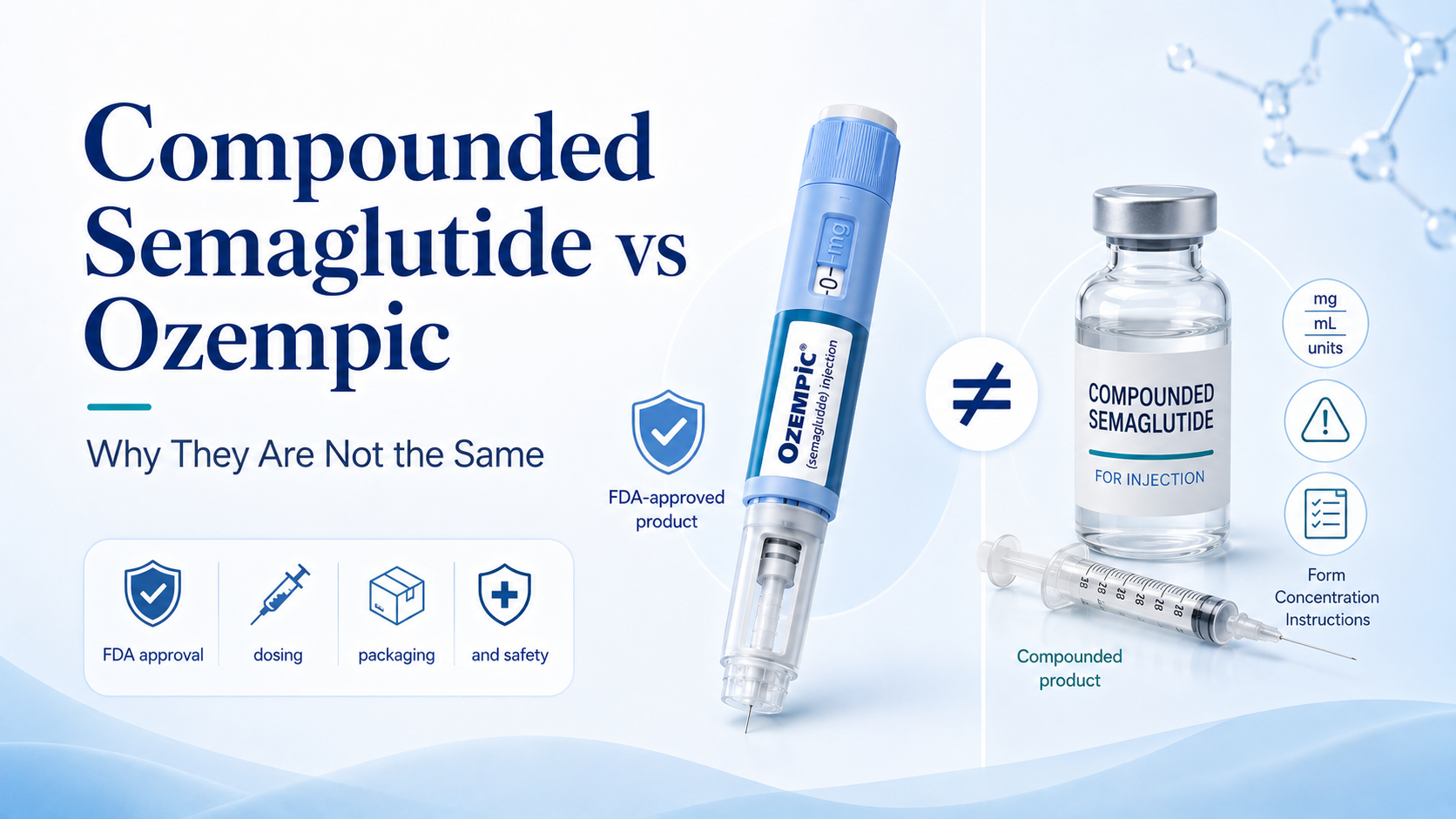
Compounded Semaglutide vs Ozempic: Why They Are Not the Same
Compounded semaglutide and Ozempic may sound similar, but they are not the same product. Ozempic is an FDA-approved brand-name medication with standardized dosing and packaging, while compounded semaglutide can vary by pharmacy, concentration, ingredients, and instructions. That difference matters because dosing errors, vial confusion, and “generic Ozempic” marketing can create real safety risks for patients.
Compounded Semaglutide vs Ozempic: Why They Are Not the Same
Last updated: June 29, 2026
Compounded semaglutide and Ozempic are often talked about as if they are interchangeable. They are not. Yes, both may be connected to semaglutide, the GLP-1 active ingredient behind Ozempic, Wegovy, and Rybelsus. But Ozempic is an FDA-approved brand-name medication with standardized manufacturing, labeling, dosing, and delivery. Compounded semaglutide is prepared by a compounding pharmacy or outsourcing facility and does not go through the same FDA approval process before reaching patients. That difference matters more than many online ads make it sound. This article explains the difference in plain English: what Ozempic is, what compounded semaglutide is, why people compare them, and what safety issues readers should understand before treating them as the same thing. If you are looking for the basic brand-vs-ingredient explanation, see our guide to [Ozempic vs Semaglutide: What’s the Difference?](/ozempic-vs-semaglutide). This page focuses specifically on compounded semaglutide vs Ozempic.
Quick Answer: Is Compounded Semaglutide the Same as Ozempic?
No. Compounded semaglutide is not the same as Ozempic. Ozempic is a specific FDA-approved brand-name injectable medication made by Novo Nordisk. It contains semaglutide and comes in a prefilled pen with standardized concentrations and dosing instructions. Compounded semaglutide is a custom-prepared drug product. It may come in a vial, syringe, or another format. Its concentration, packaging, instructions, and added ingredients may vary depending on the compounder. The simplest way to think about it: Ozempic is a regulated brand-name product. Compounded semaglutide is a pharmacy-prepared version that may contain semaglutide, but it is not FDA-approved as Ozempic, not a generic Ozempic, and not automatically equivalent to Ozempic.
Ozempic is the brand name for a prescription medication that contains semaglutide. Semaglutide belongs to a class of medications called GLP-1 receptor agonists. These medications mimic a hormone involved in blood sugar control, insulin response, appetite signals, and digestion speed. Ozempic is FDA-approved for adults with type 2 diabetes, along with diet and exercise, to help improve blood sugar control. It is also approved to reduce the risk of major cardiovascular events in certain adults with type 2 diabetes and known heart disease. Ozempic is not the same thing as “all semaglutide.” It is one branded semaglutide product. Other FDA-approved semaglutide products include Wegovy and Rybelsus, but they are used in different medical contexts and come in different forms.
What Is Compounded Semaglutide?
Compounded semaglutide is a semaglutide-containing product prepared by a compounding pharmacy or outsourcing facility. Compounding can be legitimate in certain medical situations. For example, a patient may need a customized medication when an FDA-approved product cannot meet a specific medical need. But compounded drugs are different from FDA-approved drugs. The FDA has repeatedly explained that compounded drugs do not go through FDA premarket review for safety, quality, or effectiveness before being sold. That does not automatically mean every compounded product is fake or dangerous. But it does mean the product is not reviewed the same way Ozempic is reviewed. This is where many readers get misled. “Compounded” does not mean “generic.” It does not mean “the same thing for cheaper.” And it does not mean “FDA-approved semaglutide under another label.”
Ozempic vs Compounded Semaglutide: Main Differences
| Category | Ozempic | Compounded Semaglutide | |---|---|---| | FDA status | FDA-approved medication | Not FDA-approved | | Product type | Brand-name semaglutide injection | Pharmacy-prepared semaglutide-containing product | | Form | Prefilled injection pen | Often vial, syringe, or other format | | Concentration | Standardized by the manufacturer | May vary by compounder | | Dosing instructions | Label-based, standardized | May involve units, mL, or custom instructions | | Ingredients | Approved formulation | May include added ingredients such as B12 or L-carnitine | | Quality review | FDA-reviewed before approval | Not FDA-reviewed before marketing | | Generic status | Not a generic | Not an FDA-approved generic | The big takeaway: compounded semaglutide may be presented as an alternative, but it should not be described as “the same as Ozempic.”
Why Do People Search for Compounded Semaglutide Instead of Ozempic?
Most people are not comparing these products out of curiosity. They are usually comparing them because of cost, access, or weight-loss demand. Ozempic and Wegovy can be expensive, insurance coverage can be frustrating, and shortages have pushed many people to look for other options. Online clinics and telehealth ads have also made compounded GLP-1 products much more visible. That is why searches like “compounded semaglutide vs Ozempic,” “generic semaglutide vs Ozempic,” and “Ozempic vs compounded semaglutide” keep growing. The problem is that marketing language can blur the line between three very different things: An FDA-approved brand-name drug. A true FDA-approved generic. A compounded drug product. For semaglutide, that distinction is especially important because the FDA has said there are no FDA-approved generic versions of semaglutide products.
Is Compounded Semaglutide a Generic Ozempic?
No. Compounded semaglutide is not generic Ozempic. A generic drug is FDA-approved and must meet standards for quality, strength, purity, and equivalence to the brand-name drug. Compounded semaglutide does not go through that same FDA generic approval process. It may be prepared by a pharmacy for certain patient needs, but that does not make it a generic version of Ozempic. This is one of the most common online misunderstandings. If a website or ad makes compounded semaglutide sound like “generic Ozempic,” that wording deserves caution.
Why Dosing Can Be More Confusing With Compounded Semaglutide
One of the biggest safety concerns is dosing. Ozempic comes in a prefilled pen. The product is designed around standardized dosing and concentration. Compounded semaglutide may come in a vial or syringe, and the concentration may vary. Some instructions may use “units,” while others use milligrams or milliliters. That can create confusion, especially for people who are not used to drawing medication from a vial. The FDA has warned about dosing errors with compounded injectable semaglutide. Some reports involved patients taking much more than the intended amount because they misunderstood syringe markings or unit conversions. That is not a small detail. With GLP-1 medications, taking too much can lead to severe nausea, vomiting, dehydration, abdominal pain, fainting, and other serious problems. For more context on this specific risk, see our guide to [Ozempic overdose and semaglutide dosing mistakes](/overdose). The issue is not only the medication. It is the whole system around the medication: concentration, packaging, syringe size, instructions, and patient training.
What About Semaglutide With B12 or L-Carnitine?
Some compounded semaglutide products are advertised with added ingredients such as cyanocobalamin, better known as vitamin B12, or levocarnitine, also called L-carnitine. That may sound more “complete” or more personalized. But it does not automatically make the product safer, stronger, or better. The FDA has noted that some compounded semaglutide products include added ingredients such as cyanocobalamin, pyridoxine, levocarnitine, or NAD. The safety and effectiveness of combining semaglutide with those added ingredients has not been established. This matters because “semaglutide + B12” is not the same product as Ozempic. “Semaglutide + L-carnitine” is also not the same product as Ozempic. Even if the name sounds close, the formulation is different.
What About Semaglutide Sodium or Semaglutide Acetate?
This is another important issue. FDA-approved semaglutide products use the base form of semaglutide. The FDA has raised concerns that some compounded products may use salt forms, such as semaglutide sodium or semaglutide acetate. The FDA has stated that these salt forms are different active ingredients than the active ingredient used in approved semaglutide drugs. For a regular reader, the practical meaning is simple: if something is marketed as semaglutide, you still need to know what form of semaglutide it contains and where it came from. The word “semaglutide” on its own does not answer every safety question.
Is Compounded Semaglutide Better, Cheaper, or More Effective Than Ozempic?
Cheaper does not automatically mean equivalent, and “same active ingredient” does not automatically mean same medication. Cost is one of the main reasons people look at compounded semaglutide. Ozempic and Wegovy can be expensive, and insurance coverage may be limited or confusing. That access problem is real. But the comparison should not be price alone. It should also include quality controls, dosing clarity, medical oversight, pharmacy standards, storage, follow-up care, and the exact formulation being used. There is also no good reason to assume compounded semaglutide is more effective than Ozempic. Ozempic has gone through FDA review for its approved uses. Compounded semaglutide products do not go through that same premarket review for safety, quality, or effectiveness. Some people online may report weight loss with compounded products. Personal experiences can be real, but they do not prove that a compounded product is equivalent to Ozempic or consistent from one pharmacy to another.
Ozempic vs Compounded Semaglutide for Weight Loss
This comparison gets confusing because Ozempic is widely discussed online for weight loss, but Ozempic itself is not the semaglutide brand specifically approved for chronic weight management. Wegovy is the semaglutide brand approved for weight management in certain adults and adolescents. Ozempic is approved for type 2 diabetes and certain cardiovascular risk reduction uses in adults with type 2 diabetes. That distinction does not stop people from searching “Ozempic weight loss,” but it does matter medically and legally. Compounded semaglutide is often marketed around weight loss, but compounded products are not FDA-approved for weight loss. The fact that a product contains or claims to contain semaglutide does not make it the same as Wegovy or Ozempic.
The Risk With Online “Semaglutide” Offers
Another problem is that the word “semaglutide” has become a magnet for questionable online offers. Some products may be compounded. Some may be mislabeled. Some may be counterfeit. Some may come from sources that are not legitimate pharmacies at all. This is why “compounded semaglutide vs Ozempic” should not be reduced to a simple price comparison. The more important question is: what exactly is the product, who made it, how was it prescribed, how is it dosed, and who is monitoring the patient? Readers should be especially cautious with any offer that promises easy access, no real medical screening, unusually low prices, or “generic Ozempic” language.
What Readers Should Ask Before Using Compounded Semaglutide
If someone is considering compounded semaglutide, the questions should be practical and specific:
- 1Is this being prescribed by a licensed healthcare professional?
- 2Is the pharmacy state-licensed or properly registered?
- 3What exact form of semaglutide is being used?
- 4Is it semaglutide base, or a salt form such as semaglutide sodium or semaglutide acetate?
- 5What is the concentration?
- 6Is the dose written in milligrams, milliliters, or units?
- 7What syringe size is being used?
- 8Are there added ingredients such as B12, B6, L-carnitine, or NAD?
- 9Who explains how to measure the dose?
- 10Who monitors side effects and follow-up care?
If those answers are vague, that is a warning sign.
Bottom Line
Compounded semaglutide and Ozempic are not the same thing. Ozempic is an FDA-approved brand-name semaglutide medication with standardized packaging, dosing, and manufacturing controls. Compounded semaglutide is a pharmacy-prepared product that may vary in concentration, packaging, ingredients, and instructions. The biggest mistake is assuming that “same active ingredient” means “same medication.” In real life, the difference between a prefilled pen and a multi-dose vial, or between milligrams and units, can matter a lot. Compounded semaglutide may be part of the conversation because of access and cost. But it should not be marketed or understood as generic Ozempic, FDA-approved Ozempic, or automatically equivalent to Ozempic. For anyone considering semaglutide, the safest next step is not a search result or a social media ad. It is a real conversation with a licensed healthcare professional who can explain the product, the dose, the risks, and the follow-up plan.
FAQ
Is compounded semaglutide the same as Ozempic?
No. Ozempic is an FDA-approved brand-name medication. Compounded semaglutide is prepared by a compounding pharmacy or outsourcing facility and is not FDA-approved as Ozempic.
Is compounded semaglutide generic Ozempic?
No. A generic drug must be FDA-approved. Compounded semaglutide is not an FDA-approved generic version of Ozempic.
Why do people use compounded semaglutide?
People usually look for compounded semaglutide because of cost, insurance problems, access issues, or medication shortages. But access does not make it equivalent to Ozempic.
Is compounded semaglutide safe?
Compounded drugs can serve a medical need, but they have different risks because they do not go through FDA premarket review for safety, quality, or effectiveness. The FDA has warned about dosing errors and other concerns with compounded semaglutide products.
What is the problem with semaglutide sodium or semaglutide acetate?
FDA-approved semaglutide products use the base form of semaglutide. The FDA has said salt forms such as semaglutide sodium and semaglutide acetate are different active ingredients than those used in approved drugs.
Is semaglutide with B12 the same as Ozempic?
No. A compounded product that combines semaglutide with B12 is not the same formulation as Ozempic. The safety and effectiveness of combining semaglutide with added ingredients has not been established.
Can compounded semaglutide cause dosing mistakes?
Yes, dosing can be more confusing when compounded products come in vials or use instructions based on units, milliliters, or varying concentrations. The FDA has received reports of dosing errors involving compounded injectable semaglutide.
Is Ozempic approved for weight loss?
Ozempic is FDA-approved for type 2 diabetes and certain cardiovascular risk reduction uses in adults with type 2 diabetes. Wegovy, another semaglutide product, is the semaglutide brand approved for chronic weight management in certain patients.
Sources
- 1[FDA — Dosing errors associated with compounded injectable semaglutide products](https://www.fda.gov/drugs/human-drug-compounding/fda-alerts-health-care-providers-compounders-and-patients-dosing-errors-associated-compounded)
- 2[FDA — Understanding the risks of compounded drugs](https://www.fda.gov/drugs/human-drug-compounding/understanding-risks-compounded-drugs)
- 3[FDA — FDA’s concerns with unapproved GLP-1 drugs used for weight loss](https://www.fda.gov/drugs/postmarket-drug-safety-information-patients-and-providers/medications-containing-semaglutide-marketed-type-2-diabetes-or-weight-loss)
Editorial Team
Comments (0)
Be the first to comment on this article.
