
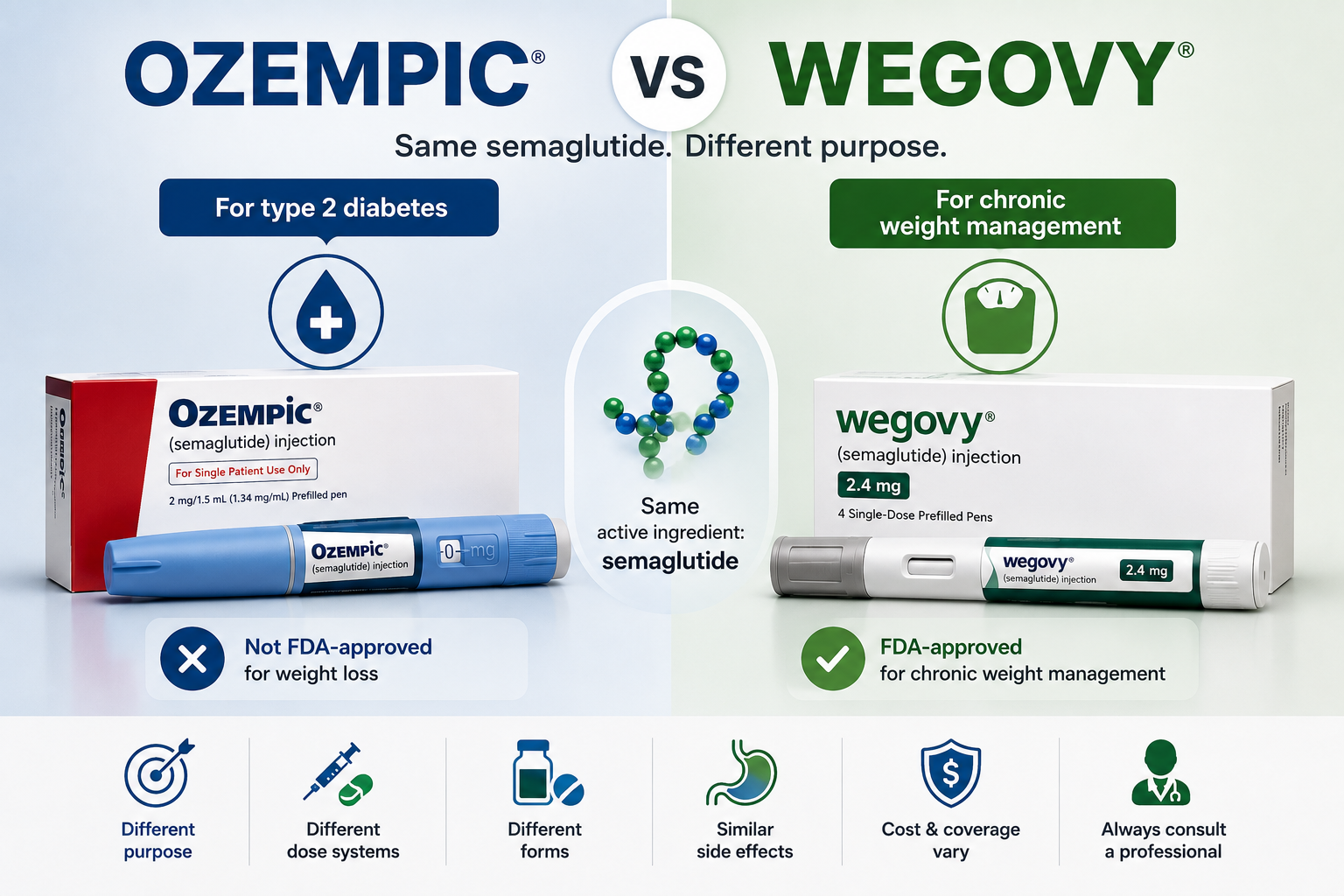
Ozempic vs Wegovy: Same Ingredient, Different Medical Context
Ozempic and Wegovy are easy to confuse because both contain semaglutide and both appear in the same GLP-1 conversation. But they are not the same prescription product. Ozempic is mainly tied to type 2 diabetes care and is not FDA-approved as a weight-loss medication, while Wegovy is specifically labeled around chronic weight management and obesity-related medical risk. This guide explains the difference in plain English — same active ingredient, different medical context, different label, and different expectations.
Ozempic vs Wegovy: Same Ingredient, Different Medical Context
Last updated: June 28, 2026
Ozempic and Wegovy are easy to confuse.
That is not because people are careless.
It is because both names sit inside the same loud conversation: semaglutide, GLP-1 medications, weight loss, diabetes, appetite, side effects, insurance, and online before-and-after stories.
But here is the part that matters:
They are not the same prescription product.
That difference changes how they are labeled, prescribed, compared, covered, reviewed, and misunderstood online.
A person searching “Wegovy vs Ozempic” is usually not asking a chemistry question. They are asking a real-world question:
If both contain semaglutide, why are there two names?
This guide explains the difference in plain English — same active ingredient, different product identity, different medical context, different labeling, and different expectations.
Sources used note: This article is based on current official Ozempic prescribing information, Ozempic tablets prescribing information, current official Wegovy prescribing information, FDA approval letters, and publicly available regulatory references. Because semaglutide product labels have changed recently, readers should always check current prescribing information and speak with a licensed healthcare professional before making medication decisions.
Quick Answer: Ozempic vs Wegovy
Ozempic and Wegovy both contain semaglutide.
That is the similarity.
The difference is the medical context.
Ozempic is a prescription semaglutide medication labeled for adults with type 2 diabetes and certain related cardiovascular and kidney-risk contexts.
Wegovy is a prescription semaglutide medication labeled for chronic weight management in specific patients and for certain cardiovascular-risk contexts in adults with obesity or overweight.
The cleanest way to say it is this:
- 1Same active ingredient.
- 2Different brand names.
- 3Different labels.
- 4Different dose systems.
- 5Different patient conversations.
- 6Different medical purpose.
Most importantly:
Wegovy is the semaglutide product specifically labeled around chronic weight management.
That is the heart of the comparison.
The Easiest Way to Understand the Difference
Think of semaglutide as the engine.
Ozempic and Wegovy are two different vehicles built around that engine.
The engine matters. But the vehicle still changes the purpose.
One vehicle may be built for city driving. Another may be built for heavy cargo. Same engine family, different design, different dashboard, different instructions, different job.
Ozempic and Wegovy work in a similar biological neighborhood because both contain semaglutide.
But they are not interchangeable names.
Ozempic is not simply “Wegovy for diabetes.”
Wegovy is not simply “Ozempic for weight loss.”
That shortcut sounds useful, then breaks down exactly where accuracy matters.
The more accurate version is this:
Ozempic and Wegovy share semaglutide, but they are different prescription medication products with different official labels and different medical purposes.
What Is Ozempic Used For?
Most people now hear the word Ozempic in weight-loss conversations.
But Ozempic did not enter the world as a weight-loss brand.
Ozempic is a prescription semaglutide medication used in a type 2 diabetes context. Official labeling for Ozempic injection describes use with diet and exercise to improve glycemic control in adults with type 2 diabetes. It also includes certain cardiovascular and kidney-related risk-reduction uses in adults with type 2 diabetes.
That matters because diabetes care is not only about the scale.
It is about blood sugar, A1C, cardiovascular risk, kidney risk, other medications, monitoring, and long-term follow-up.
So when someone says, “Ozempic is for weight loss,” they are skipping the main medical context that defines the medication.
Ozempic may appear in weight-loss stories because semaglutide can affect appetite and fullness.
But Ozempic is not FDA-approved as a weight-loss medication.
That sentence is important enough to repeat once:
Ozempic is discussed online for weight loss, but its official label is not the same as Wegovy’s weight-management label.
What Is Wegovy Used For?
Wegovy is also a prescription semaglutide medication.
But its label is different from Ozempic’s label.
Wegovy is FDA-labeled for chronic weight management in specific adults and certain pediatric patients, depending on product form and patient context. It is also labeled for reducing the risk of major cardiovascular events in adults with established cardiovascular disease and obesity or overweight.
Wegovy injection also has a specific FDA indication for adults with noncirrhotic metabolic dysfunction-associated steatohepatitis, or MASH, formerly known as NASH, with moderate to advanced liver fibrosis consistent with stages F2 to F3.
This MASH indication applies to Wegovy injection and was approved under accelerated approval. It is not a general statement about all Wegovy forms.
This is where the comparison becomes clearer:
Ozempic is the semaglutide product mainly tied to type 2 diabetes care.
Wegovy is the semaglutide product specifically built around chronic weight management and obesity-related medical risk.
Ozempic vs Wegovy for Weight Loss
People ask this because they want a simple winner.
But the honest answer is not “Ozempic wins” or “Wegovy wins.”
The honest answer is:
Wegovy is FDA-labeled for chronic weight management.
Ozempic is not FDA-approved as a weight-loss medication.
That does not mean nobody ever loses weight while taking Ozempic.
Many people talk about weight changes with Ozempic because semaglutide can affect appetite, fullness, and food intake. But online experience is not the same as official product labeling.
One person may say Ozempic helped them lose weight. Another may say Wegovy was prescribed for obesity. Another may compare results without mentioning diagnosis, dose, other medications, diet, side effects, adherence, insurance, or medical supervision.
Weight loss is not just the ingredient.
It is the patient, the product, the label, the dose system, the medical reason, the follow-up, and the response over time.
So if a page says “Ozempic vs Wegovy: which causes more weight loss?” and gives one universal answer, it is probably oversimplifying.
A better question is:
Which product is labeled for the medical context being treated?
Ozempic vs Wegovy Dosage: Why the Numbers Are Not Interchangeable
This is one of the most searched parts of the comparison — and one of the easiest to misunderstand.
People see different dose numbers and try to compare them like prices on a shelf.
That is not how prescription medication dosing works.
Ozempic and Wegovy have different dose systems because they are different products with different labels, treatment goals, patient groups, and administration instructions.
A dose is not just “how much semaglutide.”
A dose belongs to a product label.
That label explains the indication, form, escalation schedule, maintenance range, monitoring concerns, and safety information.
This is why “Wegovy vs Ozempic dose chart” searches can be risky.
A comparison can help readers understand why the labels differ.
It should not be used to switch, copy, adjust, or guess doses.
In plain English:
Do not treat Ozempic and Wegovy dose numbers as interchangeable.
They are not a DIY conversion chart.
Wegovy Pill vs Ozempic: Why This Search Is Getting More Common
For years, most people thought of Ozempic and Wegovy mainly as injections.
That comparison is now more complicated.
Current official labeling includes Wegovy injection and Wegovy tablets. Current official labeling also includes Ozempic injection and Ozempic tablets.
But that does not mean the products now have the same medical purpose.
Ozempic tablets are part of the type 2 diabetes context. FDA approval materials describe the name change from Rybelsus formulation R2 to Ozempic tablets, and the tablet label remains tied to adults with type 2 diabetes and certain cardiovascular-risk use in adults with type 2 diabetes.
Wegovy tablets are part of the adult weight-management and cardiovascular-risk context in adults with obesity or overweight.
So “pill vs injection” is not the real difference.
The real difference is still product identity, label, indication, dose system, and medical supervision.
A tablet form does not erase the difference between Ozempic and Wegovy.
It adds another layer to understand.
Ozempic vs Wegovy Side Effects
Because Ozempic and Wegovy both contain semaglutide, their side-effect conversations overlap.
That does not mean every person will have the same experience.
Commonly discussed GLP-1-related side effects include nausea, vomiting, diarrhea, constipation, abdominal discomfort, reduced appetite, and other digestive symptoms. Serious risks and warnings are described in official prescribing information and should be discussed with a healthcare professional.
The comparison point is simple:
Same active ingredient can mean similar types of side effects.
Different product context, dose system, patient group, and medical situation can change what people notice and how it is managed.
A person using Wegovy for chronic weight management may focus on appetite, fullness, digestive tolerance, and weight-loss progress.
A person using Ozempic for type 2 diabetes may also be tracking blood sugar, A1C, other diabetes medications, cardiovascular risk, kidney risk, and hypoglycemia risk when used with certain other drugs.
Ozempic vs Wegovy Cost: Why the Answer Is Complicated
Cost is one of the biggest real-world differences people care about.
It is also one of the hardest to answer cleanly.
The price someone sees can depend on:
- 1insurance coverage;
- 2diagnosis;
- 3prior authorization;
- 4pharmacy benefit rules;
- 5cash price;
- 6manufacturer savings programs;
- 7country;
- 8formulation;
- 9pharmacy;
- 10supply;
- 11whether the medication is being used within the covered medical indication.
That is why one person may say Ozempic is cheaper, another may say Wegovy is cheaper, and a third person may say neither is affordable.
All three can be telling the truth from their own situation.
The better way to think about cost is not:
Which one is cheaper?
The better question is:
Which one is covered for the medical context being treated?
For many people, coverage is not based only on the molecule semaglutide. It may be based on diagnosis, plan rules, documentation, prior authorization, and whether the product matches the reason it was prescribed.
So a cost comparison without insurance context can become misleading fast.
Ingredients in Wegovy vs Ozempic
The active ingredient in both Ozempic and Wegovy is semaglutide.
That is why the two medications are compared so often.
But ingredients are only the first layer of the comparison. The product label, form, indication, dose system, instructions, and medical context still matter.
What About Mounjaro and Zepbound?
Many searches add Mounjaro or Zepbound to the comparison.
That is understandable, but it changes the topic.
Ozempic and Wegovy both contain semaglutide.
Mounjaro and Zepbound are associated with tirzepatide, not semaglutide.
That means “Ozempic vs Wegovy” is mostly a same-ingredient, different-context comparison.
“Ozempic vs Wegovy vs Mounjaro vs Zepbound” is a broader GLP-1 and GIP medication comparison.
That deserves its own guide.
For this article, the key point is simple:
Ozempic vs Wegovy is about two semaglutide brands.
Adding Mounjaro or Zepbound brings in a different active ingredient conversation.
Bottom Line: Which Is Better, Ozempic or Wegovy?
This is the question people want answered.
But “better” is too vague.
Better for what?
- 1Blood sugar control?
- 2Chronic weight management?
- 3Cardiovascular risk reduction?
- 4Kidney-related risk in type 2 diabetes?
- 5Obesity-related care?
- 6Insurance coverage?
- 7Side-effect tolerance?
- 8Pill preference?
- 9Injection preference?
- 10Medical history?
A medication is not better in the abstract. It is better or worse for a specific patient, diagnosis, risk profile, goal, and treatment plan.
Ozempic vs Wegovy is not really a question of whether the active ingredient is the same.
It is.
Both contain semaglutide.
The real question is what the semaglutide product is being used for.
Ozempic is mainly a type 2 diabetes medication context and is not FDA-approved as a weight-loss medication.
Wegovy is the semaglutide product specifically labeled around chronic weight management and obesity-related medical risk.
So when you see “Wegovy vs Ozempic,” do not stop at “same ingredient.”
Ask what context matters: diabetes, chronic weight management, cardiovascular risk, kidney risk, cost, side effects, formulation, coverage, and medical supervision.
A licensed healthcare professional should decide which, if either, fits a person’s situation.
FAQ
Frequently Asked Questions
Not exactly. Wegovy and Ozempic both contain semaglutide, but they are different prescription medication products with different labels, dose systems, and medical contexts.
Yes. Both contain semaglutide.
The main difference is medical context. Ozempic is mainly tied to type 2 diabetes care and certain related cardiovascular and kidney-risk uses. Wegovy is specifically labeled around chronic weight management and obesity-related medical risk.
Wegovy is FDA-labeled for chronic weight management. Ozempic is not FDA-approved as a weight-loss medication. Personal treatment decisions depend on diagnosis, medical history, treatment goals, side effects, coverage, and clinician judgment.
No. Ozempic is discussed widely in weight-loss contexts, but Ozempic is not FDA-approved as a weight-loss medication.
No. They have different dose systems and product labels. Dose numbers should not be compared or converted casually.
Yes. Current official labeling includes Wegovy tablets as well as Wegovy injection.
Yes. Current official labeling includes Ozempic tablets as well as Ozempic injection. Ozempic tablets belong to the type 2 diabetes context, not a weight-loss label.
Because both contain semaglutide, side-effect discussions overlap. But dose system, product context, patient group, and medical situation can affect individual experience.
There is no single answer. Cost depends on insurance, diagnosis, coverage rules, pharmacy, country, savings programs, formulation, and supply.
That is a broader comparison. Ozempic and Wegovy contain semaglutide, while Mounjaro and Zepbound are associated with tirzepatide. That topic deserves its own guide.
No. Ozempic.review provides educational information only. Personal medication decisions should be made with a licensed healthcare professional.
Sources
- 1Ozempic Prescribing Information — official information on Ozempic injection, semaglutide, type 2 diabetes indications, cardiovascular-risk use, kidney-risk use, dosage forms, and safety information.
- 2Ozempic Tablets Prescribing Information — official information on Ozempic tablets, semaglutide tablets, type 2 diabetes indication, cardiovascular-risk use, dosage forms, and safety information.
- 3FDA Approval Letter for Ozempic Tablets — official information on the change from Rybelsus formulation R2 to Ozempic tablets.
- 4Wegovy Prescribing Information — official information on Wegovy injection and Wegovy tablets, chronic weight-management indications, cardiovascular-risk use, Wegovy injection MASH indication, dosage forms, and safety information.
- 5FDA / regulatory references — public drug labeling and safety-related information.
Editorial Team
Comments (0)
Be the first to comment on this article.
