Ozempic Hands, Feet, and Neck: What the Viral Terms Really Describe
Ozempic hands, feet and neck are slang, not diagnoses. See the real fat and muscle loss data, the 3 meanings of Ozempic feet, and when to see a doctor.
Written by Dr. Sheri Tomas. Updated November 3, 2026.
"Ozempic hands" is a social-media term, not a medical diagnosis: it describes hands that look thinner, bonier or more wrinkled after someone loses weight on a GLP-1 medicine such as Ozempic (semaglutide). "Ozempic feet" and "Ozempic neck" are newer cousins of the better-known "Ozempic face." None of the three appears in the FDA prescribing information for Ozempic, and no study has measured fat changes in the hands, feet or neck of people taking these drugs. What the evidence does show is that losing a lot of weight means losing fat everywhere, including in places that had little to start with, plus some lean tissue such as muscle. That makes veins, tendons and loose skin easier to see. This page explains what each term describes, the real body-composition numbers from the big trials, the three different things people mean by "Ozempic feet," why foot symptoms deserve extra care if you have diabetes, and what actually helps.
Ozempic Hands, Feet, and Neck: The Short Answer
- 1Not medical terms: none of the three is a diagnosis, and none is listed on the FDA label for Ozempic (as of November 2026).
- 2Likely cause: loss of fat and some lean tissue during rapid, large weight loss, not a direct effect of the drug on skin.
- 3The numbers: in trial body scans, roughly a quarter to over a third of the weight lost was lean mass rather than fat.
- 4"Ozempic feet" means three different things: looser skin, heel pain from a thinner fat pad, or nerve symptoms such as tingling.
- 5Diabetes: new numbness, burning, a wound or an ulcer on the foot needs prompt medical attention.
- 6What helps: enough protein, strength training and a steady pace of weight loss; you do not need a cosmetic procedure to stay healthy.
What Are Ozempic Hands?
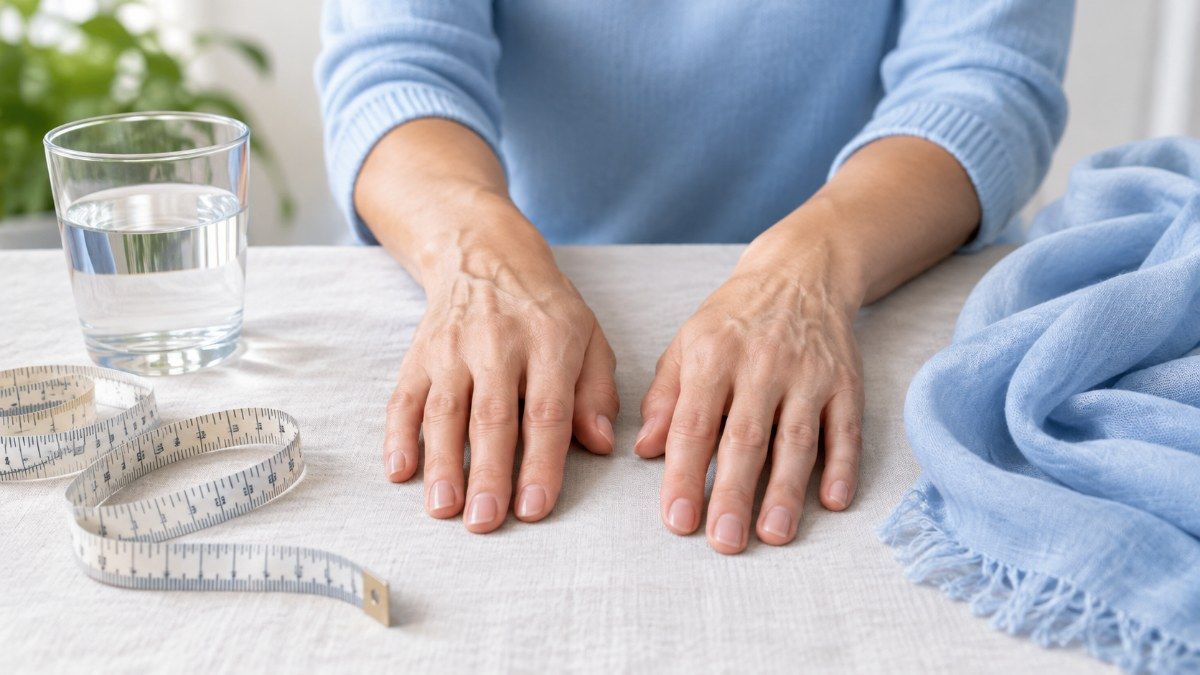
"Ozempic hands" is the label people use online for hands that look older, thinner or more wrinkled after starting a GLP-1 medicine. Health publishers that cover the trend agree that it is not a medical condition and put it down to fat loss. The explanation is simple anatomy. The backs of the hands have very little fat under the skin to begin with. Scott Isaacs, president of the American Association of Clinical Endocrinology (AACE), has explained that when that small amount of volume is lost, "veins, tendons, and bones become more pronounced." The same happens with age.
We found no study that has actually measured hand fat or hand skin in people taking semaglutide or tirzepatide. So any claim that Ozempic "ages your hands" is an inference from overall weight loss, not a measured effect. If you want to see how overall changes typically look over months of treatment, our Ozempic before and after guide walks through realistic timelines.
What Does Ozempic Feet Mean?
This is the most confusing term, because people use it for three different things.
- 1Appearance: the AACE defines "Ozempic feet" as sagging skin and reduced fat padding in the feet that can occur with rapid weight loss, and stresses that it is not limited to GLP-1 medicines.
- 2Heel pain: Rock Positano, a podiatrist at the Hospital for Special Surgery in New York, uses the term for thinning of the heel fat pad, the natural cushion under the heel bone. He says he has seen the same pattern after bariatric surgery, though he gives no numbers on how often it happens.
- 3Nerve symptoms: some podiatry practices use the term for tingling, burning or numbness. This is a different problem from fat loss and is covered in its own section below.
The first two are about tissue changing as weight comes off. The third is about nerves, and for people with diabetes it matters most.
What Is Ozempic Neck?
"Ozempic neck" describes sagging skin, lost volume and more visible platysmal bands (the vertical cords of the thin muscle at the front of the neck) after weight loss. Clinical writers who have covered it note that it is not a clinical term or diagnosis and attribute it to the weight loss itself, not to the drug. As with the hands, we found no study that measured neck fat or skin in people on GLP-1 medicines. Much of the online coverage of "Ozempic neck" moves quickly to fillers, lasers and surgery. Those are personal choices, not treatments for a medical problem; these neck changes are not dangerous.
Where Did These Terms Come From?
They grew out of "Ozempic face." The New York Times reported in January 2023 that New York dermatologist Paul Jarrod Frank had "dubbed the condition 'Ozempic face'," and the phrase was popularized from there; an earlier magazine use appeared in late 2022. A 2026 analysis in the Journal of Cosmetic Dermatology found that Google searches for "Ozempic face" rose 4,600% between November 2021 and December 2024. "Hands," "feet" and "neck" followed as social-media spin-offs. We could not find who first used any of them. Our Ozempic face guide covers the facial version in detail.
Are Ozempic Hands, Feet, or Neck Official Side Effects?
No. The FDA prescribing information for Ozempic, revised in May 2026, does not mention any of these terms. Two related items do appear, but only under postmarketing reports, meaning problems reported after the drug went on sale, where the true frequency cannot be estimated: dysesthesia (abnormal skin sensations such as tingling or burning) and alopecia (hair loss). The label does not list peripheral neuropathy. In other words, the appearance changes behind "Ozempic hands" and "Ozempic neck" are not drug side effects in the regulatory sense, while the sensation side of "Ozempic feet" overlaps with something regulators do track. For a wider look at the label's real risks, see is Ozempic safe.
Is It the Drug or the Weight Loss?
The evidence points to the weight loss. AACE experts Scott Isaacs and Spencer Nadolsky have said these changes can happen with any significant, rapid weight loss, including after bariatric surgery or a strict diet. GLP-1 medicines work mainly by reducing appetite, as explained in how Ozempic works, not by acting on skin.
The body-scan data support this. In the SURMOUNT-1 trial of tirzepatide, the ratio of fat to lean tissue lost was about 3 to 1, which the researchers described as similar to what is seen with placebo and lifestyle programs. For the face, a small study of 20 patients reported, according to a secondary summary, that midfacial volume fell about 9%, or roughly 7% for every 10 kg of weight lost, with the loss in the superficial fat layer tracking how much weight people lost. That study looked back at CT and MRI scans taken for other reasons and had no comparison group, so its figures should be treated as early and uncertain. A 2025 systematic review of the "Ozempic face" literature rated the overall evidence as low level.
How Much Muscle Do You Lose on Semaglutide or Tirzepatide?
Body composition is measured with DXA scans, the same low-dose X-ray used for bone density, which split weight into fat and lean mass. "Lean mass" is everything that is not fat: muscle, but also water, organs and bone. That matters, because it means lean-mass loss overstates muscle loss.
Body composition in two large GLP-1 trials (DXA substudies)
People scanned
140
160
Length
68 weeks
72 weeks
Total body weight change
-15.0% (placebo -3.6%)
Not reported in the substudy summary we used
Change in fat mass
-19.3%
-33.9% (placebo -8.2%)
Change in lean mass
-9.7%
-10.9% (placebo -2.6%)
Share of weight lost that was lean mass
About 38% (5.3 of 13.6 kg)
About 26% (about 74% fat)
Proportion of body that is lean
Rose 3.0 percentage points
Fat-to-lean loss ratio similar to placebo and lifestyle programs
Two points stand out. First, people lost far more fat than lean tissue, in percentage terms, on both drugs, so body composition generally improved. Second, a joint 2025 nutrition advisory from four obesity and lifestyle medicine societies estimated that only about 20% of the weight lost is actually muscle, lower than the lean-mass figures, because lean mass includes water and other tissue. The comparison between the two drugs is covered in Ozempic vs Mounjaro, and the higher weight-loss dose of semaglutide in Ozempic vs Wegovy.
What Each Term Describes and How Strong the Evidence Is
Viral GLP-1 body terms compared
Ozempic hands
Thinner, bonier, more wrinkled-looking hands
Loss of the small amount of fat under the skin
No hand-specific studies; expert opinion
Ozempic feet
Looser skin, thinner heel fat pad, or tingling and burning
Fat pad loss with weight loss; separately, nerve sensations
Expert opinion; dysesthesia in postmarketing reports and trial data
Ozempic neck
Sagging skin, lost volume, visible neck bands
Skin laxity after weight loss
No neck-specific studies; expert opinion
Ozempic face
Hollowed, older-looking face
Loss of facial fat compartments
One 20-patient scan study (no control group) and a low-level review
Can Ozempic Cause Nerve Problems in the Feet?
This is the part of "Ozempic feet" that deserves real attention. Dysesthesia, meaning unpleasant tingling, burning or altered skin sensation, is listed on the US Ozempic label only as a postmarketing report. In April 2026 the UK product information for Ozempic and Rybelsus added dysaesthesia, and in the STEP UP T2D trial it was reported by 18.9% of people (58 of 307) on a 7.2 mg semaglutide dose versus 4.9% (5 of 103) on 2.4 mg. Those doses are higher than standard Ozempic doses for diabetes, so the figures do not translate directly to everyday use.
There is a second, older issue for people with diabetes. When blood sugar is brought down very quickly, a painful nerve condition called treatment-induced neuropathy of diabetes can occur. A secondary summary of a 2015 study of 954 patients reports that an HbA1c drop of more than 2 points within 3 months was linked to a greater than 10% risk of acute painful neuropathy. That study was not about GLP-1 medicines specifically, and we could not check its figures against the original paper, but it is a reason to tell your doctor promptly about new foot pain after a big improvement in blood sugar.
The longer-term foot picture is reassuring. In a matched study of 361,480 people with diabetes published in Diabetes Care in 2025, GLP-1 medicines were associated with a lower risk of amputation above the ankle than SGLT2 inhibitors (hazard ratio 0.77). Observational data cannot prove cause and effect, but they do not suggest harm to the diabetic foot. More on diabetes use is in Ozempic for diabetes.
What Actually Helps?
Because these changes come from losing fat and some lean tissue, the useful steps are the ones that protect lean mass and keep the pace of loss reasonable. The 2025 joint advisory from the American College of Lifestyle Medicine, the American Society for Nutrition, the Obesity Medicine Association and The Obesity Society recommends:
- 1Protein: about 1.2 to 1.6 g per kg of body weight a day during active weight loss, or roughly 80 to 120 g a day, compared with the standard 0.8 g/kg; avoid staying at 2 g/kg or more for long periods.
- 2Strength training: at least three sessions a week, alongside 150 minutes or more of aerobic activity a week.
- 3A steady pace: the CDC describes 1 to 2 pounds a week as a healthy rate of weight loss; faster loss is more likely to leave loose skin.
- 4Foot care: supportive, cushioned shoes can ease heel pain from a thinner fat pad, and a podiatrist can advise if it persists.
A structured start is outlined in our 6-week Ozempic plan. Some volume may return if weight comes back, which is discussed in what happens when you stop taking Ozempic, but stopping a medicine for cosmetic reasons is a decision to make with your prescriber.
When to Talk to Your Doctor
- 1New numbness, tingling, burning or shooting pain in the feet or hands
- 2Any foot wound, blister, color change or ulcer, especially if you have diabetes
- 3Heel or foot pain that lasts more than a few weeks or changes how you walk
- 4Swelling, pain or skin changes, which AACE advises reporting
- 5Weight loss much faster than 1 to 2 pounds a week, or difficulty eating enough protein
Questions to Ask Your Doctor
- 1Is my rate of weight loss reasonable, and should my dose be adjusted?
- 2How much protein should I aim for, given my kidney function and weight?
- 3Should I see a podiatrist or have a foot exam, given my diabetes status?
- 4Could my foot symptoms be related to how quickly my blood sugar has come down?
- 5Would a dietitian or physical therapist help me keep muscle during treatment?
The Bottom Line
Ozempic hands, Ozempic feet and Ozempic neck are viral labels, not diagnoses, and none appears on the Ozempic label. The look they describe is what large, fast weight loss does to areas with little fat and to skin that has been stretched, and trial scans show the same broad fat-to-lean pattern seen with other weight-loss methods. The exception worth taking seriously is foot symptoms involving nerves: tingling, burning or numbness, and any foot wound in someone with diabetes, should be checked by a clinician. Protein, strength training and a steady pace are the evidence-based ways to protect your body during treatment.
FAQ
There are no studies on this. Lost fat can return if weight is regained, and skin elasticity varies with age and how much weight was lost. Slower weight loss and strength training may limit the change.
The same changes can happen with any large weight loss, including on Wegovy, which contains the same drug as Ozempic, and Mounjaro (tirzepatide). Experts link them to weight loss, not to one brand.
There is no evidence that it does. The changes are attributed to loss of fat and lean tissue under the skin, and they also occur after surgery or dieting.
Protein and strength training help preserve lean mass during weight loss. No study shows they prevent visible changes in the hands or neck, but they are recommended for everyone on GLP-1 treatment.
Abnormal sensations such as tingling are reported with semaglutide, but they should not be ignored. Tell your doctor, and seek prompt care if you have diabetes, numbness or a foot wound.
Experts link these changes to rapid weight loss, and the CDC suggests 1 to 2 pounds a week as a healthy pace. It has not been tested specifically for feet.
Sources
- 1Novo Nordisk. Ozempic (semaglutide) injection prescribing information, revised 05/2026, US Food and Drug Administration, 2026
- 2Wilding JPH et al. STEP 1 body composition substudy abstract, Newswise, 2021
- 3Look et al. SURMOUNT-1 body composition (DXA) analysis of tirzepatide, Diabetes, Obesity and Metabolism, 2025
- 4ACLM, ASN, OMA, TOS. Nutritional priorities to support GLP-1 therapy for obesity: a joint advisory, American Journal of Clinical Nutrition, 2025
- 5The Obesity Society. Press release on the joint GLP-1 nutrition advisory, The Obesity Society, 2025
- 6Hong et al. GLP-1 receptor agonists and amputation risk: summary of a national cohort study, Diabetes Care (via DiabeticFootOnline), 2025
- 7Report on dysaesthesia added to UK Ozempic and Rybelsus product information, The Pharmaceutical Journal, 2026
- 8AACE. What to know about Ozempic feet, American Association of Clinical Endocrinology, 2025
- 9What is Ozempic feet? Dr. Rock Positano explains the link between rapid weight loss and heel pain, Hospital for Special Surgery, 2026
- 10What are Ozempic feet? (AACE experts quoted), Hello!, 2025
- 11Clinicians see intersection of weight loss and facial aging (McCarthy et al.), Dermatology Times, 2026
- 12Weight loss and aging: the rise of Ozempic face, Advisory Board, 2023
This article summarizes published research and expert commentary for general information and is not a substitute for medical advice. The STEP 1 and SURMOUNT-1 trials were funded by the drug manufacturers, Novo Nordisk and Eli Lilly.

Dr. Sheri Tomas
Author
Comments (0)
Be the first to comment on this article.
More articles