
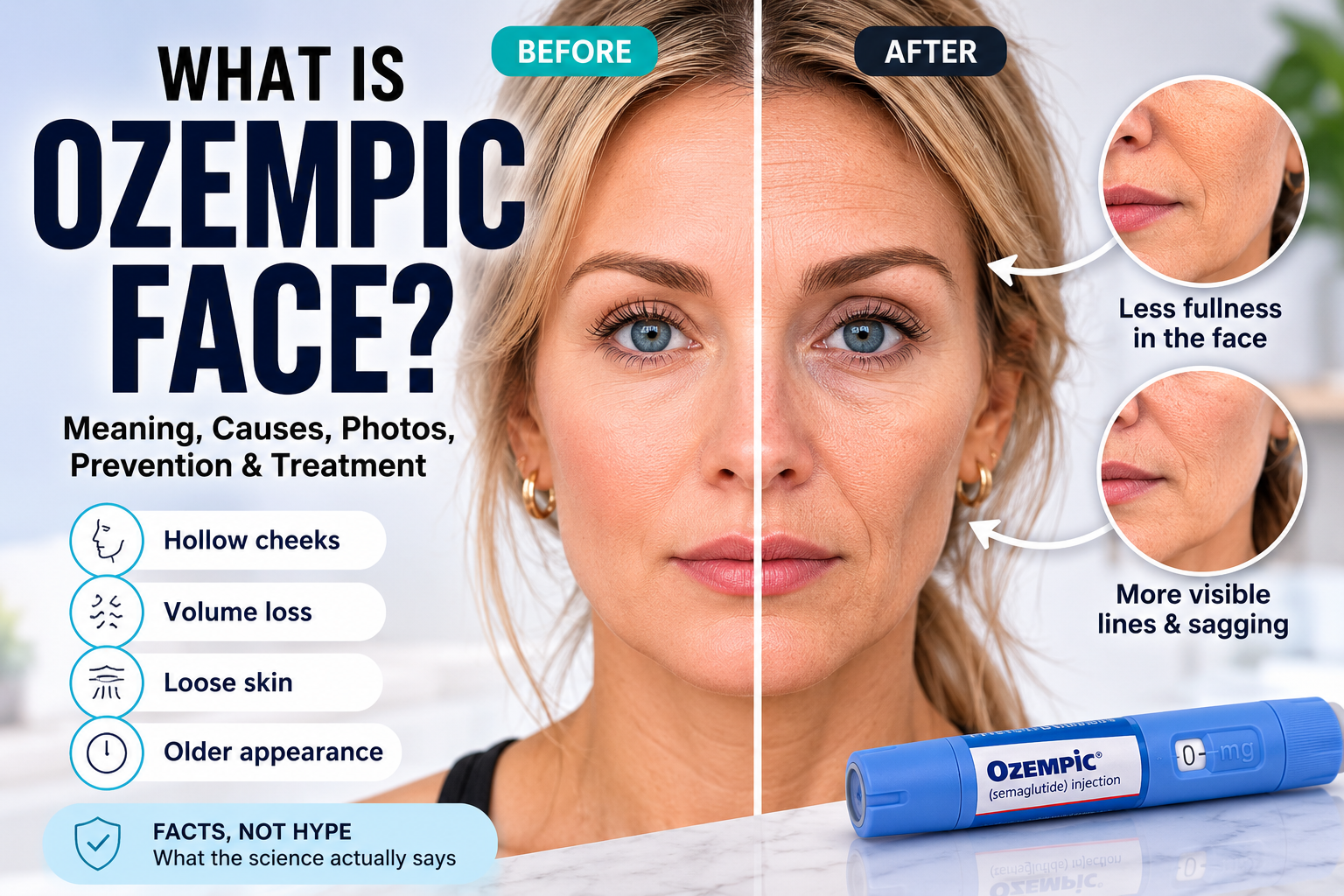
What Is Ozempic Face? The Viral Phrase Explained
“Ozempic face” sounds like a medical side effect, but the phrase is mostly a viral label for facial changes people may notice after significant or rapid weight loss. It usually refers to less facial fullness, hollow-looking cheeks, looser skin, deeper lines, or an older-looking appearance. This guide explains what Ozempic face means, what it can look like, why weight loss can change the face, why before-and-after photos and celebrity guesses can mislead, and what to know about prevention, fillers, skincare, and treatment claims.
What Is Ozempic Face? The Viral Phrase Explained
Last updated: June 28, 2026
“Ozempic face” sounds like a side effect with one clear cause.
It is not that simple.
Most of what people call Ozempic face is really the face reacting to weight loss — especially when that weight loss is fast, significant, or happens when the skin has less elasticity.
That does not mean people are imagining it.
Facial changes after major weight loss can be real. Cheeks can look less full. Lines can look sharper. Skin can look looser. A face can look older, thinner, or more tired than someone expected.
But the viral phrase can make the issue sound more mysterious than it is.
This guide explains what “Ozempic face” means, what it can look like, why people blame Ozempic, why before-and-after photos can mislead, whether it can happen with Wegovy, Mounjaro, or Zepbound, and what to know before trusting treatment, filler, skincare, or prevention claims.
Sources used note: This article is based on official prescribing information, medical references, dermatology and weight-management commentary, and public health sources. It is educational only and is not medical advice.
Quick Answer: What Is Ozempic Face?
“Ozempic face” is a viral phrase people use to describe facial changes that may appear after significant or rapid weight loss.
People usually mean:
- 1hollow-looking cheeks;
- 2less facial fullness;
- 3deeper lines or wrinkles;
- 4looser skin;
- 5a sharper jawline or thinner face;
- 6a tired, gaunt, or older-looking appearance.
It is not a formal medical diagnosis.
It is not unique to Ozempic.
It is not proof that someone took Ozempic.
And it is not always caused by the medication itself.
In many cases, the phrase describes facial volume loss that can happen when someone loses weight. That weight loss may happen while using Ozempic, Wegovy, Mounjaro, Zepbound, another GLP-1-related medication, or no medication at all.
The simple version is this:
- 1Ozempic face is a viral name for facial changes after weight loss.
- 2The face is not being targeted.
- 3Facial volume is changing.
The Phrase Sounds Medical. It Is Mostly Viral.
The phrase “Ozempic face” sounds official.
That is part of the problem.
It makes facial changes sound like a specific disease or a proven side effect with one simple cause. But the term mostly comes from media, social platforms, beauty commentary, and before-and-after culture.
That does not mean the appearance change is fake.
It means the label can be misleading.
A person can lose fat from the face during weight loss. That can change how the cheeks, jawline, under-eye area, temples, and neck look. If the change happens quickly, the face may not have time to adapt in a way that looks smooth or natural.
Calling it “Ozempic face” can hide the bigger point:
This can happen after weight loss from many causes.
It is not a special facial condition that only belongs to one brand.
What Does Ozempic Face Look Like?
The most searched question is also the most visual one:
What does Ozempic face look like?
People usually describe:
- 1sunken cheeks;
- 2hollow areas under the eyes;
- 3sharper facial angles;
- 4more visible wrinkles;
- 5looser skin around the jawline or neck;
- 6less plumpness in the midface;
- 7a tired or older-looking appearance.
But there is no single official look.
One person may notice subtle cheek hollowing.
Another may notice deeper smile lines.
Another may notice loose skin under the chin.
Another may simply look thinner.
The problem with the viral phrase is that it turns many normal weight-loss-related changes into one scary label.
- 1A thinner face is not automatically “Ozempic face.”
- 2Aging is not automatically “Ozempic face.”
- 3Bad lighting is not “Ozempic face.”
- 4A filtered before-and-after post is not medical evidence.
What Causes Ozempic Face?
The main cause people are usually noticing is facial volume loss.
Your face has fat pads under the skin. They help give the face its shape, softness, and fullness. When someone loses a significant amount of weight, the body can lose fat from many places, including the face.
Ozempic does not specifically target the face.
The face changes because weight loss can reduce facial volume.
Several factors can influence how noticeable the change is:
- 1how much weight was lost;
- 2how quickly the weight was lost;
- 3age;
- 4skin elasticity;
- 5genetics;
- 6baseline facial fullness;
- 7hydration;
- 8nutrition;
- 9muscle loss;
- 10sun damage;
- 11smoking history;
- 12natural facial structure.
Speed matters because skin and soft tissue may not adapt as smoothly when weight changes quickly.
Age matters because skin usually becomes less elastic over time.
Baseline facial volume matters because someone with naturally fuller cheeks may notice a different kind of change than someone who already had a leaner face.
That is why two people can lose the same amount of weight and look very different afterward.
Why People Blame Ozempic
People blame Ozempic because the timing is easy to see.
- 1Someone starts a medication.
- 2They lose weight.
- 3Their face changes.
- 4The internet gives the change a name.
That name spreads faster than the explanation.
Ozempic can be associated with weight loss in some people, and facial changes may become more visible when body weight changes. But that is not the same as saying the medication directly attacks facial fat.
A better way to understand it is:
- 1Ozempic may contribute to weight loss in some people.
- 2Weight loss may reduce facial volume.
- 3Reduced facial volume may change the way the face looks.
That chain is very different from “Ozempic ruins your face.”
The viral version is shorter.
The accurate version is more useful.
Is Ozempic Face a Real Side Effect?
This depends on what you mean by “real.”
If you mean, “Can people really notice facial hollowing, loose skin, or an older-looking face after weight loss?” — yes, that can happen.
If you mean, “Is Ozempic face an official medical diagnosis?” — no.
If you mean, “Does Ozempic specifically target fat in the face?” — no.
If you mean, “Is every older-looking celebrity photo proof of Ozempic use?” — absolutely not.
The safest wording is:
“Ozempic face” is a real viral phrase for a real visual concern, but it is not a precise medical diagnosis and it is not unique to Ozempic.
That distinction matters.
It keeps the article honest without dismissing what people may actually be seeing in the mirror.
For digestive and safety concerns connected to Ozempic, see the Ozempic Side Effects guide.
Ozempic Face Before-and-After Photos and Celebrity Searches: Why Images Can Mislead
A before-and-after photo can show a change.
It cannot show the reason for the change.
This is one of the biggest problems with Ozempic face content.
A photo does not tell you:
- 1whether the person took Ozempic;
- 2whether they took Wegovy, Mounjaro, Zepbound, or another medication;
- 3how much weight they lost;
- 4how quickly they lost it;
- 5whether the photo was filtered;
- 6whether lighting changed;
- 7whether makeup changed;
- 8whether the angle changed;
- 9whether the person was dehydrated;
- 10whether they were tired or ill;
- 11whether they had cosmetic treatment;
- 12whether normal aging was involved.
That is why “Ozempic face before and after” searches can be misleading.
They feel convincing because faces are emotional. We react quickly to visible change.
But photos are not medical records.
Celebrity searches make the problem worse.
A celebrity photo cannot tell you someone’s diagnosis, medication history, health status, cosmetic treatment history, stress level, weight-change timeline, lighting, editing, or private medical decisions.
Guessing from a face is not evidence.
It is speculation.
Be careful with posts that say:
- 1“Everyone gets Ozempic face.”
- 2“This celebrity definitely has it.”
- 3“This cream fixes Ozempic face.”
- 4“This supplement prevents it.”
- 5“Fillers are always the answer.”
- 6“If your face changes, the medication is dangerous.”
These statements are too simple.
Some people may notice facial changes.
Some may not.
Some may benefit from professional evaluation.
Some may need medical help because the issue is connected to side effects, poor nutrition, dehydration, or rapid weight loss.
The face is visible.
That makes the topic emotional.
But emotional does not mean simple.
Can Ozempic Face Happen With Wegovy, Mounjaro, or Zepbound?
Facial volume loss is not unique to Ozempic.
That is the key point.
Wegovy contains semaglutide, the same active ingredient used in Ozempic, but it belongs to a different medical context.
Mounjaro and Zepbound contain tirzepatide, which acts on both GIP and GLP-1 receptors.
People may discuss these medications together because they can be associated with weight change in different medical contexts.
But the face issue is not about one brand magically changing the face.
It is about weight loss and facial volume.
If significant or rapid weight loss happens with another medication, a diet program, surgery, illness, or lifestyle change, the face can also change.
That is why some people now use phrases like:
- 1Wegovy face;
- 2Mounjaro face;
- 3Zepbound face;
- 4GLP-1 face;
- 5semaglutide face.
The names change.
The basic issue is similar:
facial volume can change when body weight changes.
For the broader GLP-1 medication context, see the What Is GLP-1 guide.
Ozempic Face vs Normal Weight-Loss Face Changes
The phrase “Ozempic face” can make a normal weight-loss effect sound abnormal.
Sometimes the face simply looks different because the person is smaller.
When body weight changes, the face often changes too.
- 1Cheeks may narrow.
- 2The jawline may become sharper.
- 3The neck may look different.
- 4The under-eye area may appear more visible.
That does not automatically mean something went wrong.
The concern usually starts when the change feels too fast, too hollow, too aged, or different from what the person expected.
That emotional part matters.
Someone may be happy with weight loss but surprised by their face.
That does not make them vain.
Faces are personal. They are part of identity. A visible change can feel strange even when the overall health goal is positive.
Why Age, Skin Elasticity, and Speed of Weight Loss Matter
The same weight loss can look different at different ages.
That is because skin elasticity changes over time.
Younger skin may bounce back more easily after volume changes. Older skin may not tighten as quickly or as fully. Genetics, sun exposure, smoking, hydration, nutrition, and collagen changes can also affect how the skin responds.
Speed matters too.
When weight loss is gradual, the skin and soft tissue may have more time to adjust.
When weight loss is fast, facial volume may drop before the skin visually adapts.
That is why rapid weight loss can make the face look more hollow or loose.
The medication name gets the headline.
But age, skin, speed, and volume often explain the appearance.
Can You Prevent Ozempic Face?
No one can guarantee that facial changes will not happen during major weight loss.
That is the honest answer.
But some choices may help reduce the chance of a harsh or sudden appearance change.
The first is medical supervision.
A licensed healthcare professional can help set realistic goals, monitor side effects, and avoid unsafe weight-loss patterns.
Other helpful basics may include:
- 1avoiding crash dieting;
- 2losing weight at a medically appropriate pace;
- 3getting enough protein;
- 4staying hydrated;
- 5including resistance training when appropriate;
- 6protecting skin from sun damage;
- 7not ignoring nutrition when appetite drops;
- 8talking to a clinician if weight loss feels too fast;
- 9discussing concerns early instead of waiting until the change feels severe.
These steps are not a guarantee.
They are common-sense ways to support the body during weight change.
The goal is not just to lose weight.
The goal is to stay medically well while the body changes.
Can Ozempic Face Be Fixed or Reversed?
The word “fix” can be misleading.
Some facial changes may soften with time, weight stabilization, better hydration, improved nutrition, or changes in overall health. Other changes may persist, especially if they involve skin laxity or significant volume loss.
What helps depends on what is actually happening.
- 1Is the issue facial fat loss?
- 2Loose skin?
- 3Dehydration?
- 4Poor nutrition?
- 5Muscle loss?
- 6Normal aging?
- 7A skin condition?
- 8Something unrelated to weight loss?
Those are different problems.
They do not all have the same solution.
That is why “how to fix Ozempic face,” “how to reverse Ozempic face,” and “is Ozempic face permanent?” should not be answered with one product, one serum, or one procedure.
Sometimes appearance changes improve with time.
Sometimes they do not fully return to how they looked before.
If the face looks more hollow partly because of dehydration, poor intake, or rapid weight change, improvement may be possible when the body stabilizes and nutrition improves.
If the change is mostly from lost facial fat or reduced skin elasticity, it may not fully reverse on its own.
If weight is regained, some facial fullness may return, but weight regain is not a recommended cosmetic strategy and should not be treated casually.
The better question is not simply:
Does Ozempic face go away?
The better question is:
What is causing the facial change in this person?
That answer determines what may or may not improve.
Dermal Fillers, Skincare, and Procedures: What to Know
Dermal fillers are one of the biggest search topics around Ozempic face.
That makes sense.
If the issue is lost volume, people naturally look for ways to restore volume.
But fillers are medical aesthetic procedures, not casual beauty hacks.
They can have risks, complications, costs, and limitations. They also need a qualified professional who understands facial anatomy.
People also search for:
- 1microneedling;
- 2skin tightening;
- 3skincare;
- 4collagen treatments;
- 5biostimulators;
- 6fat grafting;
- 7laser treatments;
- 8face or neck procedures.
Some of these may be discussed with professionals in appropriate cases.
None should be treated as a universal answer.
Skincare may help skin quality, but it cannot fully replace lost facial volume.
Fillers may help volume in selected cases, but they are not right for everyone.
Procedures may be options for some people, but they require individualized evaluation.
The best first step is not buying a product.
It is understanding what changed.
When to Talk to a Doctor or Dermatology Professional
A facial change alone is not always a medical emergency.
But some situations deserve professional attention.
Talk to a healthcare professional if:
- 1weight loss is very rapid;
- 2you cannot eat enough;
- 3you are vomiting often;
- 4you feel weak, dizzy, or dehydrated;
- 5you have severe or persistent digestive symptoms;
- 6you are worried about medication side effects;
- 7you are thinking about stopping or changing medication;
- 8you are using compounded or online products;
- 9the facial change is sudden or paired with other symptoms;
- 10the appearance change is causing major distress.
For appearance-specific concerns, a dermatologist, plastic surgeon, or qualified aesthetic medical professional may help explain whether the issue is volume loss, skin laxity, hydration, skin quality, or something else.
Medication changes should go through the prescribing clinician.
Bottom Line
“Ozempic face” is a viral phrase, not a formal diagnosis.
It usually refers to facial changes people may notice after significant or rapid weight loss: hollow cheeks, less facial fullness, looser skin, deeper lines, or an older-looking appearance.
Ozempic does not specifically target the face.
The face changes because weight loss can reduce facial volume.
That can happen with Ozempic, Wegovy, Mounjaro, Zepbound, other weight-loss methods, or weight loss without medication.
Before trusting before-and-after photos, celebrity guesses, filler ads, skincare promises, or Reddit stories, remember the clean version:
Ozempic face is mostly about facial volume change after weight loss.
The viral name is simple.
The real explanation is more nuanced.
FAQ
Frequently Asked Questions
Ozempic face is a viral phrase for facial changes that may appear after significant or rapid weight loss, such as hollow cheeks, looser skin, deeper lines, or a thinner, older-looking face.
It is real in the sense that facial changes after weight loss can happen. But “Ozempic face” is not a formal medical diagnosis and is not unique to Ozempic.
People usually describe hollow cheeks, less facial fullness, more visible wrinkles, looser skin, a sharper jawline, or a tired or gaunt appearance.
The main issue is usually facial volume loss after weight loss. Age, skin elasticity, genetics, hydration, nutrition, speed of weight loss, and baseline facial structure can all affect how noticeable it is.
Ozempic does not specifically target the face. Facial changes may happen if someone loses significant weight, because the face can lose volume along with the rest of the body.
Some people may look older after rapid or significant weight loss because facial volume loss can make lines, wrinkles, or skin laxity more noticeable.
It is better described as a viral phrase for weight-loss-related facial changes, not a formal diagnosis. Official side effects and warnings should be reviewed in prescribing information and with a healthcare professional.
No. Some people notice facial changes after weight loss, and some do not. Age, skin elasticity, genetics, amount of weight lost, and speed of weight loss can all matter.
There is no simple number for how common it is because “Ozempic face” is not a formal diagnosis. Facial changes depend on weight-loss amount, speed, age, skin elasticity, and other personal factors.
Yes, facial changes can happen after significant weight loss, including weight loss associated with Wegovy. The issue is not unique to Ozempic.
Facial volume changes can happen after significant or rapid weight loss from different causes, including medications associated with weight change. It is not unique to one brand.
Semaglutide face is another phrase people use for facial changes after weight loss associated with semaglutide medications. It usually refers to the same idea as Ozempic face.
GLP-1 face is a broader phrase people use for facial changes after weight loss associated with GLP-1 or GLP-1-related medications. The underlying issue is usually facial volume loss after weight loss.
There is no guaranteed way to avoid facial changes during major weight loss. Slower medically supervised weight loss, adequate protein, hydration, resistance training when appropriate, and early professional guidance may help reduce risk.
Prevention is not guaranteed. The best approach is a medically supervised plan that avoids extreme weight-loss patterns and supports nutrition, hydration, muscle preservation, and overall health.
There is no single fix. It depends on whether the issue is facial fat loss, skin laxity, dehydration, nutrition, aging, or another factor. A dermatologist or qualified aesthetic medical professional can discuss options.
Sometimes mild changes may improve with time, weight stabilization, nutrition, hydration, or professional treatment. But lost facial volume or skin laxity may not fully reverse naturally for everyone.
Dermal fillers may be discussed for facial volume loss in selected cases, but they are medical aesthetic procedures with risks and limitations. They should be performed only by qualified professionals.
Skincare may help skin quality, but it cannot fully replace lost facial volume. Claims that one cream can reverse Ozempic face should be viewed carefully.
Sometimes appearance changes improve with time, weight stabilization, hydration, or better nutrition. Some changes may persist, especially if they involve facial fat loss or reduced skin elasticity.
Not always. Some changes may improve, while others may last or require professional treatment. It depends on age, skin elasticity, amount of weight lost, speed of weight loss, and the cause of the change.
Some mild changes may improve with time, nutrition, hydration, and weight stabilization. But lost facial volume or skin laxity may not fully reverse naturally for everyone.
Do not stop or change a prescription medication because of a viral phrase. Talk with the prescribing clinician about side effects, weight-loss speed, nutrition, and concerns.
No. Ozempic.review provides educational information only. It does not diagnose, prescribe, or recommend cosmetic procedures.
Sources
- 1Mayo Clinic Press — commentary explaining that “Ozempic face” is not a medical term and that Ozempic and similar medications do not specifically target facial weight.
- 2Cleveland Clinic — educational explanation of Ozempic face as facial volume loss related to rapid weight loss, including sunken cheeks, wrinkles, and an older-looking appearance.
- 3Ozempic Prescribing Information — official information on Ozempic, semaglutide, approved uses, warnings, and safety information.
- 4FDA’s Concerns with Unapproved GLP-1 Drugs Used for Weight Loss — official FDA information on concerns involving unapproved GLP-1 products marketed for weight loss.
- 5Medical literature on Ozempic face and facial changes after rapid weight loss — dermatology and aesthetic medicine discussion of facial volume loss, wrinkles, sagging, and treatment considerations.
Editorial Team
Comments (0)
Be the first to comment on this article.
