Ozempic vs Mounjaro: Which Works Better, and Is Tirzepatide the Same Thing?
Mounjaro beats Ozempic on blood sugar and weight in the head-to-head trial; Ozempic keeps the heart, kidney and tablet advantages. Doses, cost, switching.
Written by Dr. Sheri Tomas. Updated October 28, 2026.
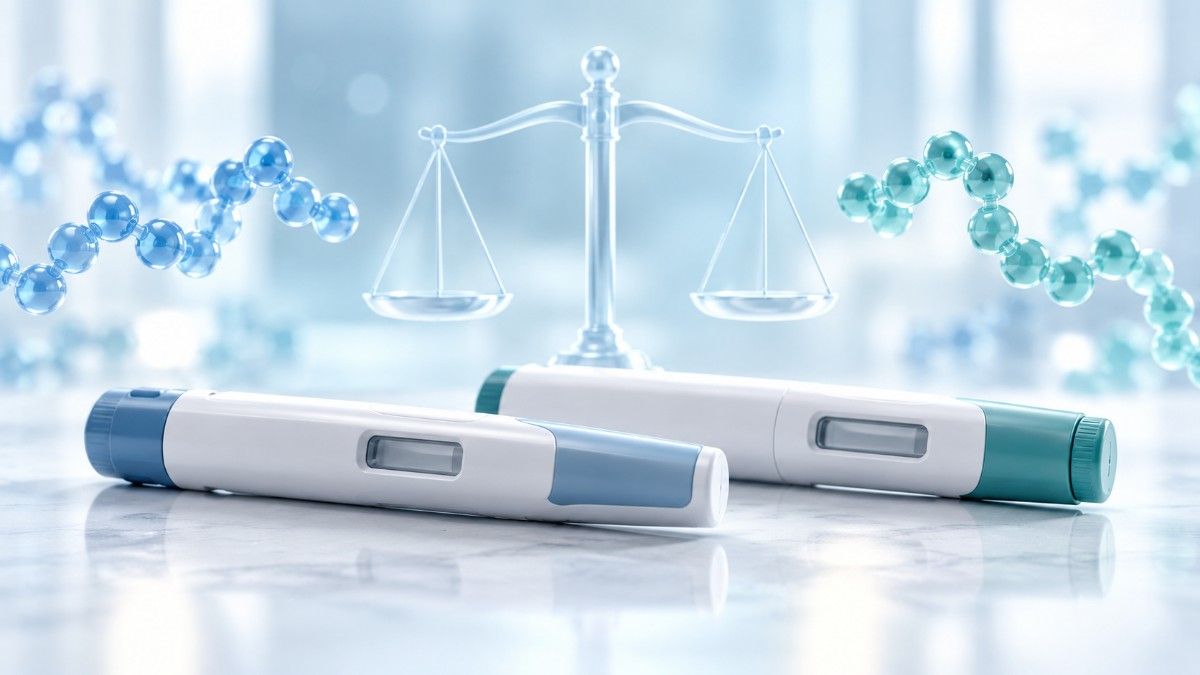
Mounjaro is better than Ozempic at the two things both drugs are prescribed for, lowering blood sugar and lowering weight, and the margin is not small. In the only head-to-head trial, 40 weeks of Mounjaro at its top dose cut HbA1c by 2.3 percentage points against 1.9 for Ozempic 1 mg, and took off 11.2 kg (25 lb) against 5.7 kg (13 lb). But Mounjaro is not the same drug, not the same price, not covered by the same evidence for the heart and kidneys, and not available as a tablet. Tirzepatide, the molecule in Mounjaro, is also not the same as semaglutide, the molecule in Ozempic, even though people use the names interchangeably; it is a different peptide that works on two gut-hormone receptors rather than one.
This guide lays out the trial numbers dose by dose, untangles the names (Mounjaro, Zepbound, tirzepatide, Ozempic, Wegovy, semaglutide), compares the heart, kidney and tablet evidence that still favours Ozempic, sets out 2026 prices and coverage, explains how switching works, and ends with who should pick which.
Is Mounjaro Better Than Ozempic? The Short Answer
- 1For blood sugar: yes. In SURPASS-2, every Mounjaro dose beat Ozempic 1 mg on HbA1c; 15 mg lowered it by 2.3 points versus 1.9.
- 2For weight: yes, by roughly double at the top doses. Mounjaro 15 mg: 11.2 kg lost in 40 weeks; Ozempic 1 mg: 5.7 kg. The weight-loss versions confirm it: Zepbound 20.2% versus Wegovy 13.7% in SURMOUNT-5.
- 3Not the same drug: Ozempic is semaglutide (GLP-1 only). Mounjaro and Zepbound are tirzepatide (GLP-1 plus GIP). Tirzepatide is not a form of Ozempic.
- 4Where Ozempic still leads: a proven reduction in heart attacks and strokes, a kidney-protection indication, a daily tablet option since 2026, and a lower cash price ($349 versus no cash programme for Mounjaro).
- 5Side effects: the same gut effects; slightly more nausea and more treatment stops at Mounjaro's higher doses.
- 6Neither is approved for weight loss. The weight-management versions are Zepbound (tirzepatide) and Wegovy (semaglutide).
First, the Names: Mounjaro, Zepbound, Tirzepatide, Ozempic, Wegovy, Semaglutide
Two molecules, two companies, five brand names. Novo Nordisk makes semaglutide and sells it as Ozempic (weekly injection for type 2 diabetes, plus daily Ozempic tablets since May 2026) and Wegovy (weekly injection and daily pill for weight management). Eli Lilly makes tirzepatide and sells it as Mounjaro (weekly injection for type 2 diabetes) and Zepbound (weekly injection for weight management and sleep apnea). So the honest answer to 'is tirzepatide the same as Ozempic' is no on every level: different molecule, different company, different receptor profile. What is the same is the pair inside each company: Mounjaro and Zepbound are identical tirzepatide in identical pens, and Ozempic and Wegovy are identical semaglutide at different dose ranges. The semaglutide side of that story is in Ozempic vs semaglutide and Ozempic vs Wegovy.
Who makes what (US, October 2026)
Molecule
Semaglutide
Semaglutide
Tirzepatide
Tirzepatide
Receptors
GLP-1
GLP-1
GLP-1 + GIP
GLP-1 + GIP
Company
Novo Nordisk
Novo Nordisk
Eli Lilly
Eli Lilly
Approved for
Type 2 diabetes; cardiovascular risk (established disease); kidney disease in diabetes
Weight management; cardiovascular risk; MASH
Type 2 diabetes
Weight management; obstructive sleep apnea
Weekly doses
0.25, 0.5, 1, 2 mg
0.25 to 2.4 mg
2.5, 5, 7.5, 10, 12.5, 15 mg
2.5 to 15 mg
Tablet?
Yes, Ozempic tablets 1.5/4/9 mg (since May 2026)
Yes, Wegovy pill to 25 mg (since Dec 2025)
No
No
Device
Multi-dose pen, separate needle
Single-dose pen
Single-dose pen
Single-dose pen, KwikPen, vials
US approval
2017
2021
2022
2023
How Do They Work Differently?
Both drugs imitate GLP-1, the gut hormone that tells the pancreas to release insulin when glucose is high, slows stomach emptying and signals fullness to the brain. Tirzepatide adds a second action on the GIP receptor, another incretin hormone released after meals. On its own GIP does little for weight, but combined with GLP-1 activity it appears to amplify appetite suppression and improve how fat tissue handles insulin, and it may blunt some of the nausea that pure GLP-1 drugs cause, which is why tirzepatide can be pushed to higher effective doses. The practical result is the trial gap below. The single-receptor mechanism is explained in how Ozempic works.
The Head-to-Head Trial: SURPASS-2, Dose by Dose
SURPASS-2 randomised 1,879 adults with type 2 diabetes on metformin to tirzepatide 5, 10 or 15 mg or semaglutide 1 mg for 40 weeks. It is the only direct comparison, and it has one important limitation: Ozempic's 2 mg dose, approved after the trial, was not included. Even so, the lowest tirzepatide dose beat the semaglutide arm on both outcomes, and the gap widened with dose.
SURPASS-2 results at 40 weeks (Frías et al., NEJM 2021)
HbA1c change (from 8.3%)
−1.86 points
−2.01
−2.24
−2.30
Difference vs Ozempic
−0.15 points
−0.39
−0.45
Weight change (from 93.7 kg)
−5.7 kg (−6.2%)
−7.6 kg (−7.8%)
−9.3 kg (−10.3%)
−11.2 kg (−12.4%)
Difference vs Ozempic
−1.9 kg
−3.6 kg
−5.5 kg
Nausea
18%
17 to 22%
17 to 22%
17 to 22%
Serious adverse events
3%
5 to 7%
5 to 7%
5 to 7%
Stopped because of side effects
4.1%
6.0%
8.5%
8.5%
The 2 mg question matters less than it looks. SUSTAIN FORTE later showed Ozempic 2 mg adds about 0.3 points of HbA1c lowering and roughly 1 kg of weight loss over 1 mg, which would bring it near Mounjaro 5 mg but nowhere near 15 mg. The weight-management twins settle the rest: in SURMOUNT-5, a direct trial of Zepbound 15 mg against Wegovy 2.4 mg in people without diabetes, tirzepatide produced 20.2% weight loss at 72 weeks against 13.7%, and 32% of the tirzepatide group lost a quarter of their body weight versus 16%.
Where Ozempic Is Still Ahead
Effectiveness on the two main numbers is not the whole comparison, and on three counts semaglutide has evidence tirzepatide does not yet match. The first is the heart. Ozempic's label includes reducing major cardiovascular events in people with type 2 diabetes and established heart disease, on the strength of SUSTAIN-6, where it cut events by 26%; Ozempic tablets gained a similar indication in 2026 from the SOUL trial. Mounjaro's outcomes trial, SURPASS-CVOT, reported in 2025 that tirzepatide was non-inferior to dulaglutide, itself a drug with proven heart benefit, which is reassuring but is not yet a label claim of superiority over anything. The second is the kidneys: Ozempic injection carries an indication for slowing chronic kidney disease in people with diabetes, from the FLOW trial; Mounjaro has no equivalent. The third is the tablet: since May 2026 the reformulated oral semaglutide is sold as Ozempic tablets, and there is no oral tirzepatide. Lilly's oral drug, orforglipron, is a different molecule. The tablet story is in Ozempic tablets explained.
Beyond blood sugar and weight
Proven fewer heart attacks and strokes
Yes: SUSTAIN-6 (−26%); label indication
Non-inferior to dulaglutide in SURPASS-CVOT; no superiority claim yet
Kidney protection indication
Yes (FLOW trial)
No
Tablet form
Yes, since 2026
No
Sleep apnea indication
No
Yes, as Zepbound
MASH (liver) indication
Yes, as Wegovy
No (trial data positive)
Years on the US market
9
4
Side Effects: Same List, Slightly Different Odds
Both drugs cause the incretin set of gut effects: nausea, vomiting, diarrhea, constipation, reduced appetite, mostly in the first weeks and after dose increases. In SURPASS-2 the rates were similar at matched steps, with nausea in 17 to 22% on tirzepatide and 18% on semaglutide 1 mg, but more people stopped tirzepatide at the 10 and 15 mg doses, which is the price of the larger effect. Both carry the same boxed warning about thyroid C-cell tumours in rodents and the same cautions on pancreatitis, gallbladder disease, dehydration-related kidney injury, retinopathy and low blood sugar when combined with insulin or sulfonylureas. Tirzepatide's label adds a note on reduced effectiveness of oral contraceptives for the first four weeks and after each dose increase, because slowed stomach emptying affects their absorption. The full semaglutide list is on our Ozempic side effects page.
What They Cost in 2026
At list price both are about $1,000 a month: Ozempic $1,027.51 per pen and Mounjaro $1,080 for four pens, with Novo's list price falling to $675 in January 2027. Cash buyers do better with Ozempic. NovoCare sells the injection for $349 a month at 0.25 to 1 mg and $499 at 2 mg, and Ozempic tablets for $149 to $299. Lilly has no cash programme for Mounjaro; its self-pay prices, $299 to $449 a month, apply to the Zepbound KwikPen through LillyDirect, which is the same tirzepatide but requires a weight-management prescription. Commercially insured patients with diabetes pay as little as $25 for either with the manufacturer savings card. Insurance covers both for type 2 diabetes, but most plans prefer one; a prescription for the non-preferred drug needs a step-therapy exception. Full pricing is in how much Ozempic costs per month and coverage rules in does insurance cover Ozempic.
Switching From Ozempic to Mounjaro, or Back
Switches in the Mounjaro direction are common when glucose or weight is short of target, and the label rule is simple: everyone starts tirzepatide at 2.5 mg, regardless of their previous Ozempic dose, because 2.5 mg is an introductory dose and the gut needs four weeks on it before escalation. Take the last Ozempic dose, wait a week, start Mounjaro 2.5 mg, then increase by 2.5 mg every four weeks as tolerated. People on Ozempic 1 or 2 mg usually find the first two tirzepatide steps feel like a dose reduction, with slightly more hunger, before the 7.5 and 10 mg doses overtake it. Insulin and sulfonylurea doses should be reviewed at the switch. Going the other way, from Mounjaro to Ozempic, is less common and usually driven by cost, coverage or side effects; the Ozempic ladder starts at 0.25 mg for four weeks, though prescribers sometimes begin at 0.5 mg in someone already tolerant of an incretin drug. Neither switch requires a washout beyond the normal one-week gap, and neither should be done by overlapping the two drugs.
Who Should Choose Mounjaro?
- 1People with type 2 diabetes whose HbA1c is well above target: the extra 0.4 points at the top dose is meaningful
- 2People with diabetes who also need substantial weight loss: roughly double the effect
- 3People who did not respond to semaglutide: many do respond to the dual agonist
- 4People with obstructive sleep apnea: the same molecule carries that indication as Zepbound
- 5People whose plan prefers tirzepatide
Who Should Choose Ozempic?
- 1People with established heart disease, where Ozempic has the proven outcomes indication
- 2People with chronic kidney disease, where only Ozempic has the kidney indication
- 3People who will not inject: Ozempic tablets exist; tirzepatide tablets do not
- 4People paying cash: $349 against no Mounjaro cash programme
- 5People who tolerate semaglutide well and are at target; there is no reason to switch a drug that is working
- 6People whose plan prefers semaglutide, or who need the longest safety track record
The wider field, including liraglutide, dulaglutide and the drugs in development, is compared in Ozempic alternatives.
When to Talk to Your Doctor
- 1If your HbA1c is above target on Ozempic 1 or 2 mg: a switch to Mounjaro is the evidence-based next step
- 2If you have heart or kidney disease: ask whether Ozempic's outcomes data should decide
- 3Before any switch, so insulin or sulfonylurea doses can be adjusted and the first-month nausea planned for
- 4If you take oral contraceptives and switch to tirzepatide: a backup method is advised for four weeks after starting and after each dose increase
- 5If cost or coverage is the deciding factor: ask which drug your plan prefers and what the savings card or NovoCare price would be
The Bottom Line
Mounjaro is better than Ozempic at lowering blood sugar and weight, by about 0.4 HbA1c points and roughly double the weight loss at its top dose, and the weight-management versions show the same gap. It is not the same drug: tirzepatide acts on two receptors, semaglutide on one. Ozempic keeps three advantages that matter for particular people, proven heart protection, a kidney indication and a tablet, plus a cash price Mounjaro does not offer. If the numbers are the problem, Mounjaro; if the heart, kidneys, needles or budget are the problem, Ozempic. Which one is right for diabetes specifically is discussed further in Ozempic for diabetes, and the weight-loss question in is Ozempic approved for weight loss.
FAQ
For blood sugar and weight, yes. In the SURPASS-2 trial, Mounjaro 15 mg lowered HbA1c by 2.3 points and weight by 11.2 kg over 40 weeks, against 1.9 points and 5.7 kg for Ozempic 1 mg. Ozempic has advantages Mounjaro lacks: proven heart protection, a kidney indication, a tablet form and a cash price.
No. Tirzepatide is the molecule in Mounjaro and Zepbound and acts on GLP-1 and GIP receptors. Ozempic is semaglutide, a GLP-1-only drug from a different company. They are not interchangeable.
Yes. Both are tirzepatide in the same pens from Eli Lilly. Mounjaro is approved for type 2 diabetes; Zepbound for weight management and sleep apnea. The same relationship holds between Ozempic and Wegovy (semaglutide).
Yes, roughly double at the top doses. Mounjaro 15 mg produced 11.2 kg of loss versus 5.7 kg for Ozempic 1 mg in 40 weeks. In people without diabetes, Zepbound produced 20.2% versus 13.7% for Wegovy in a direct trial.
Yes. Take your last Ozempic dose, wait a week, and start Mounjaro at 2.5 mg, the required starting dose regardless of your previous Ozempic dose, increasing every four weeks as tolerated. Insulin or sulfonylurea doses should be reviewed.
List prices are similar, about $1,027 for Ozempic and $1,080 for Mounjaro per month. For cash buyers Ozempic is cheaper: $349 a month through NovoCare (or $149 to $299 for the tablets), while Mounjaro has no cash programme. With commercial insurance both can cost $25 with a savings card.
Sources
- 1Frías JP et al. Tirzepatide versus semaglutide once weekly in patients with type 2 diabetes (SURPASS-2), New England Journal of Medicine, 2021
- 2Aronne LJ et al. Tirzepatide as compared with semaglutide for the treatment of obesity (SURMOUNT-5), New England Journal of Medicine, 2025
- 3Frías JP et al. Semaglutide 2.0 mg versus 1.0 mg (SUSTAIN FORTE), Lancet Diabetes and Endocrinology, 2021
- 4Marso SP et al. Semaglutide and cardiovascular outcomes in patients with type 2 diabetes (SUSTAIN-6), New England Journal of Medicine, 2016
- 5Mounjaro (tirzepatide) injection prescribing information, Eli Lilly
- 6Ozempic (semaglutide) injection prescribing information, Novo Nordisk
- 7Mounjaro vs Ozempic: 6 differences you should know about, GoodRx, June 2026
This comparison summarizes published trials and labels for general information. Treatment choices should be made with your prescriber.

Dr. Sheri Tomas
Author
Comments (0)
Be the first to comment on this article.
More articles