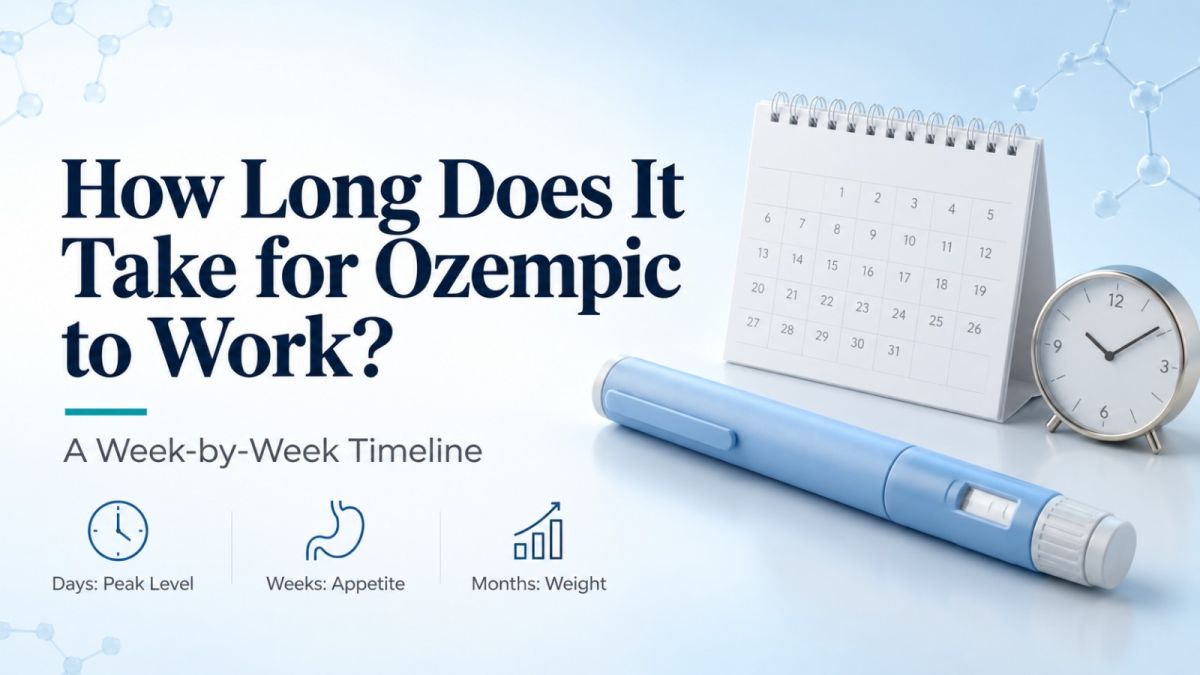
How Long Does It Take for Ozempic to Work? A Week-by-Week Timeline
Ozempic acts within days, but the full effect takes 2–3 months. A week-by-week timeline for appetite, blood sugar and weight, and what slows results.
Written by Dr. Sheri Tomas. Updated October 22, 2026.
Ozempic starts acting within days, but it takes about two to three months to see what it can really do. The drug peaks in your blood one to three days after each shot, and many people notice less hunger in the first week or two. Blood sugar usually improves once you reach the 0.5 mg treatment dose, A1C is typically rechecked at around 12 weeks, and weight loss keeps building for most of the first year.
The slow start is by design. Here's what happens week by week, why the first month often feels underwhelming, and what can hold results back.
The Ozempic Timeline at a Glance
What to expect after starting Ozempic
Days 1–3
Semaglutide reaches its peak level after the first shot
Mild nausea or fullness for some; many people feel nothing yet
Weeks 1–4 (0.25 mg)
Starter dose; the drug slowly builds up in your body
Smaller appetite for many; little change on the scale
Weeks 5–8 (0.5 mg)
First treatment dose; levels settle after 4 to 5 weeks
Better blood sugar readings; side effects can flare after the step up
Around week 12
Enough time for A1C to reflect the change
First A1C check; decision about raising the dose
Months 3–12
Dose may go to 1 mg or 2 mg
Weight loss continues; for most people it slows toward the end of the first year
Why the First Month Feels Slow
Two things are going on. First, Ozempic is started at 0.25 mg for four weeks. That dose is there to let your stomach adjust, not to deliver the full effect, so it's normal to see only small changes at first. Second, semaglutide has a half-life of about a week. According to the label, it takes four to five weeks of weekly shots for the level in your blood to stabilize, and that clock restarts with each dose increase.
In practice, the first month is mostly about getting used to the drug. The people who get frustrated at week three are usually judging it on a dose that was never meant to do the heavy lifting. Our 6-week results guide shows what counts as on track early on.
When Ozempic Starts Working on Blood Sugar
For people with type 2 diabetes, home glucose readings often start coming down in the first few weeks, especially after moving to 0.5 mg. Fasting numbers tend to improve first, and the after-meal spikes get smaller because food leaves the stomach more slowly.
A1C is the number that counts, and it reflects roughly three months of blood sugar. That's why doctors usually wait about 12 weeks before checking it and deciding whether to raise the dose. In the clinical trials, the main A1C results were measured at 30 to 56 weeks, so the full effect takes time even at a stable dose. If you also take insulin or a sulfonylurea, check your glucose more often in the first weeks; that's when lows are most likely. More in Ozempic for diabetes.
When Appetite and Weight Start to Change
Appetite is usually the first thing people notice. Many describe it within the first week or two: smaller portions feel like enough, and the constant thinking about food goes quiet. In a study of adults with obesity, semaglutide cut how much people ate at an all-you-can-eat lunch by about 24% after 12 weeks.
Weight takes longer. In people with type 2 diabetes, Ozempic at 1 mg or 2 mg led to an average loss of about 6 to 7 kg (13 to 15 lb) over 40 weeks. In the STEP 1 trial of the higher-dose version, Wegovy 2.4 mg, people without diabetes kept losing weight until around week 60 and averaged about 15% of their body weight at 68 weeks. For the full picture, see how Ozempic helps you lose weight.
A useful checkpoint: if you've been on a full treatment dose for about three months and lost less than 5% of your starting weight, that's the time to talk with your prescriber about the dose, your eating, or a different medicine. It's not a reason to double up on your own.
What Can Slow Ozempic Down
- 1Still being on a low dose. Many people stay at 0.25 or 0.5 mg longer because of side effects. That's fine, but the effect is smaller.
- 2Missed or late doses. One missed week can blunt appetite control for several days. See our missed dose guide.
- 3Injection technique. Hold the pen against your skin until the counter shows 0, then count slowly to six before lifting it. Pulling away early can mean a partial dose.
- 4A heat-damaged pen. Semaglutide is a peptide and can lose potency if it gets too hot or freezes. Check our storage guide.
- 5Eating around the drug. Liquid calories, grazing and very rich foods can cancel out a smaller appetite. Alcohol adds calories and lowers your guard; see Ozempic and alcohol.
- 6Biology. Some people simply respond less. That's a conversation for your prescriber, not a sign you're doing something wrong.
What to Expect After Your First Dose
Most people feel very little after the first shot. The most common early effects are mild nausea, feeling full sooner, burping, and changes in bowel habits. They tend to show up a day or two after the injection, when the drug peaks, and they often return briefly after each dose increase.
- 1Eat smaller meals and stop at the first sign of fullness.
- 2Go easy on greasy, fried and very sweet foods for the first few weeks.
- 3Drink water through the day, especially if you have diarrhea or vomiting.
- 4Pick a fixed injection day; you can change it if at least two days have passed since your last dose.
When to Call Your Doctor
- 1Severe stomach pain that doesn't go away, with or without vomiting, which can be a sign of pancreatitis.
- 2Vomiting or diarrhea that stops you from keeping fluids down.
- 3Shakiness, sweating, confusion or a fast heartbeat if you also take insulin or a sulfonylurea.
- 4Swelling of the face or throat, trouble breathing or a severe rash.
For the full list of risks, see Is Ozempic Safe?.
If you have reached a full dose and the scale still has not moved, our guide to why you are not losing weight on Ozempic walks through the nine most common reasons and what to ask your doctor.
Bottom Line
Ozempic gets to work within days, but you won't see its real effect in the first month. Expect appetite changes in the first couple of weeks, better blood sugar after you reach 0.5 mg, a first A1C check at about three months, and weight loss that continues for most of a year. Judge it on a treatment dose over several months, not on the starter dose.
FAQ
It reaches its peak level one to three days after a shot, and many people notice less appetite within the first week or two. The full effect takes two to three months.
Glucose readings often improve within a few weeks, especially at 0.5 mg. A1C is usually checked after about 12 weeks.
The 0.25 mg starter dose is for getting used to the drug. Most weight loss comes after you reach a treatment dose.
Semaglutide has a half-life of about a week, which is why it's injected once weekly. It takes about five weeks to clear from your body after the last dose.
Higher doses usually mean a stronger effect, but each dose increase is spaced at least four weeks apart to limit side effects. Skipping steps tends to cause more nausea, not faster results.
Don't judge it on the starter dose. If you've been on a full dose for about three months with little change, talk to your prescriber about next steps.
Sources
- 1Ozempic (semaglutide) prescribing information, Novo Nordisk
- 2Once-Weekly Semaglutide in Adults with Overweight or Obesity (STEP 1), New England Journal of Medicine, 2021
- 3Effects of once-weekly semaglutide on appetite, energy intake, control of eating and food preference, Diabetes, Obesity and Metabolism, 2017
- 4SUSTAIN FORTE: semaglutide 2 mg vs 1 mg in type 2 diabetes, Novo Nordisk via BioSpace
- 5How long do you spend on semaglutide for weight loss?, Mayo Clinic Diet

Dr. Sheri Tomas
Author
Comments (0)
Be the first to comment on this article.
More articles