Traveling With Ozempic: Flights, TSA, Time Zones and Heat
Yes, you can fly with Ozempic. Label rules for 56-day room-temperature storage, TSA screening, heat, time-zone dosing, missed doses and international travel.
Written by Dr. Sheri Tomas. Updated November 16, 2026.
Yes, you can travel with Ozempic, and you can fly with your pens in your carry-on. Once a pen has been used for the first time, the FDA label allows it to be kept for up to 56 days at room temperature (59°F to 86°F, or 15°C to 30°C), so most trips do not need a refrigerator. New, unused pens should stay refrigerated until first use. At airport security, the TSA allows liquid medicines above the usual 3.4-ounce limit in reasonable quantities, as long as you tell the officer, and it allows unused needles when they travel with the medicine. The part most travel guides skip is timing. Ozempic is a once-weekly injection that can be taken at any time of day, the day can be changed if the doses stay more than 48 hours apart, and a missed dose can be taken within 5 days. Those three label rules cover almost every time-zone problem. This guide explains each rule in plain English, along with heat, freezing, international travel and the new Ozempic pill.
Traveling With Ozempic: The Short Answer
- 1Storage: after first use, a pen can stay at 59°F to 86°F (15°C to 30°C) for up to 56 days; unused pens stay in the fridge.
- 2Airport security: tell the TSA officer about your pens; liquid medicines and medically necessary gel packs are allowed in reasonable quantities.
- 3Bag choice: the CDC advises packing medicine in your carry-on, not checked luggage.
- 4Heat and cold: protect pens from excessive heat and sunlight, and never use a pen that has frozen.
- 5Time zones: keep doses more than 48 hours apart, and take a missed dose within 5 days.
- 6International trips: check embassy rules, keep the original packaging and carry a prescription copy and doctor's note.
How Long Can Ozempic Stay Out of the Fridge When You Travel?
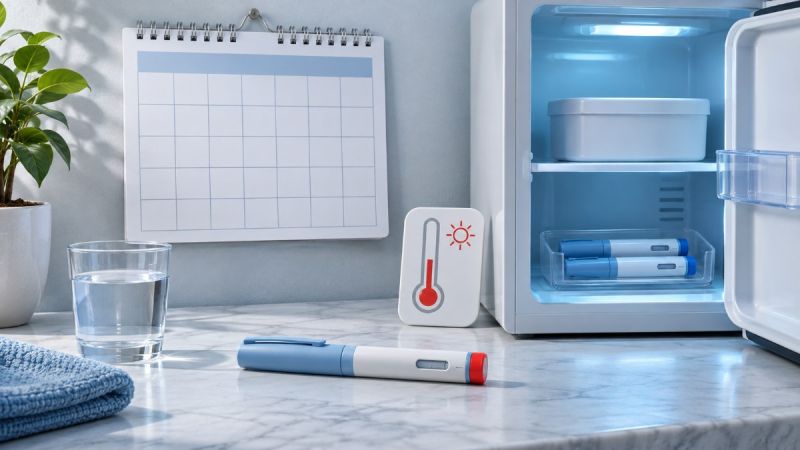
According to the Ozempic injection label (revised October 2025), pens that have not been used yet belong in a refrigerator at 36°F to 46°F (2°C to 8°C). After the first injection, "the pen can be stored for 56 days at controlled room temperature 59°F to 86°F (15°C to 30°C) or in a refrigerator." In practice, the pen you are currently using can come with you without a cooler for a typical trip, as long as the room or bag stays within that range. The 56-day clock starts at first use, not when you leave home, so it helps to write the start date on the box. Spare pens that you have not started yet should travel cool and go back in a fridge when you arrive. Our Ozempic storage guide covers the room-temperature rule in more detail.
Ozempic storage at a glance (label and manufacturer information, as of November 2026)
Unused Ozempic pen
Refrigerator, 36°F to 46°F (2°C to 8°C)
Until first use (check expiry date)
Do not freeze; do not use if frozen
FDA label
In-use Ozempic pen
59°F to 86°F (15°C to 30°C) or refrigerator
56 days after first use
Do not freeze; do not use if frozen
FDA label
Ozempic pill
68°F to 77°F (20°C to 25°C); do not refrigerate
Keep in the original bottle, not a pill organizer
Not addressed in the FAQ
Novo Nordisk HCP FAQ
Can You Bring Ozempic Pens Through TSA Security?
Yes. The TSA's "What Can I Bring?" list allows liquid medications in both carry-on and checked bags. Larger amounts than the usual 3.4-ounce limit are allowed "in reasonable quantities," but you must "declare them to TSA officers at the checkpoint." The TSA has no entry for Ozempic by name, but its entry for insulin pens, a similar injectable, advises telling officers you have medically necessary liquids and placing them "in a bin separately for x-ray screening." Unused needles are "allowed when accompanied by injectable medication," and used needles are allowed in a sharps disposal container or a similar hard-sided container.
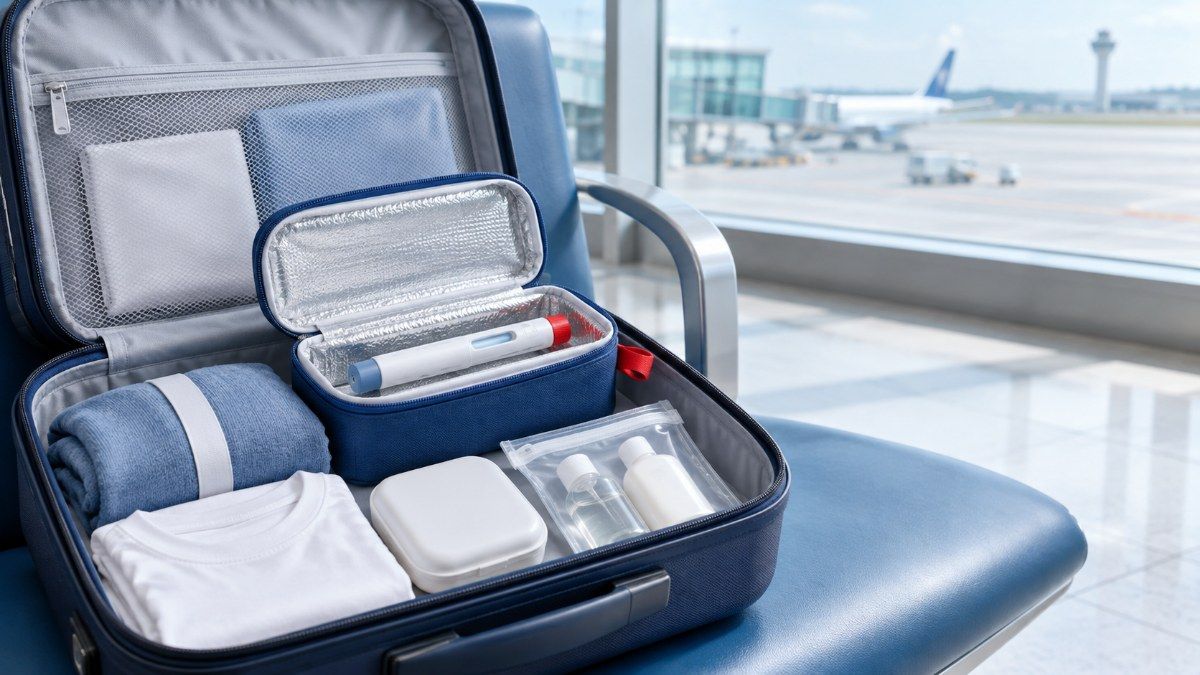
If you pack a cooling case, medically necessary gel ice packs are allowed in reasonable quantities even if they are melted or slushy; tell the officer about them. Regular ice is allowed only if it is "frozen solid when presented for screening." The TSA does not require a prescription label, but the American Diabetes Association notes that having one can speed up screening.
Does Airport X-Ray Screening Affect Ozempic?
We found no primary source showing whether X-ray screening affects semaglutide, the active ingredient in Ozempic, in either direction. The label does not mention it. The American Diabetes Association notes that travelers can ask for a hand inspection instead of X-ray for insulin, and you can make the same request for your pens if you prefer. Either way, tell the officer what you are carrying before screening starts.
Should Ozempic Go in a Carry-On or Checked Bag?
Carry-on. The CDC's advice for traveling with medicine is to pack it in your carry-on, keep it in its original labeled packaging and bring extra in case of delays. The American Diabetes Association advises never putting insulin in checked baggage because "it could be affected by severe changes in pressure and temperature." That advice is written for insulin, not Ozempic, but the same caution makes sense: a checked bag can be lost, delayed or left in a hot or cold place, and you cannot check on it. Keeping your pens with you also means you can dose on time if your bag goes missing.
How Do You Keep Ozempic Cool on a Long Trip or in Hot Weather?
The label says Ozempic "should be protected from excessive heat and sunlight" and to keep the pen cap on when not in use. Practical steps that follow from those rules:
- 1Use an insulated travel case for unused pens, with gel packs that do not touch the pen directly.
- 2Do not leave pens in a parked car, a sunny window, a beach bag in the sun or a glove compartment.
- 3In hotels, use the room fridge for unused pens, but keep them away from the cooling element at the back, which can freeze them (Novo Nordisk advises against storing pens next to the cooling element).
- 4Remove the needle after each injection and store the pen without a needle attached, as the manufacturer advises.
- 5Never share a pen with a travel companion, even with a new needle; the label says pens must never be shared.
If you are unsure how to give the injection away from home, our guide to where to inject Ozempic and our explainer on Ozempic pen clicks cover the basics.
What Happens If Your Ozempic Pen Gets Too Hot or Freezes?
Freezing is clear-cut. The label says: "Do not freeze OZEMPIC and do not use OZEMPIC if it has been frozen." If a pen has frozen, even once, replace it rather than using it after it thaws.
Heat is less clear. The label gives an upper limit of 86°F (30°C) for in-use pens and says to protect the pen from excessive heat, but it gives no figure for how long a pen can tolerate temperatures above that, and there is no official "hours in a hot car" number. If a pen has been somewhere hotter than 86°F, ask a pharmacist or the manufacturer whether to keep using it rather than guessing.
How Do You Time Your Weekly Ozempic Dose Across Time Zones?
The label gives three rules that answer most time-zone questions. First, Ozempic is taken "once weekly, on the same day each week, at any time of the day, with or without meals," so the exact hour does not matter. Second, "the day of weekly administration can be changed if necessary" as long as "the time between two doses is at least 2 days (>48 hours)." Third, a missed dose can be given "as soon as possible within 5 days after the missed dose."
For most trips, the simplest approach is to keep your usual weekday and inject on that day in local time. Crossing a few time zones shifts the gap between doses by only a few hours, which is far above the 48-hour minimum. The scenarios below show how the rules apply. They are examples, not personal advice, so confirm your plan with your prescriber.
Ozempic dose timing across time zones: example scenarios checked against the label
Fly east (for example, U.S. to Europe)
Inject on your usual weekday in local time; the gap is a few hours shorter than 7 days
Any time of day; gap stays well above 48 hours
Fly west (for example, U.S. to Asia or Hawaii)
Inject on your usual weekday in local time; the gap is a few hours longer than 7 days
Any time of day, same weekday
Crossing the International Date Line, a calendar day is skipped or repeated
Pick the day that keeps the gap close to 7 days and never 48 hours or less; ask your prescriber
More than 48 hours between doses
You want to move your dose day to fit a travel day
Change the day, as long as at least 2 days (more than 48 hours) have passed since the last dose
Day can be changed if necessary
You forgot your dose while traveling, 5 days or fewer ago
Take it as soon as possible, then go back to your regular day
Missed dose within 5 days
More than 5 days have passed since the missed dose
Skip it and take the next dose on your regular day
Manufacturer FAQ
What If You Miss an Ozempic Dose While Traveling?
Under the label, a missed dose can be taken as soon as possible within 5 days. Novo Nordisk's FAQ adds that if more than 5 days have passed, you should skip the missed dose and take the next one on your regular day. Do not take two doses close together to catch up. Our article on what happens if you miss an Ozempic dose explains what to expect after a skipped week. A phone reminder set to your home weekday, rather than a fixed clock time, can help on long trips. Digestive side effects can also be harder to manage on the road; our guide to Ozempic and diarrhea has general tips.
What Do You Need to Fly Internationally With Ozempic?
Rules differ by country, and we have not verified the rules for any specific destination. The CDC's guidance for traveling abroad with medicine recommends:
- 1Check with the embassy of your destination, and of any country where you have a layover, about rules for your medicines.
- 2Keep medicine in its original labeled packaging.
- 3Carry copies of your prescriptions, including the generic name (semaglutide).
- 4Pack medicine in your carry-on and bring enough for the whole trip plus extra in case of delays.
- 5Get medicine abroad only in an emergency, because counterfeit medicines are a risk in some places.
- 6Ask your prescriber for a note if you carry injectable medicines.
The CDC Yellow Book adds that a doctor's letter should list each drug's generic name, dosing and purpose, that needle-related supplies should be ready to show if asked, and that some countries, such as Japan, allow certain medicines only in limited quantities or with advance permission. Compounded semaglutide is a different product from Ozempic, and this guide's label rules do not apply to it; see our comparison of compounded semaglutide vs Ozempic.
Traveling With the Ozempic Pill: What's Different?
"Ozempic" no longer means only the pen. A secondary report citing a Novo Nordisk announcement of February 4, 2026, said Rybelsus tablets were being rebranded as "Ozempic Pill," the same semaglutide molecule, in 1.5, 4 and 9 mg strengths, with a U.S. launch planned for the second quarter of 2026. We have not confirmed the launch status as of November 2026. Storage rules for the pill are different from the pen. According to Novo Nordisk's FAQ for health professionals, the pill should not be refrigerated; store it at 68°F to 77°F (20°C to 25°C) in its original bottle, not a pill organizer. If you miss a pill dose, skip it and take the next dose the following day. More on the tablet is in our Ozempic tablets guide.
Packing Checklist for Ozempic Travel
- 1In-use pen, with the first-use date written on the box
- 2Unused pens in an insulated case with gel packs that do not touch the pens
- 3Enough new needles for the trip, packed with the pens
- 4A small hard-sided sharps container for used needles
- 5Prescription copy and, for international trips, a doctor's note listing semaglutide
- 6Extra supply in case of delays, if your prescriber and pharmacy allow it
- 7A dose reminder set to your usual weekday
When to Talk to Your Doctor
- 1Before a long trip, if you plan to change your dose day or cross the International Date Line
- 2If a pen has frozen, or has been somewhere hotter than 86°F (30°C), and you are unsure whether to use it
- 3If you have missed a dose by more than 5 days, or missed more than one dose
- 4If you get severe stomach pain, persistent vomiting or signs of dehydration while away
- 5If you need a letter for customs or a larger supply for an extended stay
Questions to Ask Your Doctor or Pharmacist Before You Go
- 1Can you write a travel letter listing semaglutide, my dosing and why I take it?
- 2Can I get an early refill or extra pens for this trip?
- 3Given my itinerary, which day should I take my dose while I am away?
- 4What should I do if my pen is exposed to heat or I lose my supply abroad?
- 5Does my destination have rules on bringing injectable medicines?
If you do not yet have a prescriber, our guide to getting prescribed Ozempic explains the process.
Before packing pens for a trip, check how long each one has left. Our guide on whether Ozempic expires explains the printed EXP date, the 56-day in-use limit and what the label says about frozen or overheated pens.
The Bottom Line
Traveling with Ozempic is mostly a matter of following the label. The pen you are using can stay at room temperature (up to 86°F, or 30°C) for 56 days after first use, unused pens should stay cool, and no pen should be frozen or left in the heat. Carry your pens in your hand luggage and tell the TSA officer about them. For time zones, inject on your usual weekday in local time, keep doses more than 48 hours apart, and take a missed dose within 5 days. For international trips, check embassy rules and carry a prescription copy and a doctor's note.
FAQ
Yes. The TSA allows liquid medicines in carry-on bags in reasonable quantities if you declare them at the checkpoint, and unused needles are allowed when they travel with the medicine. The CDC advises keeping medicine in your carry-on.
Unused pens should be kept refrigerated at 36°F to 46°F. After first use, a pen can be kept at 59°F to 86°F for up to 56 days, so an in-use pen does not need a fridge on most trips.
We found no primary source showing an effect either way, and the label does not mention X-rays. You can ask the officer for a hand inspection instead.
The label allows Ozempic at any time of day on your dose day, so most travelers inject on their usual weekday in local time. If you change the day, keep more than 48 hours between doses.
Yes. The label says to protect pens from excessive heat and sunlight, and in-use pens should stay at or below 86°F. There is no official safe number of hours above that, so ask a pharmacist if a pen has overheated.
The TSA does not require prescription labels, but they can speed up screening. For international travel, the CDC recommends carrying prescription copies and a doctor's note for injectable medicines.
Sources
- 1Novo Nordisk. OZEMPIC (semaglutide) injection, prescribing information (revised 10/2025), U.S. Food and Drug Administration, 2025
- 2Novo Nordisk. FAQs: Ozempic (semaglutide) injection & pill, NovoMedLink, 2026
- 3Transportation Security Administration. What Can I Bring? All list, TSA, 2026
- 4Centers for Disease Control and Prevention. Traveling Abroad with Medicine, CDC, 2026
- 5Centers for Disease Control and Prevention. Traveling with Prohibited or Restricted Medications, CDC Yellow Book, 2026
- 6American Diabetes Association. Am I allowed to bring my diabetes supplies with me on the plane?, ADA
- 7Rybelsus to be rebranded as Ozempic pill (report on Novo Nordisk release), Epocrates, 2026
This article is general information based on the FDA label and public travel guidance, and it is not a substitute for advice from your prescriber or pharmacist. Ozempic is made by Novo Nordisk; manufacturer FAQs cited here are company materials.

Dr. Sheri Tomas
Author
Comments (0)
Be the first to comment on this article.
More articles