Ozempic and Pancreatitis: Risk, Symptoms and What the Label Says
How often Ozempic causes pancreatitis, what the FDA label and SELECT trial show, warning signs to act on, and what to ask your doctor.
Written by Dr. Sheri Tomas. Updated November 27, 2026.
Ozempic can cause pancreatitis, but it is uncommon: the FDA label lists acute pancreatitis as a warning, and in the diabetes trials behind the label it was confirmed in 7 people on Ozempic (0.3 cases per 100 patient-years) against 3 people on comparison treatments (0.2 per 100 patient-years). The label also notes that serious forms, including hemorrhagic and necrotizing pancreatitis, sometimes fatal, have been seen with GLP-1 drugs. In the large SELECT trial of 17,604 people, pancreatitis was no more common on semaglutide than on placebo (0.2% vs 0.3%). Some claims-data studies have found a higher risk, and in January 2026 the UK regulator strengthened its warnings after reviewing 1,296 reports. The practical message is simple: ordinary nausea and stomach upset are common on Ozempic, while severe, constant belly pain that may spread to the back is a reason to stop the drug and get urgent care. This guide explains the label, the numbers and how to tell the two apart.
Ozempic and Pancreatitis: The Short Answer
- 1Pancreatitis is a listed warning on the Ozempic label, but confirmed cases in trials were rare (0.3 per 100 patient-years).
- 2In SELECT, acute pancreatitis occurred in 0.2% on semaglutide and 0.3% on placebo, a difference that was not significant.
- 3An observational claims study found a higher risk than with another weight-loss drug, but with very few events and a wide margin of error.
- 4The key warning sign is persistent, severe abdominal pain, sometimes spreading to the back, with or without vomiting.
- 5If pancreatitis is suspected, the label says to stop Ozempic and contact your doctor promptly.
- 6The UK regulator advises not restarting a GLP-1 drug if pancreatitis is confirmed.
Can Ozempic Cause Pancreatitis?
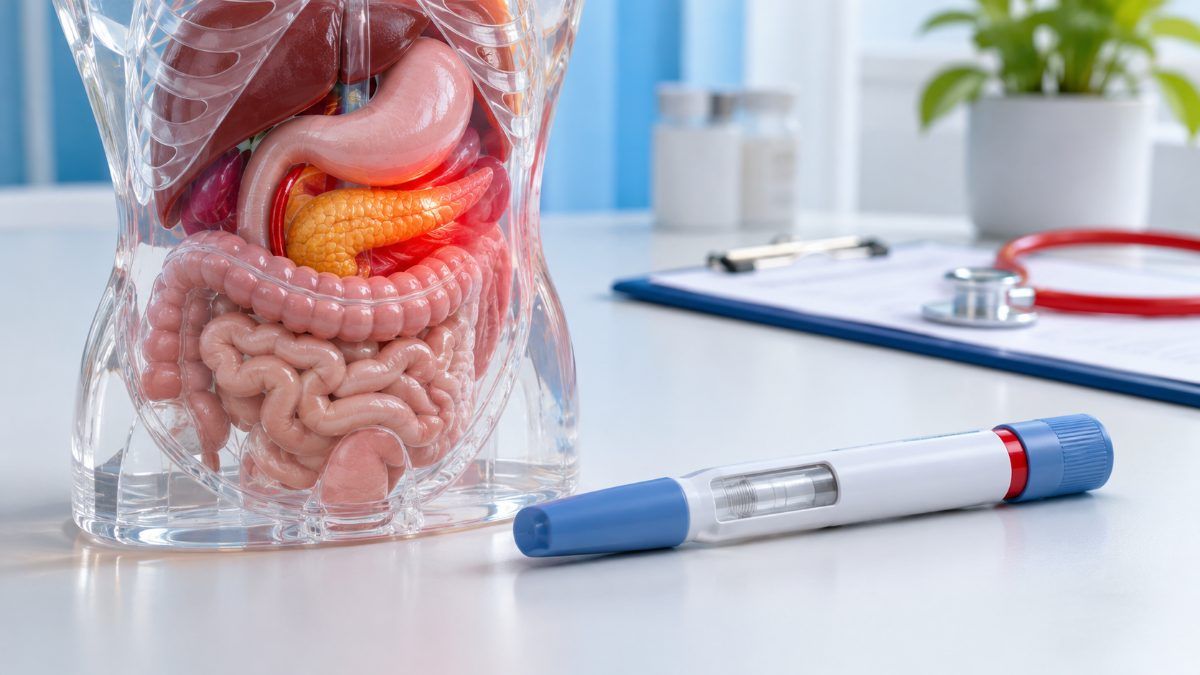
It can, though a direct cause has not been proven for most cases. Pancreatitis is inflammation of the pancreas, the organ behind the stomach that makes digestive enzymes and insulin. Ozempic (semaglutide) is a GLP-1 receptor agonist, a drug that mimics a gut hormone to lower blood sugar and slow digestion, as explained in how Ozempic works. Regulators treat pancreatitis as a known, infrequent risk of this whole drug class. The UK Medicines and Healthcare products Regulatory Agency (MHRA) put it plainly in January 2026: "Acute pancreatitis is a known, but infrequent side effect of taking GLP-1s." For background on the drug itself, see what Ozempic is.
What Does the Ozempic Label Say About Pancreatitis?
The current US prescribing information (revised May 2026) covers pancreatitis in section 5.2. It states: "Acute pancreatitis, including fatal and non-fatal hemorrhagic or necrotizing pancreatitis, has been observed in patients treated with GLP-1 receptor agonists, including OZEMPIC." Key points from the label:
- 1Warning signs: persistent severe abdominal pain, sometimes radiating to the back, with or without vomiting.
- 2Action: "If pancreatitis is suspected, discontinue OZEMPIC" and start appropriate management.
- 3Counseling (section 17): "Instruct patients to discontinue OZEMPIC promptly and contact their physician if pancreatitis is suspected."
- 4Lab changes: in placebo-controlled trials, the pancreatic enzymes amylase and lipase rose by a mean of 13% and 22% from baseline; these rises were not seen with placebo.
- 5Postmarketing reports (section 6.2) include acute and necrotizing pancreatitis, sometimes resulting in death, as well as ileus, intestinal obstruction and severe constipation.
The label we reviewed does not contain a sentence saying Ozempic has not been studied in people with past pancreatitis. You may see that wording online; it comes from older labels or secondary sites, not the current Ozempic text.
How Common Is Pancreatitis on Ozempic?
In absolute terms, it is rare. Most of the numbers below come from trials where cases were confirmed by review, which is stricter than counting reports. The claims study is a different kind of evidence and is explained in the next sections.
Pancreatitis in semaglutide trials, labels and a claims study
Source
Population
Semaglutide
Comparator
Ozempic label, glycemic control trials
Type 2 diabetes
7 cases (0.3 per 100 patient-years)
3 cases (0.2 per 100 patient-years)
Wegovy label, adult weight trials
Obesity or overweight
4 cases (0.2 per 100 patient-years)
1 case (<0.1 per 100 patient-years) on placebo
SELECT trial (semaglutide 2.4 mg)
Heart disease and overweight, no diabetes
0.2%
0.3% on placebo (p = 0.28)
Sodhi et al., JAMA 2023 (claims data)
Weight-loss users, no diabetes
4.6 per 1,000 person-years
1.0 per 1,000 person-years on bupropion-naltrexone (HR 9.09, 95% CI 1.25-66.00)
A rate of 0.3 per 100 patient-years means roughly 3 cases for every 1,000 people treated for a year. Wegovy contains the same medicine at higher doses for weight loss; the differences are covered in Ozempic vs Wegovy.
What Did Large Trials Like SELECT Find?
SELECT tested semaglutide 2.4 mg (the Wegovy dose) against placebo in 17,604 people with heart disease and overweight or obesity but no diabetes, followed for an average of 40 months. Acute pancreatitis occurred in 0.2% of the semaglutide group and 0.3% of the placebo group, with no significant difference (p = 0.28). Side effects that led people to stop the drug were more common on semaglutide (16.6% vs 8.2%), mainly because of stomach and bowel intolerance. A published safety analysis also reported gallbladder disorders in 2.8% vs 2.3%. SELECT was funded by Novo Nordisk, which makes Ozempic and Wegovy.
Why Do Some Studies Show a Higher Risk?
Different study designs answer different questions. A 2023 research letter in JAMA by Sodhi and colleagues used US insurance claims data and compared people using GLP-1 drugs for weight loss with people using bupropion-naltrexone. The adjusted hazard ratio for pancreatitis was 9.09, which sounds alarming, but the 95% confidence interval ran from 1.25 to 66.00. That very wide range reflects a small number of events. The database had no BMI data, and the authors noted it was uncertain whether all use was for weight loss. This is an association, not proof that semaglutide caused the cases.
The MHRA review counted 1,296 UK Yellow Card reports of pancreatitis with GLP-1 or GLP-1/GIP drugs from 2007 to October 2025, including 19 fatal and 24 necrotizing cases. For context, about 25.4 million packs were dispensed over five years. Spontaneous reports cannot give a true rate or prove cause, but they can reveal serious cases that trials are too small to catch. The MHRA said the overall frequency "remains uncommon" and is studying, with Genomics England, whether genes affect who is at risk.
What Are the Symptoms of Pancreatitis on Ozempic?
The label describes the main sign as persistent severe abdominal pain, sometimes radiating to the back, with or without vomiting. In practice, watch for:
- 1Pain in the upper belly that is severe and constant rather than crampy and brief.
- 2Pain that spreads through to your back.
- 3Vomiting along with the pain, especially if you cannot keep fluids down.
- 4Pain that does not ease after a few hours or keeps getting worse.
- 5Feeling very unwell, feverish or with a fast heartbeat alongside belly pain.
If you notice these, do not take your next dose. Contact your doctor straight away or go to urgent care or an emergency department.
Ozempic Stomach Pain vs Pancreatitis: How to Tell the Difference
Stomach upset is one of the most common reasons people feel unwell on Ozempic, so it helps to know what is typical. In the label's Table 1, nausea affected 15.8% to 20.3% of people on Ozempic (6.1% on placebo), vomiting 5% to 9.2% (2.3% on placebo) and abdominal pain 5.7% to 7.3% (4.6% on placebo). Pancreatitis is far rarer. Bowel changes are covered in Ozempic diarrhea.
Common GI side effects vs possible pancreatitis
Feature
Common GI side effects
Possible pancreatitis
How often (Ozempic label)
Nausea up to 20.3%, vomiting up to 9.2%, abdominal pain up to 7.3%
0.3 cases per 100 patient-years
Pain pattern
Mild to moderate, comes and goes, often after a dose increase
Persistent and severe, may radiate to the back
Vomiting
Occasional, usually manageable
May come with the pain; cannot keep fluids down
What to do
Tell your prescriber; eat smaller meals
Stop Ozempic and seek urgent care (label sections 5.2 and 17; MHRA)
When in doubt, treat severe pain as urgent. Only a doctor can confirm pancreatitis, usually with blood tests and sometimes imaging. Because the label reports mild lipase and amylase rises on Ozempic, a raised enzyme result alone is interpreted alongside your symptoms.
Can You Take Ozempic if You Have Had Pancreatitis Before?
This is a decision for you and your doctor. The MHRA advises using GLP-1 drugs with caution in people with a history of pancreatitis. Before starting, your doctor will want to know what caused your previous episode (for example gallstones, alcohol or very high triglycerides) and whether that cause has been treated.
A conference abstract at ENDO 2024, reported by HealthDay, looked at more than 638,000 people with prior pancreatitis and found recurrence in about 15% on semaglutide versus nearly 52% on no drug. This was presented at a conference and we found no verified peer-reviewed paper, so treat it as preliminary rather than a reason to assume Ozempic is safe after pancreatitis.
Are Gallstones Part of the Picture?
Gallstones are a common cause of pancreatitis in general, and the Ozempic label lists gallstones (cholelithiasis) as a separate warning in section 5.9. They occurred in 1.5% of patients on 0.5 mg and 0.4% on 1 mg, and were not reported with placebo. In SELECT, cholelithiasis was 1.4% vs 1.1%. The label does not link Ozempic's gallstone risk to its pancreatitis cases, but upper right belly pain, yellowing of the skin or eyes, fever or clay-colored stools are reasons to call your doctor. Heavy drinking is another well-known pancreatitis trigger; see Ozempic and alcohol.
What Happens if Pancreatitis Is Confirmed?
Pancreatitis is treated in hospital or under close medical care, usually with fluids, pain relief and rest for the gut. Ozempic is stopped. The MHRA advises not restarting a GLP-1 drug if pancreatitis is confirmed. Your doctor will plan another way to manage blood sugar or weight. Stopping can lead to higher blood sugar and weight regain, as described in what happens when you stop Ozempic.
What Dose of Ozempic Does the Label Recommend?
From the label: start at 0.25 mg once weekly for 4 weeks, then increase to 0.5 mg once weekly. If needed, the dose may be increased to 1 mg and then 2 mg once weekly. "The maximum recommended dosage is 2 mg once weekly." The 0.25 mg dose is the starting dose, used to reduce stomach side effects. The label does not name a dose that avoids pancreatitis. Only your prescriber should change your dose.
When to Talk to Your Doctor
- 1Severe, constant belly pain, especially if it spreads to your back: stop Ozempic and seek urgent care.
- 2Vomiting that stops you keeping fluids down for more than a day.
- 3Yellow skin or eyes, fever or pain under the right ribs (possible gallbladder problem).
- 4You have had pancreatitis, gallstones or very high triglycerides before and are considering Ozempic.
- 5A blood test shows high lipase or amylase and you are unsure what it means.
- 6You have a procedure or surgery planned; see Ozempic before surgery.
What to Do Next: Questions and a Safety Checklist
- 1Ask: Does my history (gallstones, alcohol use, triglycerides, past pancreatitis) change my risk on Ozempic?
- 2Ask: Which symptoms should make me skip a dose and call you, and which mean going to the emergency department?
- 3Ask: Should we check my triglycerides or other labs before starting or increasing the dose?
- 4Checklist: save your prescriber's number and the nearest urgent care in your phone.
- 5Checklist: keep a short symptom log after each dose increase (pain, vomiting, timing).
- 6Checklist: tell every doctor you see, including in the emergency department, that you take Ozempic.
- 7Read more on weighing risks in is Ozempic safe; legal claims are covered in the Ozempic lawsuit guide.
The Bottom Line
Pancreatitis is a real but uncommon risk with Ozempic. The label reports 0.3 confirmed cases per 100 patient-years in diabetes trials, SELECT found no significant difference from placebo, and a claims study suggested higher risk with very wide uncertainty. Regulators in the US and UK agree on the action: if you develop severe, persistent belly pain, possibly spreading to the back, stop Ozempic and get medical help. If pancreatitis is confirmed, do not restart without clear advice from your doctor.
FAQ
Uncommon. In the diabetes trials in the label, 7 people on Ozempic had confirmed acute pancreatitis (0.3 per 100 patient-years) versus 3 on comparators (0.2 per 100 patient-years).
The label describes persistent, severe abdominal pain that sometimes radiates to the back, with or without vomiting. It is constant and worsening, unlike brief cramps.
Discuss it with your doctor. The UK regulator advises caution in people with a history of pancreatitis, and the cause of the earlier episode matters.
Mild, passing discomfort is common; tell your prescriber. If pain is severe and persistent or spreads to your back, stop Ozempic and seek urgent care, as the label advises.
The UK MHRA advises not restarting a GLP-1 drug if pancreatitis is confirmed. Your doctor will suggest other options.
Yes, mildly on average. The label reports mean increases of 22% in lipase and 13% in amylase from baseline in placebo-controlled trials.
Sources
- 1OZEMPIC (semaglutide) injection, for subcutaneous use. Prescribing Information, US FDA / Novo Nordisk, revised May 2026
- 2FDA approval letter for Ozempic supplement S-044, US FDA, 2026
- 3WEGOVY (semaglutide) injection / WEGOVY (semaglutide) tablets. Prescribing Information, US FDA / Novo Nordisk, revised May 2026
- 4Semaglutide Effects on Cardiovascular Outcomes in People With Overweight or Obesity - SELECT, American College of Cardiology, 2023
- 5Safety profile of semaglutide versus placebo in the SELECT study: a randomized controlled trial, Obesity (Kushner RF et al.), 2025
- 6Risk of Gastrointestinal Adverse Events Associated With Glucagon-Like Peptide-1 Receptor Agonists for Weight Loss, JAMA (Sodhi M et al.), 2023
- 7GLP-1 receptor agonists and dual GLP-1/GIP receptor agonists: strengthened warnings on acute pancreatitis, including necrotising and fatal cases, MHRA Drug Safety Update, 2026
- 8MHRA updates guidance for GLP-1 prescribers and patients, MHRA, 2026
- 9GLP-1 Weight Loss Meds Might Keep Your Pancreas Healthy, HealthDay via Drugs.com, 2024
This article is general information based on FDA labels, regulator updates and published research, and is not a substitute for advice from a doctor. SELECT and the trials behind the Ozempic and Wegovy labels were funded by Novo Nordisk, which makes semaglutide.

Dr. Sheri Tomas
Author
Comments (0)
Be the first to comment on this article.
More articles