
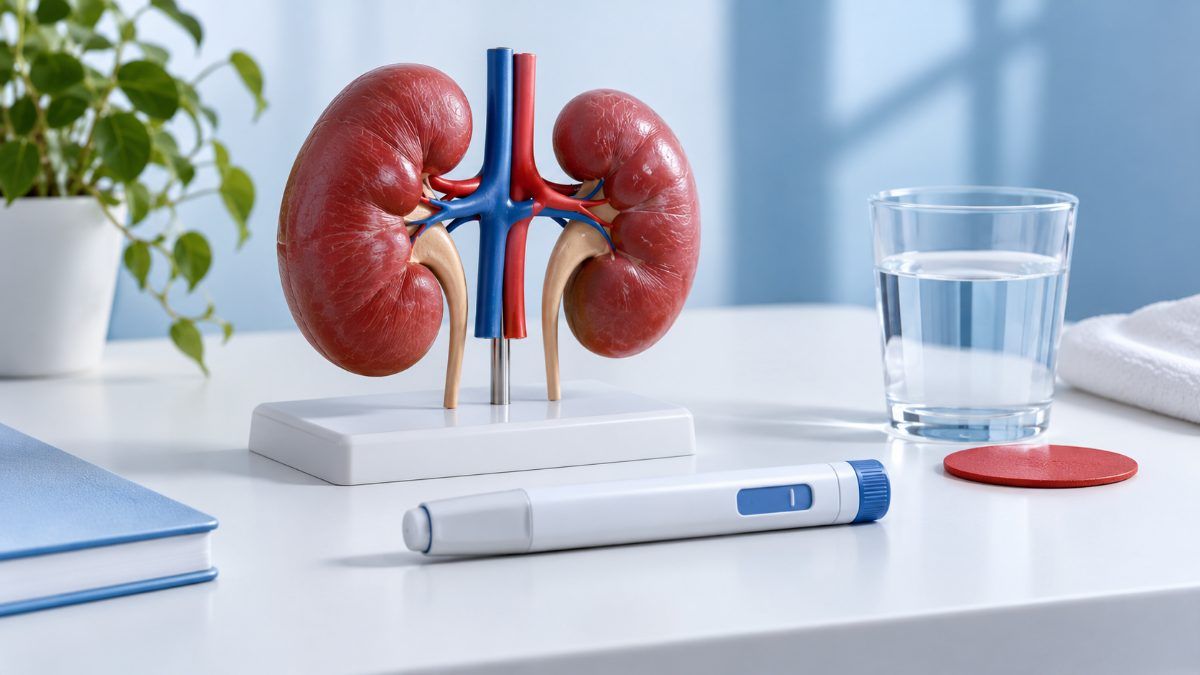
Ozempic and Your Kidneys: CKD Approval, Risks and What to Watch
Ozempic is FDA-approved to protect kidneys in type 2 diabetes with CKD. See FLOW trial results, the dehydration warning, kidney tests and when to call a doctor.
Written by Dr. Sheri Tomas. Updated November 28, 2026.
For most people with type 2 diabetes and chronic kidney disease (CKD), Ozempic is good for the kidneys: it is FDA-approved to lower the risk of kidney function decline, kidney failure and death from heart disease in that group. The approval rests on the FLOW trial, in which 3,533 adults took Ozempic 1 mg or placebo for a median of about 3.4 years. Serious kidney or heart events happened in 18.7% on Ozempic and 23.2% on placebo, a 24% lower risk. The main kidney danger is different and indirect. The label warns that nausea, vomiting and diarrhea can cause dehydration, and dehydration can lead to acute kidney injury, in some reported cases severe enough to need dialysis. So the practical picture is two-sided: long-term protection for people with diabetes and CKD, plus a short-term risk on days when you cannot keep fluids down. This guide covers what was approved, who it applies to, the label's warnings, the tests worth tracking and when to call your doctor.
Ozempic and Your Kidneys: The Short Answer
- 1Approved use: Ozempic lowers the risk of sustained eGFR decline, kidney failure and cardiovascular death in adults with type 2 diabetes and CKD.
- 2Evidence: in FLOW, the main kidney-and-heart outcome was 24% lower than placebo (HR 0.76).
- 3Not approved: CKD without type 2 diabetes is not a labeled use.
- 4Main risk: dehydration from vomiting or diarrhea can cause acute kidney injury; the label advises extra monitoring when starting or raising the dose.
- 5Dosing: the label recommends no dose change for kidney impairment; the CKD maintenance dose in the label is 1 mg weekly.
- 6FLOW slowed kidney decline; it did not show that Ozempic reverses kidney disease.
What Did the FDA Approve Ozempic for in Kidney Disease?
The current Ozempic label (revised May 2026) lists a kidney indication: "to reduce the risk of sustained eGFR decline, end-stage kidney disease, and cardiovascular death in adults with type 2 diabetes mellitus and chronic kidney disease." The approval was announced on January 28, 2025, as reported by Pharmacy Times. Ozempic keeps its other two uses: lowering blood sugar in type 2 diabetes, and reducing heart attack, stroke and cardiovascular death in adults with type 2 diabetes and established heart disease. You can read more about those in Ozempic for diabetes and Ozempic and heart health.
Two limits matter. First, the indication requires both type 2 diabetes and CKD. Second, Ozempic contains semaglutide, the same medicine as Wegovy, but the kidney indication belongs to Ozempic as labeled. If you are unsure how the brands relate, see Ozempic vs semaglutide.
What Did the FLOW Trial Show?
FLOW randomized 3,533 adults to Ozempic 1 mg once weekly (1,767 people) or placebo (1,766). The main outcome combined five events: a sustained drop in eGFR of 50% or more, eGFR falling below 15, the need for dialysis or a kidney transplant, death from kidney disease, or death from cardiovascular causes. An independent monitoring committee recommended stopping the trial early because the benefit was clear. Results were published in the New England Journal of Medicine in 2024, and the trial was funded by Novo Nordisk, which makes Ozempic.
FLOW trial results at a glance (Ozempic 1 mg vs placebo)
Outcome
Ozempic 1 mg
Placebo
Hazard ratio (95% CI)
Main composite (kidney events + CV death)
331 (18.7%)
410 (23.2%)
0.76 (0.66-0.88)
Kidney-specific events only
-
-
0.79 (0.66-0.94)
Cardiovascular death
-
-
0.71 (0.56-0.89)
Major cardiovascular events
212
254
0.82 (0.68-0.98)
Death from any cause
-
-
0.80 (0.67-0.95)
Yearly eGFR decline
1.16 mL/min/1.73 m2 per year slower
Reference
P<0.001
Serious adverse events
49.6%
53.8%
-
A hazard ratio below 1 favours Ozempic, and here every confidence interval stays below 1. The eGFR slope result means kidney function still declined on Ozempic, just more slowly. That is why headlines saying Ozempic "reverses" kidney disease go further than the trial. Serious adverse events were slightly less common on Ozempic than on placebo.
Who Was in FLOW, and Does It Apply to You?
FLOW enrolled people with type 2 diabetes and moderate-to-advanced CKD with protein leaking into the urine. According to the label, they had an eGFR of 25 to 75 mL/min/1.73m2 and a urine albumin-to-creatinine ratio (UACR) above 100 and below 5,000 mg/g, with an HbA1c of 10% or lower. In everyday terms, that covers many people with stage 3 and some with stage 4 CKD.
- 1Closest match: type 2 diabetes, eGFR 25 to 75, and albumin in the urine above 100 mg/g.
- 2Less certain: eGFR below 25, people on dialysis, or CKD with little or no albumin in the urine (not the FLOW population).
- 3Not covered: CKD without type 2 diabetes, or type 1 diabetes.
- 4Ask your doctor where your latest eGFR and UACR results fall before assuming the FLOW results apply to you.
Can Ozempic Cause Kidney Damage?
Yes, indirectly. Warning 5.6 of the label, "Acute Kidney Injury Due to Volume Depletion," says: "There have been postmarketing reports of acute kidney injury, in some cases requiring hemodialysis." It adds that "the majority of the reported events occurred in patients who experienced gastrointestinal reactions leading to dehydration." The label tells prescribers to monitor kidney function in people with side effects that could cause fluid loss, "especially during dosage initiation and escalation." These are reports collected after approval, so they show that the problem happens, not how often.
This risk does not cancel out the FLOW benefit. It is the reason to treat persistent vomiting or diarrhea on Ozempic as a medical issue rather than something to push through. For a wider look at the label's warnings, see is Ozempic safe?, and for a separate serious warning, Ozempic and pancreatitis.
Why Dehydration Is the Main Kidney Risk
Ozempic slows digestion and commonly causes stomach side effects, especially in the first weeks and after each dose increase. The label's placebo-controlled data show how often they occur.
Stomach side effects that can lead to dehydration (Ozempic label, placebo-controlled trials)
Side effect
Placebo
Ozempic 0.5 mg
Ozempic 1 mg
Nausea
6.1%
15.8%
20.3%
Vomiting
2.3%
5%
9.2%
Diarrhea
1.9%
8.5%
8.8%
Stopped treatment because of stomach effects
0.4%
3.1%
3.8%
The Medication Guide puts it simply: "Diarrhea, nausea, and vomiting may cause a loss of fluids (dehydration) which may cause kidney problems." It asks patients to tell their healthcare provider right away about nausea, vomiting or diarrhea that does not go away. People who already have CKD have less reserve, and some also take medicines that affect fluid balance, such as diuretics. Practical tips for managing loose stools are in Ozempic diarrhea, and changes in urination are covered in does Ozempic make you pee more?.
Simple ways to lower the risk:
- 1Sip fluids through the day, especially when nausea makes meals smaller.
- 2Eat smaller meals and stop when you feel full.
- 3On days with vomiting or diarrhea, call your care team early instead of waiting.
- 4Ask whether any of your regular medicines should be paused on sick days; do not stop them on your own.
Do You Need a Lower Dose if You Have Kidney Disease?
No, according to the label. Section 8.6 states: "No dose adjustment of OZEMPIC is recommended for patients with renal impairment," and reports no clinically relevant change in how the body handles the drug in renal impairment, including kidney failure. The label dosing, quoted here from the FDA label and not as a recommendation, is: start at 0.25 mg once weekly for 4 weeks, then 0.5 mg. Maintenance doses are 0.5, 1 or 2 mg weekly, with a maximum of 2 mg. For the CKD indication, the label says to "increase the dosage to the maintenance dosage, 1 mg once weekly, after at least 4 weeks on the 0.5 mg dosage." Your prescriber sets your schedule. The basics of how the medicine works are in what is Ozempic?.
Can You Take Ozempic With an SGLT2 Inhibitor or Other Kidney Drugs?
Many people with diabetic kidney disease also take an SGLT2 inhibitor such as Jardiance (empagliflozin) or Farxiga (dapagliflozin). In FLOW, only 550 participants were on an SGLT2 inhibitor at the start. A prespecified analysis published in Nature Medicine found a hazard ratio of 1.07 (0.69-1.67) in that group, against 0.73 (0.63-0.85) in people not taking one. The difference between the groups was not statistically significant (P for interaction 0.109), and the authors noted the subgroup was too small to be conclusive.
The fair summary: the added benefit of Ozempic on top of an SGLT2 inhibitor was not clearly shown in this small subgroup. That is different from showing it does not work. Whether to use both is a decision for you and your doctor, who will weigh your blood sugar, heart risk, kidney numbers and side effects. Ozempic's effects on blood pressure, another kidney risk factor, are covered in does Ozempic lower blood pressure and cholesterol?.
Does Ozempic Help Kidneys If You Don't Have Diabetes?
This is not an approved use. Drugs.com, reporting a HealthDay story, described a 24-week study published in Nature Medicine on October 25, 2024, in 101 people with obesity and CKD but without diabetes. It reported up to a 52% reduction in urine albumin measures compared with placebo. We could not verify the trial name, the paper's title or its funding, and urine albumin is a marker, not a hard outcome such as kidney failure. Treat it as early research.
Which Kidney Tests Should You Track?
Two routine tests describe kidney health in diabetes, and FLOW used both to choose participants.
- 1eGFR (estimated glomerular filtration rate): a blood test estimate of how well the kidneys filter. FLOW enrolled people with eGFR 25 to 75.
- 2UACR (urine albumin-to-creatinine ratio): a urine test for protein leakage. FLOW required a UACR above 100 mg/g.
- 3Ask for both results at baseline, then at the intervals your doctor recommends.
- 4Ask for a kidney check if you have had vomiting or diarrhea, as the label advises monitoring in that situation.
- 5Keep a simple log of results so you can see the trend rather than a single number.
When to Talk to Your Doctor
- 1Nausea, vomiting or diarrhea that does not go away, or you cannot keep fluids down.
- 2Signs of dehydration: dizziness on standing, very dark urine, or passing much less urine than usual.
- 3Swelling of the legs or face, or sudden shortness of breath.
- 4Severe stomach pain that will not go away, with or without vomiting (seek urgent care).
- 5You have CKD without type 2 diabetes and are considering Ozempic.
- 6You take diuretics, an SGLT2 inhibitor or other kidney or blood pressure medicines and are starting or increasing Ozempic.
What to Do Next: Questions to Ask and a Checklist
- 1Ask: Do my eGFR and UACR results fit the FLOW population?
- 2Ask: Should I stay on, add or change my SGLT2 inhibitor or other kidney medicines?
- 3Ask: What is my sick-day plan if I vomit or have diarrhea?
- 4Ask: How often should my kidney function be checked while I increase the dose?
- 5Checklist: bring your latest lab results and a full medicine list to each visit.
- 6Checklist: track fluids and side effects in the first weeks of each new dose.
- 7Checklist: if cost is a barrier, see does insurance cover Ozempic?.
The Bottom Line
For adults with type 2 diabetes and chronic kidney disease, Ozempic is an approved kidney-protecting treatment: in FLOW it lowered the combined risk of serious kidney events and cardiovascular death by 24% and slowed eGFR decline. It does not reverse CKD, it is not approved for CKD without diabetes, and its benefit on top of an SGLT2 inhibitor is not yet clear. The kidney risk to plan for is dehydration from stomach side effects, which can cause acute kidney injury. Drink enough, report persistent vomiting or diarrhea, and keep your eGFR and UACR under regular review.
FAQ
For most people, no. In FLOW it slowed kidney decline in type 2 diabetes with CKD. The label warns that dehydration from vomiting or diarrhea can cause acute kidney injury.
Yes, for adults with type 2 diabetes and chronic kidney disease, to reduce the risk of eGFR decline, kidney failure and cardiovascular death. It is not approved for CKD without diabetes.
The label reports postmarketing cases of acute kidney injury, some needing dialysis, mostly in people dehydrated by stomach side effects. In FLOW, kidney-specific events, a combined outcome that included kidney failure, were 21% less common on Ozempic.
FLOW enrolled people with eGFR 25 to 75, which includes many with stage 3 and some with stage 4 CKD. The label recommends no dose change for kidney impairment.
The label does not give a typical creatinine change. Dehydration from vomiting or diarrhea can cause acute kidney injury, so the label advises checking kidney function in that case.
Doctors may prescribe both. In FLOW, only 550 people took an SGLT2 inhibitor, and Ozempic's added benefit was not clearly shown in that small subgroup.
Sources
- 1Ozempic (semaglutide) injection Prescribing Information, FDA, 2026
- 2FDA Approves Semaglutide to Reduce Kidney Disease, Cardiovascular Death Risk in Adults With Type 2 Diabetes, Chronic Kidney Disease, Pharmacy Times, 2025
- 3Effects of Semaglutide on Chronic Kidney Disease in Patients with Type 2 Diabetes (Perkovic V, et al., N Engl J Med), NEJM, 2024
- 4Effects of semaglutide with and without concomitant SGLT2 inhibitor use in participants with type 2 diabetes and chronic kidney disease in the FLOW trial, Nature Medicine, 2024
- 5Ozempic Curbs Kidney Disease in Obese People Without Diabetes, Drugs.com/HealthDay, 2024
This article provides general information based on the FDA label and published research and is not a substitute for advice from a doctor who knows your health history. The FLOW trial was funded by Novo Nordisk, which makes Ozempic.

Dr. Sheri Tomas
Author
Comments (0)
Be the first to comment on this article.
More articles