
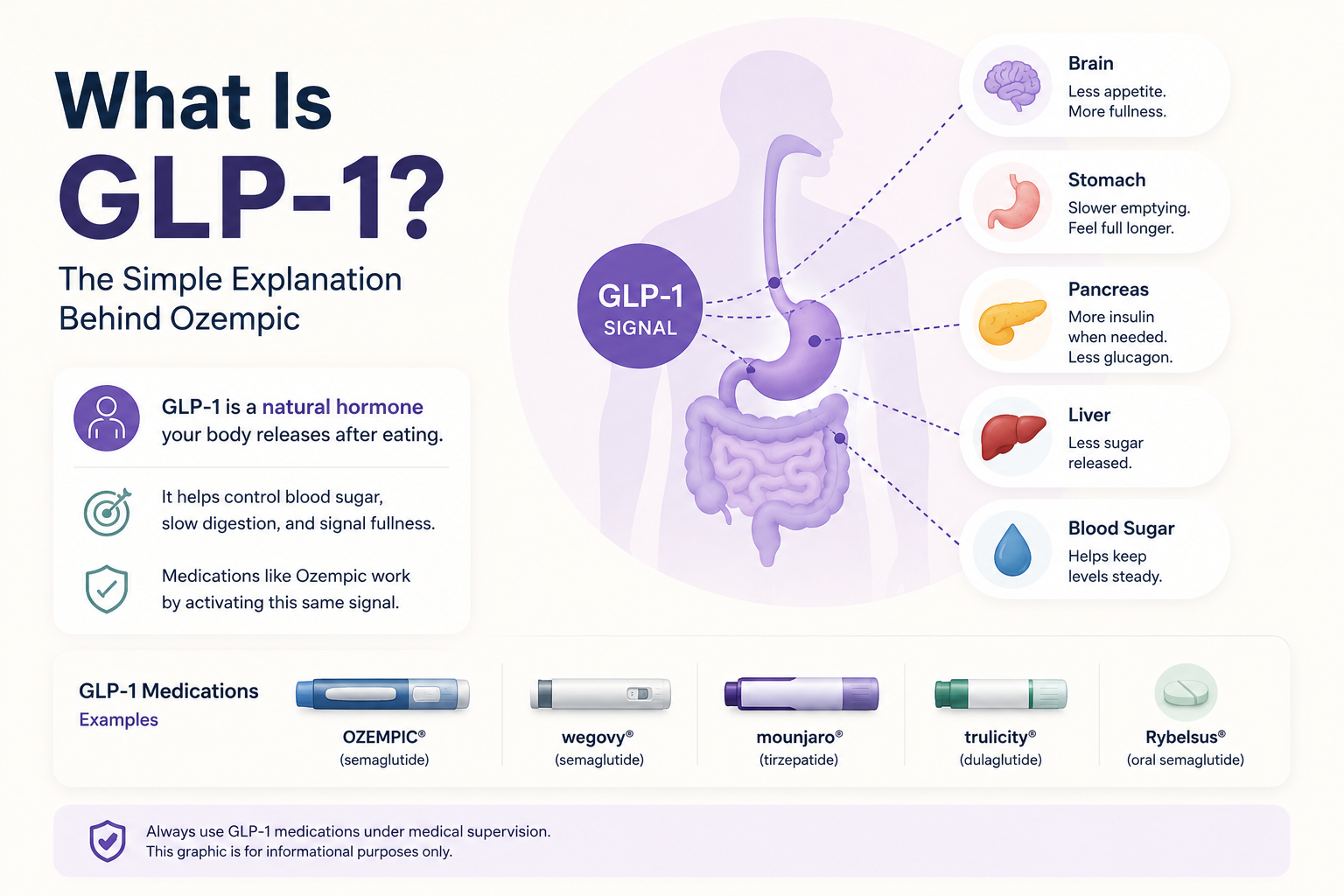
What Is GLP-1? The Simple Explanation Behind Ozempic
GLP-1 sounds like the name of a drug, but it is actually a natural hormone signal your body uses after eating. Long before Ozempic became famous, GLP-1 was already involved in blood sugar, insulin response, glucagon, stomach emptying, fullness, and appetite. This guide explains what GLP-1 means, how it works, why Ozempic and semaglutide are connected to it, and why GLP-1 drugs, pills, patches, supplements, diabetes, and weight-loss claims are so often confused.
What Is GLP-1? The Simple Explanation Behind Ozempic
Last updated: June 28, 2026
GLP-1 sounds like the name of a drug.
It is not.
Before Ozempic became famous, GLP-1 was already part of normal human biology — a signal your body uses after eating.
That is the first thing to understand.
GLP-1 is not a brand. It is not Ozempic. It is not a weight-loss shortcut. It is not a magic hormone that melts fat.
GLP-1 is a natural hormone involved in how the body responds to food.
After you eat, your body has to make a series of decisions:
- 1How much insulin should be released?
- 2Should the liver keep sending sugar into the blood?
- 3How fast should the stomach empty?
- 4How full do you feel?
- 5How much more food do you want?
GLP-1 is part of that conversation.
Ozempic became famous because semaglutide, its active ingredient, activates the GLP-1 receptor. But the signal itself existed long before the medication.
This guide explains GLP-1 in plain English: what it stands for, what it does, why it matters for diabetes, why it became part of the weight-loss conversation, what GLP-1 receptor agonists are, and why pills, patches, supplements, and online GLP-1 claims can be confusing.
Sources used note: This article is based on official prescribing information, FDA safety communications, and publicly available medical references on GLP-1 biology and GLP-1 receptor agonists. It is educational only and is not medical advice.
Quick Answer: What Is GLP-1?
GLP-1 stands for glucagon-like peptide-1.
It is a natural hormone involved in the body’s response after eating.
In simple terms, GLP-1 helps tell the body:
- 1food has arrived;
- 2blood sugar may be rising;
- 3the pancreas should respond;
- 4the liver should not release too much extra sugar;
- 5the stomach can slow down;
- 6fullness signals may increase.
GLP-1 matters because several well-known medications are designed to act on GLP-1 pathways.
Ozempic contains semaglutide, which is a GLP-1 receptor agonist. That means it activates the GLP-1 receptor, the target used by natural GLP-1.
So the short answer is:
- 1GLP-1 is a natural food-response signal.
- 2Ozempic is a medication that uses that signal.
That difference matters.
What Does GLP-1 Stand For?
The name sounds more complicated than the idea.
GLP-1 stands for glucagon-like peptide-1.
That name comes from biology, not marketing.
“Peptide” means it is made of amino acids.
“Glucagon-like” refers to its relationship to a family of hormones involved in glucose regulation.
The “1” separates it from related peptides.
But for normal readers, the full name is less important than the job.
GLP-1 is one of the body’s after-meal signals. It helps the body respond to food in a coordinated way.
That is why GLP-1 became important in both diabetes and weight-management medicine.
The Body Had a GLP-1 Signal Before Ozempic Existed
People often talk about GLP-1 as if the medication created the biology.
It did not.
Your body already makes GLP-1.
GLP-1 is released after eating, especially from cells in the gut. It is part of the incretin system, which helps connect food intake with insulin response and blood sugar regulation.
That is why GLP-1 medications do not feel like a normal “drug trick.”
They are built around a signal the body already uses.
- 1The medication does not invent fullness.
- 2It does not invent insulin response.
- 3It does not invent stomach-emptying control.
It amplifies or imitates a pathway that already exists.
That is what made GLP-1 biology so powerful in medicine.
It sits at the intersection of food, blood sugar, digestion, and appetite.
What GLP-1 Does After You Eat
After food arrives, the body needs coordination.
Think of eating like opening a busy restaurant kitchen.
- 1Food comes in.
- 2Orders start moving.
- 3Different stations need to know what to do.
- 4The pancreas has a role.
- 5The liver has a role.
- 6The stomach has a role.
- 7The brain has a role.
GLP-1 helps send part of the message.
It does not do everything by itself. But it helps the body respond more intelligently after food arrives.
That is why GLP-1 is often discussed through four simple areas:
- 1blood sugar;
- 2insulin and glucagon;
- 3stomach emptying;
- 4fullness and appetite.
Those four areas explain most of the public interest in GLP-1 medications.
GLP-1 and Blood Sugar: Why Insulin and Glucagon Matter
Blood sugar is not controlled by one switch.
It is controlled by a conversation.
Two important voices in that conversation are insulin and glucagon.
Insulin helps move glucose from the blood into cells.
Glucagon tells the liver to release stored sugar into the blood.
After eating, the body usually needs more insulin response and less unnecessary sugar release from the liver.
GLP-1 supports that balance.
One key point matters:
GLP-1 stimulates insulin secretion in a glucose-dependent way.
That means the insulin signal is connected to blood sugar being elevated, not simply forced on all the time.
GLP-1 also helps reduce glucagon secretion, which can help limit extra sugar release from the liver.
This is why GLP-1 became important in type 2 diabetes care.
Type 2 diabetes is not just “too much sugar.” It involves how the body handles glucose, insulin response, and liver sugar output over time.
GLP-1 sits inside that system.
GLP-1 and the Stomach: Why Fullness Can Last Longer
The stomach is not just a bag that holds food.
It is more like a gate.
One of GLP-1’s effects is slowing gastric emptying, which means food may leave the stomach more slowly.
That can matter for blood sugar because food entering the intestine more gradually may affect how quickly glucose appears in the blood after eating.
It can also matter for fullness.
If the stomach empties more slowly, some people may feel full sooner or full longer.
This is one reason GLP-1 medications are often associated with appetite changes.
But slower stomach emptying is also part of why digestive side effects can happen.
The same biology that can support fullness may also contribute to nausea, stomach discomfort, constipation, or changes in how food feels.
That is why GLP-1 is not a simple “good hormone” or “bad hormone.”
It is a powerful signal.
Powerful signals need context.
GLP-1 and Appetite: Why It Became a Weight-Loss Conversation
GLP-1 does not burn fat directly.
That is where many people get the story wrong.
GLP-1 became medically important before the public hype because of diabetes and blood sugar biology. Weight loss became the louder public story later because GLP-1 pathways also affect fullness, appetite, and food intake.
That is the bridge.
Some people taking GLP-1 receptor agonist medications report feeling full sooner, thinking about food less, or eating smaller portions.
That can reduce food intake and contribute to weight loss in some people.
But the mechanism is not magic.
It is biology.
The public often jumps straight to “GLP-1 for weight loss.”
The better first question is:
What part of the food-response system is GLP-1 changing?
What Is a GLP-1 Receptor Agonist?
The phrase “GLP-1 receptor agonist” sounds harder than it is.
Break it into three parts.
- 1GLP-1 is the signal.
- 2A receptor is the place where the signal acts.
- 3An agonist is something that activates that receptor.
So a GLP-1 receptor agonist is a medication that activates the GLP-1 receptor.
A simple way to think about it:
- 1GLP-1 is the body’s message.
- 2The GLP-1 receptor is the mailbox.
- 3A GLP-1 receptor agonist is a medication that delivers a similar message to that mailbox.
The analogy is not perfect, but it helps.
The key idea is that these medications work by activating a specific biological pathway, not by acting like stimulants or fat burners.
GLP-1 vs Semaglutide vs Ozempic: The Simple Difference
This confusion is everywhere online.
People often use “GLP-1,” “semaglutide,” and “Ozempic” like they are the same word.
They are connected.
They are not identical.
- 1GLP-1 is a natural hormone signal.
- 2A GLP-1 receptor agonist is a medication that activates the GLP-1 receptor.
- 3Semaglutide is an active ingredient that acts as a GLP-1 receptor agonist.
- 4Ozempic is a brand-name medication containing semaglutide.
That means Ozempic is commonly called a GLP-1 medication, but technically Ozempic is not the natural GLP-1 hormone itself. It contains semaglutide, a drug that activates the GLP-1 receptor.
The same confusion happens with other names.
Wegovy is another brand-name semaglutide medication in a different medical context.
Oral semaglutide products also belong to the GLP-1 receptor agonist conversation.
The clean version is simple:
- 1GLP-1 is the signal.
- 2Semaglutide is the active ingredient.
- 3Ozempic is the brand.
GLP-1 Medications and Drugs: Why the Names Get Confusing
The word “GLP-1” now gets used like an umbrella.
That can be useful.
It can also be misleading.
People search for GLP-1 medications, GLP-1 drugs, GLP-1 injections, GLP-1 pills, GLP-1 shots, oral GLP-1, and GLP-1 drugs list.
- 1Some of those searches are about approved prescription medications.
- 2Some are about telehealth ads.
- 3Some are about compounded products.
- 4Some are about supplements.
- 5Some are about patches.
- 6Some are about products that may not be FDA-approved at all.
That is why the word “GLP-1” needs careful reading.
A true GLP-1 medication is not just anything that uses the phrase on a website.
The important questions are:
- 1What is the exact active ingredient?
- 2Is it FDA-approved?
- 3What is the approved use?
- 4Who prescribed it?
- 5Is it coming from a licensed pharmacy?
- 6Is the dose clear?
- 7Is there real medical follow-up?
A product can borrow the language of GLP-1 without giving you the safety, evidence, or regulatory status of an approved prescription medication.
That is one of the biggest things people miss.
Are Wegovy, Mounjaro, Zepbound, Rybelsus, and Trulicity GLP-1 Drugs?
People often ask whether each famous name is “a GLP-1.”
The answer depends on how precise you want to be.
Wegovy contains semaglutide and is part of the GLP-1 receptor agonist conversation.
Trulicity contains dulaglutide, another GLP-1 receptor agonist.
Mounjaro and Zepbound contain tirzepatide, which acts on both GIP and GLP-1 receptors. That means they are often discussed alongside GLP-1 medications, but they are not the same as GLP-1-only semaglutide products.
Oral semaglutide products also sit in the GLP-1 receptor agonist conversation, but the exact brand, label, and medical context still matter.
For a normal reader, the practical lesson is this:
Do not assume all “GLP-1” drugs are the same.
They may have different active ingredients, approved uses, doses, side-effect profiles, and prescribing contexts.
GLP-1 Pills, Injections, Patches, and Supplements: What People Often Miss
A pill is not automatically safer.
A patch is not automatically real.
A supplement is not automatically a GLP-1 medication.
People search for GLP-1 pills, GLP-1 injections, GLP-1 patches, GLP-1 supplements, natural GLP-1, and GLP-1 boosters because the market has become crowded and confusing.
Some approved GLP-1-related medications are injections.
Some approved products are oral medications.
But many products marketed with GLP-1 language are not the same as approved prescription GLP-1 medications.
That is especially important with patches and supplements.
A product may claim to “support GLP-1” or “boost GLP-1” without being a prescription GLP-1 receptor agonist.
- 1That does not automatically mean it works like Ozempic.
- 2It does not automatically mean it has the same evidence.
- 3It does not automatically mean it is appropriate for weight loss or diabetes.
GLP-1 has become a powerful marketing phrase.
Marketing language is not the same as medical evidence.
Do GLP-1 Patches Work?
The most important thing about GLP-1 patches is not the patch.
It is the claim.
Many people search whether GLP-1 patches work because patches sound easy: no injection, no prescription, no complicated medication plan.
That simplicity is exactly why the claim should be questioned.
A patch marketed with GLP-1 language is not automatically an approved GLP-1 medication.
- 1It may be a wellness product.
- 2It may be a supplement-style product.
- 3It may use vague language like “supports GLP-1” rather than clearly identifying an FDA-approved active ingredient.
This article does not recommend GLP-1 patches.
The safer question is not:
Does this patch sound like Ozempic?
The safer question is:
What exactly is in it, what evidence supports it, is it FDA-approved for the claimed use, and has a licensed healthcare professional reviewed it?
If the answer is unclear, the risk is not unclear.
Can You Increase GLP-1 Naturally?
“Natural GLP-1” sounds harmless.
The reality is more complicated.
Food, digestion, gut signals, and metabolic health can influence the body’s incretin system. People often search for ways to increase GLP-1 naturally through diet, fiber, protein, exercise, sleep, or gut health.
Those topics may matter for general health.
But they should not be confused with prescription GLP-1 receptor agonist medications.
- 1Eating more fiber is not the same as taking semaglutide.
- 2A probiotic is not the same as Ozempic.
- 3A supplement is not the same as an FDA-approved GLP-1 medication.
That does not mean lifestyle is unimportant.
It means the comparison should be honest.
- 1Natural habits may support metabolic health.
- 2They do not turn into prescription GLP-1 therapy.
GLP-1 Side Effects and Safety Questions
A signal that affects food, stomach emptying, appetite, and blood sugar can also create side effects.
That should not be surprising.
People search for GLP-1 side effects, GLP-1 long-term side effects, whether GLP-1 is safe, whether GLP-1 causes hair loss, and whether GLP-1 causes cancer.
Those are serious questions.
This article cannot replace prescribing information or a medical visit, but it can explain the basic reason side effects are part of the GLP-1 conversation.
Commonly discussed GLP-1 medication side effects often involve the digestive system: nausea, vomiting, diarrhea, constipation, stomach discomfort, reduced appetite, and changes in how food feels.
More serious risks and warnings depend on the specific medication and the person’s medical history.
Safety is not only about the drug class.
It is about the exact product, dose, diagnosis, other medications, kidney function, digestive history, gallbladder or pancreas concerns, pregnancy or breastfeeding considerations, and clinical supervision.
That is why “Is GLP-1 safe?” is too broad.
The better question is:
Safe for which person, using which medication, for which condition, under what medical supervision?
GLP-1 for Diabetes vs GLP-1 for Weight Loss
The same biology can sit inside two different medical conversations.
That is why people get confused.
For type 2 diabetes, GLP-1 receptor agonists matter because they can help improve blood sugar control through insulin response, glucagon regulation, and slower stomach emptying.
For weight management, GLP-1-related therapies matter because fullness, appetite, stomach emptying, and food intake can affect body weight.
Those are connected systems.
But connected does not mean identical.
A medication used for diabetes may have a different label, dose system, patient group, and medical goal than a medication used for chronic weight management.
That is why Ozempic and Wegovy can both contain semaglutide but still belong to different medical conversations.
The ingredient can overlap.
The label context can differ.
That is the key.
Bottom Line
- 1GLP-1 is not Ozempic.
- 2GLP-1 is not a brand.
- 3GLP-1 is a natural hormone signal involved in how the body responds after eating.
It helps connect food intake with insulin response, glucagon regulation, stomach emptying, fullness, appetite, and blood sugar.
GLP-1 receptor agonists are medications that act on that signal.
Ozempic is one brand connected to that pathway because it contains semaglutide, a GLP-1 receptor agonist.
But “GLP-1” now appears everywhere: prescription medications, diabetes care, weight-loss headlines, telehealth ads, pills, injections, patches, supplements, and online claims.
That is why the word needs context.
The clean way to understand it is this:
- 1GLP-1 is the body’s signal.
- 2GLP-1 receptor agonists are medications that act on that signal.
- 3Ozempic is one brand connected to that pathway.
- 1The signal came first.
- 2The hype came later.
FAQ
Frequently Asked Questions
GLP-1 stands for glucagon-like peptide-1. It is a natural hormone involved in the body’s response after eating, including blood sugar, insulin, glucagon, stomach emptying, fullness, and appetite.
GLP-1 stands for glucagon-like peptide-1.
GLP-1 itself is a natural hormone signal. GLP-1 receptor agonists are medications designed to activate the GLP-1 receptor.
GLP-1 helps the body respond after eating. It is involved in insulin response, glucagon regulation, stomach emptying, fullness, appetite, and food intake.
GLP-1 works by activating GLP-1 receptors. In practical terms, it helps signal the pancreas, liver, stomach, and appetite pathways after food arrives.
A GLP-1 receptor agonist is a medication that activates the GLP-1 receptor, the target used by natural GLP-1.
Ozempic is commonly called a GLP-1 medication, but technically Ozempic is not natural GLP-1 itself. Ozempic contains semaglutide, a GLP-1 receptor agonist.
Semaglutide is a GLP-1 receptor agonist. It activates the GLP-1 receptor.
No. GLP-1 is a natural hormone signal. Ozempic is a brand-name medication containing semaglutide, which activates the GLP-1 receptor.
Wegovy contains semaglutide and belongs to the GLP-1 receptor agonist conversation.
Mounjaro contains tirzepatide, which acts on both GIP and GLP-1 receptors. It is often discussed alongside GLP-1 drugs, but it is not the same as semaglutide.
Zepbound contains tirzepatide, which acts on both GIP and GLP-1 receptors. It is often grouped with GLP-1-related therapies, but it is not a GLP-1-only semaglutide product.
No. Metformin is not a GLP-1 receptor agonist. It is a different type of medication used in diabetes care.
Yes. GLP-1 receptor agonists are used in type 2 diabetes care because they can help improve blood sugar control.
Some GLP-1-related medications are approved for chronic weight management in eligible patients. Others are approved for diabetes or other specific uses. The exact product and label matter.
No. GLP-1 medications do not directly burn fat. Weight loss, when it happens, is usually related to appetite, fullness, stomach emptying, food intake, and metabolic context.
A GLP-1 patch is not automatically an approved GLP-1 medication. Check the active ingredient, evidence, approval status, and medical supervision before trusting any claim.
No. Supplements marketed around GLP-1 are not the same as prescription GLP-1 receptor agonist medications.
Food, digestion, exercise, fiber, protein, and metabolic health may influence gut hormone signaling, but lifestyle habits are not the same as prescription GLP-1 receptor agonist medications.
Safety depends on the exact medication, the person, the diagnosis, other medications, medical history, and clinical supervision. GLP-1 medications can have side effects and warnings.
Commonly discussed side effects often include nausea, vomiting, diarrhea, constipation, stomach discomfort, reduced appetite, and digestive changes. Serious warnings depend on the specific medication.
No. Ozempic.review provides educational information only. It does not prescribe, diagnose, rank medications, or recommend a specific GLP-1 drug.
Sources
- 1Ozempic Prescribing Information — official information describing semaglutide as a GLP-1 receptor agonist that selectively binds to and activates the GLP-1 receptor.
- 2Medical review literature on GLP-1 biology — information on GLP-1 as an incretin hormone involved in insulin secretion, gastric emptying, food intake, and appetite-related pathways.
- 3FDA’s Concerns with Unapproved GLP-1 Drugs Used for Weight Loss — official FDA information on concerns involving unapproved GLP-1 drugs marketed for weight loss.
- 4NIDDK information on GLP-1 receptor agonists and weight-management medications — federal educational information on incretin-based therapies in diabetes and weight-related care.
- 5Official prescribing information for GLP-1-related medications — product-specific information on approved uses, warnings, side effects, and limitations.
Editorial Team
Comments (0)
Be the first to comment on this article.
