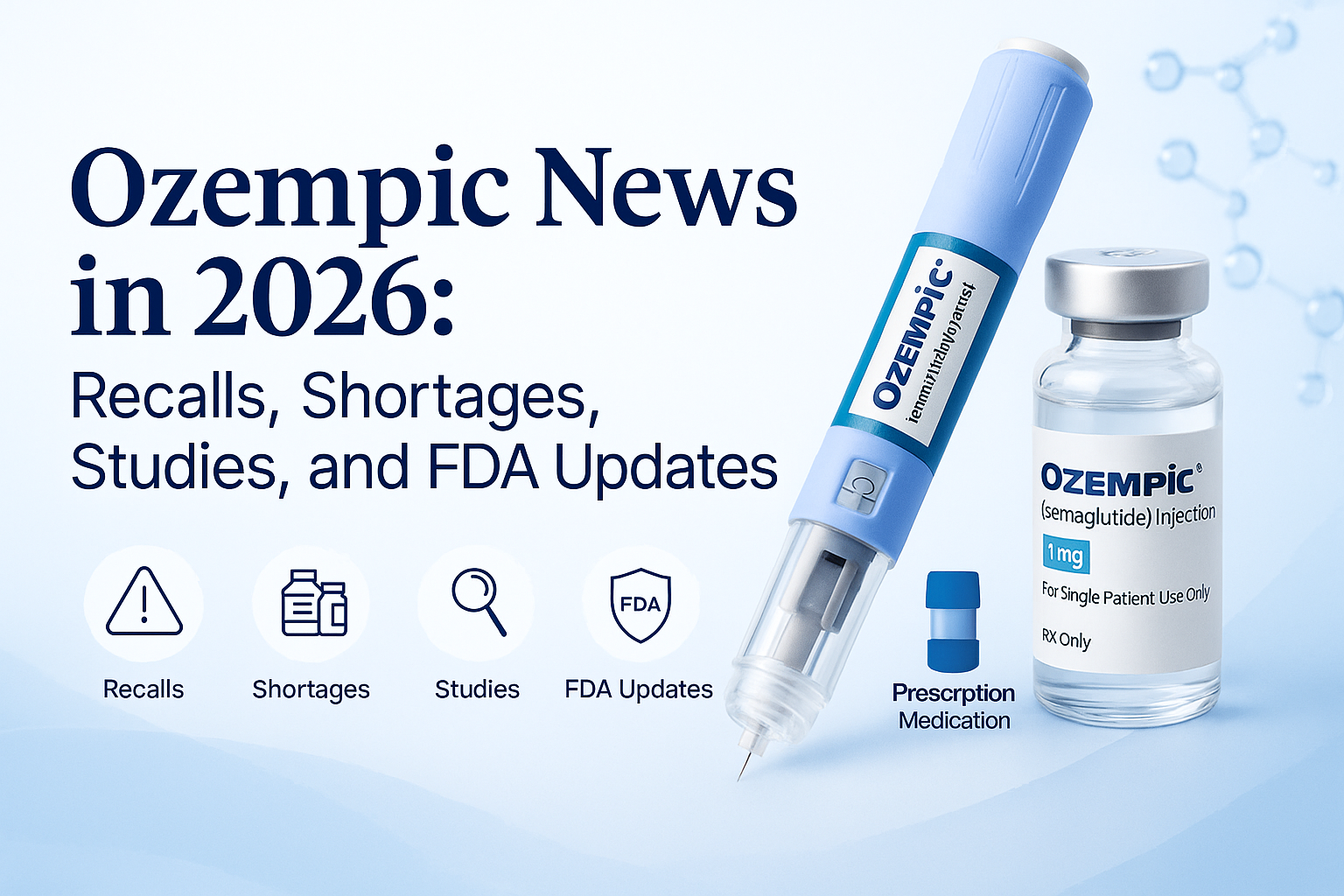
Ozempic News in 2026: Recalls, Shortages, Studies, and FDA Updates
Ozempic news 2026: shortage is over, but FDA compounding bans, counterfeit pens, recalls, lawsuits, and new studies still affect patients. Here's what to know.
Here’s the latest Ozempic news for 2026 — drawn from the evidence, not the forums. Shortages have ended, but the fallout hasn’t. Compounded copies face extinction. Lawsuits are piling up. And a few terms invented online are masking real, though poorly understood, changes in people’s bodies.
This article is for general education only and does not replace medical advice from a licensed healthcare professional.
Quick Answer
The U.S. semaglutide injection shortage ended in February 2025. Ozempic and Wegovy are no longer officially short, though some pharmacies still run out of specific doses.
The FDA is moving to permanently ban compounded semaglutide (pharmacy‑made copies not manufactured by Novo Nordisk), tirzepatide, and liraglutide. Counterfeit Ozempic pens continue to surface, and the agency warns against any product labeled “for research purposes.”
More than 3,500 federal lawsuits consolidated in MDL 3094 claim the makers failed to warn about severe gastrointestinal injuries. A separate, smaller group of cases (MDL 3163) targets a rare form of vision loss. As of August 2026, there are no settlements. Terms like “Ozempic face” and “Ozempic vulva” are social‑media coinages, not medically recognized side effects.
What You’re Actually Taking
Ozempic’s active ingredient is semaglutide, a synthetic GLP‑1 receptor agonist that mimics a gut hormone to regulate blood sugar and slow stomach emptying — which also suppresses appetite.
The drug is FDA‑approved for type 2 diabetes — not for weight loss. Wegovy is the same molecule at a higher dose and is approved for chronic weight management. Rybelsus is an oral semaglutide tablet for diabetes only. In December 2025, the FDA also approved an oral Wegovy pill for weight loss — the first oral GLP‑1 cleared for that indication.
Mounjaro and Zepbound contain tirzepatide, which activates both GLP‑1 and GIP receptors. They are not interchangeable with semaglutide. Studies on Wegovy or Mounjaro don’t automatically apply to Ozempic at its diabetes‑treatment doses.
Shortages, Compounding, and Counterfeits
The U.S. semaglutide injection shortage was declared resolved on February 21, 2025. A phase‑out followed: within 60 to 90 days, most compounding of Ozempic or Wegovy copies became illegal, since the law only permits compounding while a drug is officially short.
The larger crackdown came in April 2026, when the FDA proposed permanently excluding semaglutide, tirzepatide, and liraglutide from the list of substances that large outsourcing facilities can use. Public comment closed in July 2026. If finalized, even the biggest compounding operations would be cut off.
While that fight plays out, some companies have found a workaround: vials stamped “for research use only” or “not for human consumption” that ship with a dosing schedule. The FDA calls these unapproved, of unknown quality, and sometimes outright counterfeit. Counterfeit Ozempic pens have already been found inside the legitimate U.S. supply chain — they could contain the wrong ingredients, too little active drug, or harmful substances.
One 2026 recall grabbed headlines, but it happened in South Africa. Regulators there pulled iDexis products that mixed semaglutide and tirzepatide, calling them a severe risk to patient safety. In the United States, no recall of authentic Novo Nordisk‑manufactured Ozempic has been issued.
The Lawsuit Landscape
More than 3,500 federal lawsuits against Novo Nordisk and Eli Lilly are consolidated in a Pennsylvania court under MDL 3094. Plaintiffs claim the companies failed to adequately warn about severe gastrointestinal injuries, including gastroparesis — a condition where the stomach empties too slowly. In some cases, the damage may be long‑lasting.
A newer, separate track (MDL 3163, created December 2025) targets semaglutide for a rare form of vision loss called non‑arteritic anterior ischemic optic neuropathy (NAION). A large observational study in JAMA Ophthalmology (2024) found semaglutide was associated with a higher risk: roughly a fourfold increase in people with type 2 diabetes, and over a sevenfold increase in those who were overweight or obese, compared to patients on other medications. The study was observational and cannot prove cause and effect, but it has become a centerpiece of the litigation.
Europe’s drug regulator added NAION to the label in 2025; the UK followed in February 2026. As of August 2026, the U.S. labeling for Ozempic, Wegovy, and Rybelsus still does not mention NAION — a gap that fuels the vision‑loss lawsuits. No settlements or verdicts have been reached in either MDL.
Severe abdominal pain, persistent vomiting, or an inability to keep down fluids while on these medications warrants immediate medical attention. Sudden vision loss or a shadow over part of your vision is a medical emergency. Seek help immediately.
Viral Terms That Aren’t Medical Diagnoses
The hollowed, gaunt look photographed and posted as “Ozempic face” is real — but it’s not a disease, and it’s not unique to semaglutide. Any rapid weight loss, whether from bariatric surgery, a crash diet, or a GLP‑1 drug, strips subcutaneous fat from the face, making wrinkles and sunken cheeks more prominent. A 2025 systematic review found no evidence that semaglutide targets facial fat any differently than other weight‑loss methods.
“Ozempic vulva” (or “Ozempic vagina”) is an even shakier concept. No clinical study has confirmed that semaglutide directly causes vaginal dryness, sagging, changes in sensitivity, or the other sensations some users describe online. Clinicians hypothesize that rapid total‑body fat loss, dehydration from GI side effects, and loss of pelvic floor muscle mass could all play a role. That’s a plausible theory, not a proven drug side effect. The term belongs to social media, not to a drug label.
If you’re experiencing symptoms that bother you, bring them to your doctor. They may be genuine. But the explanation you find in a TikTok comment is not a diagnosis.
Mounjaro vs. Ozempic; Wegovy vs. Ozempic
Tirzepatide (Mounjaro) consistently shows bigger weight loss numbers in studies. A real‑world analysis in JAMA Internal Medicine found that people with overweight or obesity taking tirzepatide were three times more likely to achieve at least 15% body‑weight loss than those on semaglutide. Rates of moderate‑to‑severe GI side effects were similar. In weight‑loss trials, tirzepatide produced roughly 21% body‑weight reduction against about 15% for semaglutide. In a head‑to‑head diabetes trial, all doses of Mounjaro beat Ozempic 1 mg on A1C drop and pounds lost — though Ozempic’s current maximum dose (2 mg) wasn’t tested then.
Ozempic and Wegovy share the same active ingredient, semaglutide. Novo Nordisk launched a subscription program in March 2026 offering Wegovy injections for as low as $249 per month with a 12‑month commitment — a move that makes the FDA‑approved option more accessible for some people paying out of pocket, since Ozempic itself is not approved for weight loss.
Bottom Line
Ozempic became a household name, but 2026 is the year the legal and regulatory consequences caught up. The supply chain has changed. Compounded GLP‑1s face permanent exclusion. Thousands of lawsuits are moving through the courts. And the gap between what the FDA has approved and what your social feed tells you has never been wider. Close it by talking to a doctor, not a forum.
FAQ
Frequently Asked Questions
No. The FDA resolved the semaglutide injection shortage in February 2025. Ozempic and Wegovy are no longer on the official drug shortage list, though some individual pharmacies may occasionally run out of specific doses.
It’s a term for the gaunt appearance from rapid weight loss, not a direct side effect of semaglutide. Any method that causes fast fat loss — surgery, severe calorie restriction, or a GLP‑1 drug — can produce similar changes.
No FDA‑mandated recall of brand‑name Ozempic has been issued in the United States. A South African recall in July 2026 involved compounded products, and the FDA has warned about counterfeit Ozempic pens in the U.S., but those are not manufacturer recalls.
Ozempic contains semaglutide, a single GLP‑1 agonist. Mounjaro contains tirzepatide, which activates both GLP‑1 and GIP receptors. Studies show tirzepatide tends to produce greater weight loss and A1C reductions than semaglutide at comparable doses. Both are FDA‑approved for type 2 diabetes; for weight loss, the corresponding brands are Zepbound and Wegovy.
Yes. More than 3,500 federal lawsuits claim Novo Nordisk and Eli Lilly failed to adequately warn about gastroparesis and other gastrointestinal injuries. A separate group of cases focuses on vision loss (NAION). As of August 2026, no settlements or verdicts have been reached.
No clinical study has established a direct link between semaglutide and vulvar or vaginal changes. The term comes from social‑media anecdotes. While symptoms like dryness or sagging could theoretically stem from rapid weight loss and dehydration, it is not a recognized medical side effect.
The legal landscape has tightened considerably. With the shortage resolved, most compounding of semaglutide is no longer permitted, and the FDA is moving to permanently ban it from large‑scale compounding lists. The agency also warns against products labeled “for research purposes,” as these are unapproved and can be dangerous.
Dr. Sheri Tomas
Comments (0)
Be the first to comment on this article.
